Tuesday, July 28, 2009

Taking a Leaf out of Frederick William I's Book....


Yesterday was 9 Thermidor, when the Jacobins were overthrown, the Reign of Terror ended and the White Terror began. The White Terror is an oddly unknown historical movement during the Thermidorian Reaction, where monarchists and counter-revolutionaries continued on the Terror, only focused it on a. Jacobins, b. anyone who disagreed with the new government (the quickly corrupted Directory, whose political disorganization, economic screw-ups and general inefficacy paved the way for Bonaparte's take-over), c. the peasants, and d. the government of Paris.

Frankly, it was not very funny.

However, some of the disaffected youth who joined the movement were. Gone were the ardent revolutionaries who read Rousseau and Voltaire, who debated the sources of political legitimacy and jumped up on cafe tables to proselytize. The new group, the jeunesse dorée/the Muscadins/the Incroyables, were basically a roving group of angry fops in knee-breeches, exaggerated frock coats, collars so high one would today assume they were wearing neck braces, and powdered hair cut short to emulate the haircut given to a condemned person by the executioner.

To be very basic, the Jacobins had been working to what Robespierre called "the republic of virtue", so those whom the Jacobins considered to be the enemies of France/the republic of virtue decided to reject everything that the Jacobins had proposed (except the guillotining of political opponents). Ergo, virtue of all kinds was considered rather passé so, even though France, who was still entirely without trading partners or easy access to its colonies, was in the middle of a severe famine. They also decided that actually paying attention to political issues was a waste of time, as, to top an otherwise monarchist ensemble, they also wore their powdered hair as several revolutionaries did, with most pulled back in a queue, and a lock of hair on either side of the face. Similarly, they wore cravats with prints on them, which were working-class and generally showed that one supported the sans-culottes.

Thus armed, these gentlemen ran wild in the streets of Paris, drinking very load toasts to the monarchy in front of angry, starving sans-culottes, and beating people up with sticks.

The Amateur Historian believes that the disaffected youth just wanted to beat people up with sticks. The outfits were just an excuse. That, or the collars helped when the sans-culottes, hardened from years of work, grabbed the sticks from the idle members of the aristocracy and beat them up in return.

Saturday, July 18, 2009

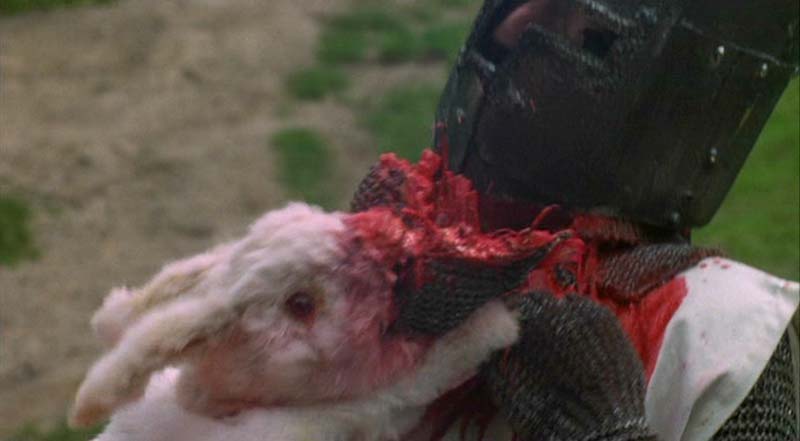
Too Bad He Didn't Have the Holy Hand Grenade....


After the 1807 Peace of Tilsit, Napoleon decided to relax by having a hunting party for the court and, to that end, asking his scarily efficient chief-of-staff, Alexandre Berthier, to organize a rabbit hunt.

Berthier, in charge of one of the most organized and effective armies in Europe, attacked this request with his usual foresight and planning, even bringing in hundreds of rabbits should nature prove so monstrously disobliging as to fail to uphold its end, hunting-wise.

Unfortunately, Berthier proved to be too good at making the rabbit hunt entertaining. As soon as the Emperor arrived, the keepers released the rabbits and the lepine horde rushed straight at Napoleon. The freaked-our generals of the court immediately formed a skirmish line to protect the Emperor, but the rabbits somehow had a better grasp of Napoleonic strategy than Napoleon's generals and, dividing into two wings, poured around the flanks of the skirmish line.


Napoleon had to run for his carriage, but the rabbits pursued and the Emperor had to physically toss rabbits out of the imperial coach. Rabbits apparently kept flying out of the windows as the coach drove off.

Later on, Berthier discovered that he had accidentally bought a horde of domesticated rabbits who assumed the gentleman walking towards them was their feeder, not the Emperor of France and the Conqueror of Europe.

Thursday, July 16, 2009

Desmoulins later shared a cordial antipathy with the prettiest member of the French Revolution, Louis Saint-Just. Saint-Just was fond of the very stiff, high collars than in fashion and was also very cold and austere, in a manner that did not endear him to Desmoulins. Desmoulins is said to have said of Saint-Just, "He carries his head like the Holy Sacrament."

"And I," Saint-Just, not to be outdone, is said to have replied, "will make him carry his head like Saint-Denis."

Ouch.

Literally.

Tuesday, July 14, 2009

Happy Bastille Day!


A very happy 14th of July to you all, commemorating the day when Parisians, spurred on by street orators like Camille Desmoulins, panicked about the economic crisis, the food shortage, the dismissal of the enormously popular finance minister, Necker, and the fact that the king had stationed foreign troops around the city. The king had done so to keep the Parisians from rioting at the loss of the only finance minister they had liked in the past five years, but this plan backfired catestrophically. The Parisians assumed that Necker's dismissal meant the triumph of the conservative faction and therefore the violent shut down of the National Constituent Assembly (the group that had broken off from the Estates-General and demanded a government with a constitution).


Several street orators jumped up onto tables to prolethyse the crowds, but the most famous of these is Camille Desmoulins, who jumped up onto a table whilst holding two pistols and shouted, "'Citizens, there is no time to lose; the dismissal of Necker is the knell of a Saint Bartholomew for patriots! This very night all the Swiss and German battalions will leave the Champ de Mars to massacre us all; one resource is left; to take arms!"


Unfortunately, the people didn't really have arms, so they raided where they could and, after about two days of continuous rioting, converged on the Bastille, where they heard there were arms and gunpowder. The Bastille was an old, costly fortress that was then housing a grand total of seven prisoners: four forgers, two lunatics, and one deviant aristocrat, the comte de Solages . The Marquis de Sade had been removed from the Bastille ten days earlier for harassing the people who walked too close to his window. Though the Bastille was not popular and was going to be shut down because it was too expensive to maintain, it was the place you were most likely to end up if you were arrested on a lettre de cachet, or rather, a letter signed by the king and a cabinet minister to enforce arbitrary legislation and effectively outlawing any possibility of an appeal.


After a shoot-out lasting several hours, in the Amateur Historian's personal favorite part of the proceedings, one man actually scaled the chains holding up the drawbridge of the Bastille and cut them down, allowing his fellow Parisians to seize the fortress and completely freak out the French aristocracy.


This culminated in the very famous dialogue between Louis XVI and the Duc de Rochefoucauld.


"Then it's a revolt?" asked Louis XVI.


"No, Sire," the duc replied. "It is a revolution."

Sunday, July 12, 2009

What's in a name?

There is a popular saying that one should never engage in a battle of wits with an unarmed opponent, but that never stopped Voltaire... often to a detrimental degree, but Voltaire seems to have possessed more resilience than rubber so it often didn't matter. In his early years as a poet, Voltaire's quick wit gained him entrance into French high society and quite nearly knocked him out of it again.

Voltaire somehow or other managed to annoy one Auguste de Rohan-Chabot, perhaps by the admittedly, not very difficult task of being cleverer than Auguste de Rohan-Chabot. While Voltaire was at the opera with a group of friends, de Rohan-Chabot dropped into their box to pay his compliments and to glance distainfully at Voltaire. "Ah," he is said to have remarked, "there you are M. Voltaire, or Arouet, or whatever it is you call yourself."

Feeling pretty clever for having brought up Voltaire's low origins and lack of an important family name, he attempted to join the party, but Voltaire forestalled him.

"Yes, I am the first to honor my name," said Voltaire, "but what have you done to honor yours?"
(de Rohan-Chabot's answer was to have his lackies ambush Voltaire and beat the poet up. Ouch. Voltaire challenged him to a duel later on and de Rohan-Chabot got Voltaire exiled to England, where Voltaire became a pan-European celebrity. Yeah, real cruel punishment, there, increasing his audience and book sales.)

Tuesday, July 7, 2009

A Not-So-Romantic Friendship

The prominant literary critic Charles Lamb had an increasingly bad relationship with the poet Samuel Taylor Coleridge. Coleridge was fond of sentimental friendships, all grand, sweeping emotions, declarations of love and tearful embraces. Charles Lamb grew disenchanted and ultimately rather annoyed with them. Coleridge was also fond of the Romantic, metaphysical monologues about nothing in particular.

During one particularly rambling monologue about the life, the universe and everything, Coleridge, who had once been a Unitarian minister planning on founding a utopian commune on the banks of the Susquehanna interrupted himself to ask, "Charles, have you ever heard me preach?"

Replied the weary Lamb: "I have never heard you do anything else."

Saturday, July 4, 2009

Happy 4th!


Happy "Screw you King George III!" day to those that celebrate it! In honor of one of the more fascinating events of the 18th century, I bring you the following Founder, John Adams.

During the drafting of the Declaration of Independence, John Adams was "obnoxious and disliked", as he later wrote, and it's not entirely hard to see why the Continental Congress got so pissed off at him, since his opinion of congress was equally dismal. "In my many years I have come to a conclusion that one useless man is a shame, two is a law firm, and three or more is a congress."

Adams was not generally one for aphorisms (that was Ben Franklin's forte and you bet he exploited it), but his letters to his beloved and generally kick-ass wife Abigail Adams have unexpected and enjoyable glimpses of wit. At one point he wrote, "I must not write a word to you about politics, because you are a woman." (ouch) He didn't let that stop him however/Abigail wasn't going to stand for that, even if his writings about politics got increasingly whiney:

"I have accepted a seat in the House of Representatives, and thereby have consented to my own ruin, to your ruin, and to the ruin of our children. I give you this warning that you may prepare your mind for your fate."

"My country has contrived for me the most insignificant office that ever the invention of man contrived or his imagination conceived." (Adams got elected to be the first vice president. He was less than pleased he wasn't president.)

"The Declaration of Independence I always considered as a theatrical show. Jefferson ran away with all the stage effect of that... and all the glory of it." (No wonder these biffles stopped talking to each other for a couple of years! There are more complicated reasons behind it- Jefferson was a total Francophile (he was one of the first American ambassadors to France, save Franklin and Adams himself) and Adams decided not to help the French Republic against Britain (he was the first American ambassador to England, which the Amateur Historian believes must have sucked); the moralistic Adams was outraged by the rumors about Jefferson and Sally Hemmings, etc.- but this? Rawr, Adams, sheath your claws in this catfight!)

"No man who ever held the office of president would congratulate a friend on obtaining it." (Dude was never satisfied!)

Sunday, June 28, 2009

Well, that was awkward for us all.


Not only is the title going to be the name of the tell-all autobiography by one of the Amateur Historian's friends, it is also the story of a rather, er... delicate matter concerning an august member (har har) of French history.

When Napoleon died on St. Helena, the Romantic period was in full swing, and with it, the resurgance of the medeval idea of carrying around saints' relics... with one noticable difference. Instead of saints, your average Romantic collected objects and organs of famous writers, artists and other Great Men. Keats went into a swoon over Milton's hair and Mary Shelley traveled around with her husband's powdered heart. It thus comes as no surprise that after Napoleon's death, Vignali, the priest who had given the former Emperor his last rights wanted a keepsake. Instead of cutting off a lock of hair, the priest decided he wanted Napoleon's penis.

Apparently, either after or during the autopsy, Vignali and his valet found themselves alone with Napoleon's corpse and did some very delicate anatomical restructuring. Vignali also inherited a number of Napoleon's personal effects (though the Amateur Historian respectfully doubts that Napoleon ever meant for Vignali's Napoleona to be that personal) and the lot of it was auctioned off in 1916. The collection was continually sold off but, in 1961, failed to sell. This lead to the amusing tabloid headline, "NOT TONIGHT JOSEPHINE" and a considerable blow to the pride of the owners of the collection. Said owner apparently spent eight years recovering fromt he indignity of not being able to sell Napoleon's penis and put said object on the auction block at Christie's in 1977. It sold for $3,000 to John K. Lattimer, professor emeritus and former chairman of urology at the Columbia University College of Physicians and Surgeons. He then took it to his home in New Jersey and stored it under his bed for the next thirty years.

It is not entirey clear whether or not it actually is Napoleon's penis or not; Professor Lattimer seems to think it is, and since he's a urologist, the Amateur Historian assumes he is familiar with his, er... subject and, frankly, does not want to personally investigate.

Sunday, June 21, 2009

Warfare is no reason to be impolite


Despite popular reports from several years ago, General Washington was not made of radiation (Thank you, TV Tropes page for this disturbing video I thought I had forgotten), but he was a pretty impressive figure and wrote some vastly entertaining letters.

1777 was not a really great year for the American forces, as General Howe took New York and then the sort-of capitol of the colonies, Philadelphia. George Washington wrote that circumstances were so bad that, "if [he] could have justified the measure to posterity and [his] own conscience" it would have been better if he had "retired to the back country, and lived in a wigwam."

As amusing as such a phrase is, the Amateur Historian likes this letter best:

Octr 6. 1777

General Washington's compliments to General Howe. He does himself the pleasure to return him a dog, which accidentally fell into his hands, and by the inscription on the Collar appears to belong to General Howe.


Manners were important in 18th century society, after all. I'll bet Washington would have looked up the land permits before building his backwoods wigwam, too.

Friday, June 19, 2009

Erickson's "historical entertainment": Neither Historical Nor Entertaining

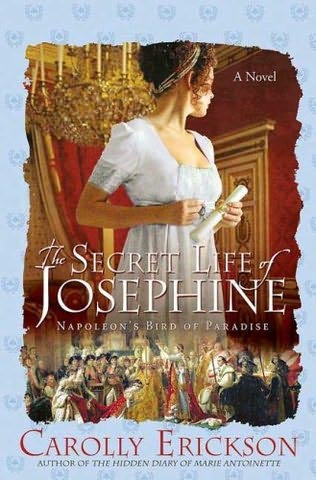
The Amateur Historian picked up a novel entitled The Secret Life of Josephine: Napoleon's Bird of Paradise from her local library, which was just the beginning of her intellectual torture.

"Hunh," said the Amateur Historian to herself. "The author seems familiar. Maybe I've liked her previous stuff? I'll check it out."

Unfortunately, the Amateur Historian was familiar with the author because she wrote, without doubt, the worst book I have ever read, the godawful excuse for a novel, The Hidden Diary of Marie Antoinette, which, upon reflection, deserves every nasty thing the Amateur Historian is insinutating.
Truth is, according to Kierkegaard, subjective, so someone may find redeeming features in The Hidden Diary of Marie Antoinette. The Amateur Historian does not.
Erickson prides herself on writing something called, "historical entertainment", which is neither historical nor entertaining. In these sad excuses for works of even dubious literary merit, Carolly Erickson picks a famous female historical figure, preferably one with a crown, and invents a really boring and simplistic world in which a simplified-to-the-point-of-inanity version of said historical figure makes the readers wish for the protagonist's painful demise with every page.

The Amateur Historian is a huge fan of the Empress Josephine and has read some marvelous historical fantasies about Josephine wherein the author actually does research, effectively simplifies the historical event to narrative form while keeping most of its complexity and presents a sympathetic but flawed character whose motives are understandable and who seems a genuine part of their society. Those books were the Josephine B trilogy by the marvelous Sandra Gulland.
It was not this wretched excuse for fiction by Erickson, which ought to have been named Josephine's Dear Penthouse Letter: A Bizarre Metaphor That Does Not Even Appear in the Text.

This book, though I hesitate to call it a book since it failed so much at being part of any genre but that of Gross Stupidity, has little to no relationship with historical fact, except that it appears Erickson once-upon-a-time read a general life-and-times biography of Josephine and decided that the characters were too complex and the time period too interesting and, furthermore, that the mentions of Josephine's love affairs weren't explicit and annoying enough.

Thus, this travesty of a novel was vomited forth into hardback.

I cannot begin to say how truly awful this book was. I hated it. I hated every historical inaccuracy, I hated every character Erickson introduced and I hated the fact that an intelligent, politically astute, clever woman was reduced to Miss Look-Who-I-Slept-With (which is apparently most of Europe). There was so much more to Josephine than the fact that she had sex! Unfortunately, Erickson either doesn't believe so, or feels that a complex emotional, spiritual and/or intellectual inner life makes for boring reading. Ditto with historical fact. Who cares how Napoleon's Grande Armee, the largest military force Europe had ever seen, met with disaster in Russia if there isn't sex involved?

And then, there is her godawful Napoleon. This is a man who is still revered as a hero, who inspired the poorest, worst-supplied army in Europe to capture Italy from the supposedly unbeatable Austrian forces, who created an entire legal system, who seized control of France when he was only thirty and whose army was so devoted they turned on Louis XVIII to support Napoleon at Waterloo. You'd be surprised by that if your only knowledge of the Napoleonic era came from this awful excuse for historical fiction. Napoleon is truly hateful and amazingly stupid. Though he hates Josephine (this from a man who, according to his generals, worshiped his wife, and whose existing letters to her are embarrassingly explicit) and grows to loathe her over the course of the novel, he bows to her every whim. God alone knows why, since this Josephine was one of the most unappealing characters I've had the misfortune to read. She is flat, one-dimensional, boring, and so annoying I still had no sympathy for her aafter the author attempted to force the readers to like Josephine by having someone rape the future Empress (which is just one of many "what the hell?" moments for anyone with a passing acquaintance with the historical time period or personnages).

I would like to give this novel a negative grade for not only failing to be even accidentally historically accurate, but also failing to have any of the conventional traits of fiction, like, well-rounded, interesting characters, a compelling plot, useful dialogue, wit, intelligence or proof of the author's basic literacy. What was the point of writing a prologue displaying that she had, in fact, done research, when absolutely none of it made it into the book?

There is nothing redeeming about this novel. If you can find it, Gentle Readers, pray inform me. I gave up when Josephine decided to travel to Russia after Napoleon.
... on second thought, that would mean forcing my Gentle Readers to expose themselves to such radioactive garbage. Forget the existance of this book. It will be better for everyone involved. I am personally attempting to find brain bleach to forget I ever wasted my time on something so hopelessly bad.