
Gentle Readers, are you having difficulty telling who is who in War and Peace, for those of you who are brave enough to attempt reading this monolith? Be not afraid, the Amateur Historian has a helpful schema for you!
1. Does this character speak French?
THEN THEY'RE BAD AND INSINCERE AND YOU SHOULD HATE THEM.
2. Does this character speak Russian?
Then they're good!
3. Is this character French?
THEN THEY'RE BAD AND INSINCERE AND YOU SHOULD HATE THEM.
4. Is this character associated with the countryside?
Then they're good!
5. Is this character associated with the city?
THEN THEY ARE BAD AND INSINCERE AND YOU SHOULD HATE THEM.
6. Is this character a young woman?
Then they will marry, retire to the countryside, and lose every character trait that made them interesting.
7. Do you like this character?
Too bad, because they're going to DIE.
Monday, February 28, 2011

Sunday, February 27, 2011
Costume Links
For those who are fans of historical costuming, here is a link to the New York Metropolitan Museum of Art's online searchable database.
You can see the real versions of these clothes:
The Beau Brummel Mystery Series!
Gentle Readers, my sincerest apologies for a long and unexplained absence! The Amateur Historian, though being but a modest student of history, is in reality a full-time student at university writing an honors thesis. Since that is (mostly) finished, I hereby swear that your Amateur Historian will again be purveying amusing historical anecdotes.
And book reviews!

The Amateur Historian, as it must be admitted, has a soft spot for dandies, and Beau Brummel is certainly the One Dandy to Rule Them All. So, when she spotted a mystery series about said gentleman, she immediately checked out several books at once. The text itself is... mostly successful. Sort of.
It is extremely clear that the Beau Brummell mystery series by Rosemary Stevens is painstakingly and wonderfully researched, but the Amateur Historian has to question both the detective ability of a man who took four hours to get dressed every morning, and the author's addiction to descriptive clause openings for sentences. If you will forgive the momentary pastiche, a paragraph reads something like: "Wearing a black bombazine dress with a high- waist and a black lace mantilla, she came towards me. Thinking quickly, I deduced it was because no one of fashion wears bombazine unless they were in mourning. As I am known as the arbitrator of fashion, she should have known better- how could she have known her rich uncle had been foully murdered when I had out-ridden the messenger come from London? Smirking, I lifted my quizzing glass...." and so on and so forth until there's slightly awkward dialogue.
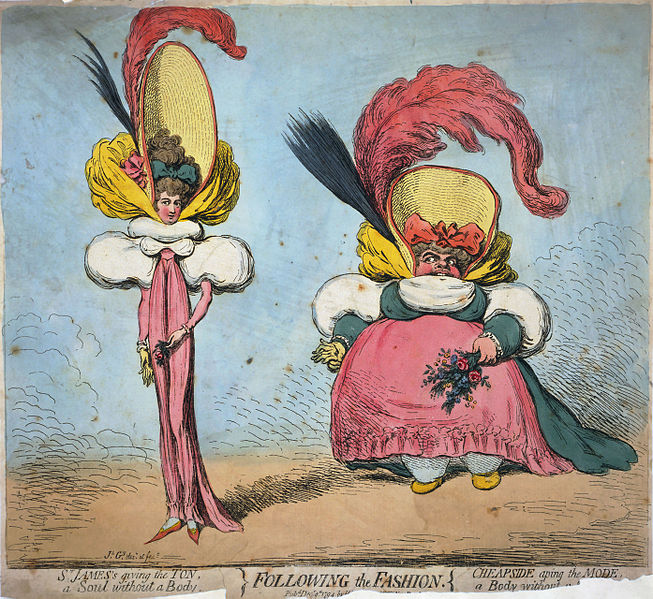
The problem with having really clever characters- or using historical personages that are well known for their bon mots and on-dits and scathing wit- is that they actually have to sound clever when they're speaking. If one is not particularly clever at turning a phrase in Austen-style language, or coming up with a subtle yet scathing insult without tumbling into cringe-inducing territory, one had best get a really cracking editor. Beau Brummel was known as much as for what he said as for what he wore. There is also the matter of Brummell's love life. Though one would have certain... associations, shall we say, with basically the Regency equivalent of a male model, Brummell is staunchly heterosexual and, oh joy of joys, also receives a Mary Sue as his potential love interest, as well as (for some reason) the Duchess of York. You know, the one who was so ugly all the newspapers praised her small feet, leading Gillray to create this print?

She's apparently prettier than the Duchess of Devonshire.
Yeah.
On the other hand, the plotting of the mystery is excellent and the murders are always extremely interesting. They read like plots Agatha Christy might have come up with if she was writing about Regency Britain.
The Beau Brummel mystery series has the distinction of being better plotted than another series of novels solved by real life historical figures of the Regency Era, i.e. the Jane Austen mystery series. Neither of them has the distinction of having main characters as witty as their real life counterparts. The Amateur Historian's advice on the disappointing repartee in both?
If you are going to have someone famous for their wit as your main character, you have to make them witty. This is one case where shameless plagerism of someone else's aphorisms and quips is a really good idea.
And book reviews!

The Amateur Historian, as it must be admitted, has a soft spot for dandies, and Beau Brummel is certainly the One Dandy to Rule Them All. So, when she spotted a mystery series about said gentleman, she immediately checked out several books at once. The text itself is... mostly successful. Sort of.
It is extremely clear that the Beau Brummell mystery series by Rosemary Stevens is painstakingly and wonderfully researched, but the Amateur Historian has to question both the detective ability of a man who took four hours to get dressed every morning, and the author's addiction to descriptive clause openings for sentences. If you will forgive the momentary pastiche, a paragraph reads something like: "Wearing a black bombazine dress with a high- waist and a black lace mantilla, she came towards me. Thinking quickly, I deduced it was because no one of fashion wears bombazine unless they were in mourning. As I am known as the arbitrator of fashion, she should have known better- how could she have known her rich uncle had been foully murdered when I had out-ridden the messenger come from London? Smirking, I lifted my quizzing glass...." and so on and so forth until there's slightly awkward dialogue.
The problem with having really clever characters- or using historical personages that are well known for their bon mots and on-dits and scathing wit- is that they actually have to sound clever when they're speaking. If one is not particularly clever at turning a phrase in Austen-style language, or coming up with a subtle yet scathing insult without tumbling into cringe-inducing territory, one had best get a really cracking editor. Beau Brummel was known as much as for what he said as for what he wore. There is also the matter of Brummell's love life. Though one would have certain... associations, shall we say, with basically the Regency equivalent of a male model, Brummell is staunchly heterosexual and, oh joy of joys, also receives a Mary Sue as his potential love interest, as well as (for some reason) the Duchess of York. You know, the one who was so ugly all the newspapers praised her small feet, leading Gillray to create this print?

She's apparently prettier than the Duchess of Devonshire.
Yeah.
On the other hand, the plotting of the mystery is excellent and the murders are always extremely interesting. They read like plots Agatha Christy might have come up with if she was writing about Regency Britain.
The Beau Brummel mystery series has the distinction of being better plotted than another series of novels solved by real life historical figures of the Regency Era, i.e. the Jane Austen mystery series. Neither of them has the distinction of having main characters as witty as their real life counterparts. The Amateur Historian's advice on the disappointing repartee in both?
If you are going to have someone famous for their wit as your main character, you have to make them witty. This is one case where shameless plagerism of someone else's aphorisms and quips is a really good idea.
Wednesday, December 8, 2010
March To The Scaffold - Symphonie Fantastique Movement 4
Apologies Gentle Readers, the Amateur Historian meant to post this in honor of the anniversary of the debut of Berlioz's Symphonie Fantastique on December 5th, but had some techincal issues trying to figure out how to link to specific times in youtube videos.
A Google search has since remedied this problem, and so the Amateur Historian would therefore like to discuss her favorite section of the Symphonie Fantastique, the fourth movement. This symphony follows a young Romantic, desperately in love with a woman who distains to even look at him. In the fourth movement, the young Romantic ODs on opium and hallucinates that he's killed his beloved and been condemned to the guillotine. After he's marched up to the scaffold, he takes a moment to think of his beloved (there is a pre-Wagnerian lietmotif associated with his beloved which returns in each movement) and then his head gets chopped off. And, best of all, there's two notes as his head thunks down two steps.
Oh Romanticism. You make the macabre kind of hilarious.
The French Revolution ("Bad Romance" by Lady Gaga)
Well, look what the Amateur Historian's friends kindly link her to, to save her the trouble of searching for these things on youtube herself. I would like to warn my Gentle Readers that the singing is actually painful and the background music is of the bad electronica variety found on the worst sorts of karoke machines, but it's....
Factual. Ish.
And probably the worst of all the videos the Amateur Historian has inflicted on you Gentle Readres. Including the one where Salieri got molested by a clown.
Thursday, November 25, 2010
Turkies, penguins... they're both birds!
Happy Thanksgiving to those Gentle Readers who celebrate it! Have hundreds of Napoleon look-alikes sliding on the ice on their bellies and feel better about your turkey-filled one.
Friday, November 19, 2010
So this is why France has socialized health care!
Apparently the rest of this week is ust going to be "funny commercials starting Napoleon", so you have fair warning, Gentle Readers.
For those Gentle Readers who do not speak French, the ad goes:
Napoleon: Long live France! Long live the Republic! Yaaaaaaaaaaaaah! (charges!)
Horse: (whinnies)
Napoleon: But what are you doing, I said, 'Long live France'?!
General: It's not possible! We don't have any insurance.
Napoleon: But why?!
General: It's very expensive!
Thursday, November 18, 2010
Garmin 2008 60 second Super Bowl Commercial
Look what the Amateur Historian's youtube trawling has unearthed now! The real reason why Napoleon kept his hand tucked in his coat, according to the makers of Garmin.
Monday, November 15, 2010
Clearly not a fan of France.

The 1830 French war with Algeria is, in the opinion of the Amateur Historian, more than a little odd. For one thing, it was orchestrated by the French king Charles X to distract French people from his absolutest policies (they weren't) and to rouse a feeling of French pride and patriotism via colonization that was planned to rival England's(it didn't) and for another, it had such a very odd beginning.
During the Napoleonic invasion of Egypt, the French bought a large amount of grain from Algeria and, after thirty or so years, the Dey of Algiers expectedly wanted to know when he was going to get paid. The French consul was not forthcoming nor was he particularly polite, so the Dey hit the French consul on the arm with a fly-swatter/fan made out of feathers.
Somehow, this was given as an acceptable excuse to take over Algeria.
Thursday, November 11, 2010
If nautical nonsense be something you wish....
Occasionally, parents have supportive comments when their offspring run off with significant others. Some parents simply have funny ones.
When James Joyce ran off with Nora Barnacle, Mr. Joyce was said to comment, "She'll certainly stick to him."
When James Joyce ran off with Nora Barnacle, Mr. Joyce was said to comment, "She'll certainly stick to him."
Subscribe to:
Posts (Atom)