Friday, October 16, 2009

Have a Wilde One!


Happy birthday, dear Oscar Wilde, wit until the end.

Though his witticisms and one-liners have so entered into the collective subconscious the Amateur Historian has been reluctant to post about them, she cannot help but mention her favorite.

Wilde spent his last few years in the Hôtel d'Alsace, where he kept up with his pleasures and with various intellectual circles. About a month before his death, Wilde quite glibly informed his friends, "My wallpaper and I are fighting a duel to the death. One of us has got to go."

Friday, October 9, 2009

It also tastes delicious with butter

The French Romantic period had a number of authors who took Romanticism to its illogical extremes. One such poet was Gerard de Nerval, who, like many young writers, took it upon himself to shock the bourgoise in order to display the falseness of society and his role, as a poet, in breaking them free of their shackles. To this end, he joined the 'bosingos', which, though an important force in the 1830s Revolution, spent a lot of time doing the weirdest things they could imagine. Since the group de Nerval belonged to was an offshoot, the 'bouzingos', were mostly poets who placed art above politics and tended to annoy the monarchists just for the hell of it instead of out of legitimate political protest, they came up with some pretty bizarre stuff even for Romantics. The Amateur Historian believes that at one point the 'bouzingos' decided it would be a great idea to hold a literary salon in the nude and then any follow it up with a concert, despite, or perhaps because of, the fact that none of them could play an instrument. The Amateur Historian believes that the 'bouzingos' were still nude when they did this.

De Nerval fit in with the bouzingos perfectly. He liked to go out walking with a lobster on a pale blue ribbon and, when asked why, replied that the lobster did not bark and that it knew the secrets of the deep.

Monday, October 5, 2009

Quit Monkeying Around

It is sometimes difficult to remember that, during the Napoleonic Wars, there still existed very isolated villages with little to no contact with the outside world, whom the Enlightenment appeared to have passed over in lieu of more interesting citizens.

The village of Hartlepool is a case in point (though, depending on who you ask, it might actually be Boddam). During the Napoleonic Wars, a storm destroyed a French chasse-marée, or a little fishing vessel, and the wreckage washed up on the shores of Hartlepool. Among the debris, there was one lone survivor, a monkey.

The crew had dressed up the monkey in a French uniform for their amusement, but this turned out to be a bad idea for poor Curious Georges. The villagers of Hartlepool had no idea what a French person might look like and decided to hold a trial for it on the beach. Despite the fact that the villagers had a. no idea what a monkey looked like, and b. no idea that there might be a language barrier even if the monkey had not been a monkey, the villagers concluded that since the monkey did not respond, it was probably a French spy, sentanced it to death and hung it on the mast of a fishing boat on the Headland.

One wonders how the villagers dealt with Darwin's theory of evolution later in the 19th century.

Sunday, October 4, 2009

A Sort of Romantic Avoidance


Being a medical student is a difficult, exhausting and sometimes disgusting process and being one in the nineteenth century was no better. Hector Berlioz (here showing that the neckbeard is a bad fashion choice no matter what century) was forced into the medical field, one in which he had no interest what-so-ever, by his parents and was thoroughly unprepared for the dissection room.

He writes in his memoirs: "The sight of that horrible human charnel house, these scattered limbs, grinning heads, open skulls, the bloody cesspool in which we walked, the revolting smell which emanated from it, the swarms of sparrows wrangling over scraps of lungs, the rats gnawing bloody vertebrae in their corner--all this filled me with such terror that I leapt through the window of the dissecting-room."

One hopes that the window was open, lest Berlioz be forced to return to the medical school in a still less agreeable position.

Tuesday, September 29, 2009

Hernani: The Play Where the Audience is SUPPOSED to Be More Interesting Than the Actors


The Romantic movement came to France much later than it did to England in Germany, and the backlash was correspondingly more severe. The elements of French culture that proved resistant to Romanticism, i.e. the Academie Francaise, and the wide-spread use and popularity of classical form, also proved extremely reactionary, as could be seen on Feb. 25, 1830, when a young Victor Hugo decided to stage a play.

Victor Hugo, who is pretty much The Romantic of the French Romantic movement, broke with tradition when he wrote Hernani, a play that can be summed up as, "Oops, I am in love with someone who is in love with/engaged to someone else and now I have killed myself for no easily discernable reason." Though the main cast was dead in the end, as happens with most French tragedy, Hugo made the great mistake of using forbidden words such as "handkerchief" and forcing the actors to express grand sweeps of Romantic passion while in period costume. One actress was so appalled by her period costume she refused to go onstage without wearing her contemporary but hideous 1830s hat. Since the Comedie Francaise, i.e. the Maison de Moliere, i.e. the oldest theatre company in Europe, i.e. The Be All and End All of French Drama, was deigning to stage a (gasp) Romantic piece, Hugo was understandably nervous about its reception. He therefore passed out red tickets (normally given to the author of any staged drama, like a courtesy copy of a book) to his friends, who formed a Romantic Army and invaded the Comedie Francaise on the opening night.

To make sure the production would begin on time and sans interference from the classicists, the Romantic Army got to the building at three-o-clock and locked themselves in for the next four hours with provisions and their cosplay get-up (Seriously, Hugo himself describes the Romantic Army as full of "wild whimsical characters, bearded, long-haired, dressed in every fashion except the reigning one, in pea-jackets, Spanish cloaks, in waistcoats a la Robespierre, in Henry III bonnets...and this in the middle of Paris in broad daylight"). Sometime before seven-o-clock, they realized that they had no bathrooms, as they had locked themselves into the auditorium, and just did their business in the boxes of the classicists.

The classicists were understandably pissy (in all senses of the word, thanks to the lack of bathrooms) and began having fistfights in the pit. The actors, already unhappy with having to go Romantic and forsake their 1830s habberdashery, were made further unhappy by the fact that they could not get through a single performance without someone in the audience :
a. challenging someone else to a duel,
b. starting a fistfight,
c. hissing at the stage loud enough to drown out the actors,
d. arguing over classical vs. Romantic forms and politics very, very loudly, or
e. getting up onstage in a red waistcoat and lime green pants before the curtain to sing praises of the Romantic, bohemian lifestyle. (Not like that, though. More the songs of angry men.)

Hernani ran for a hundred full-house performances. The Amateur Historian is willing to bet that the actors of the Comedie Francaise hated every one of them.

Tuesday, September 22, 2009

Congratulations, citizens, today is Day One on the French Republican calendar, one of the most interesting developments to come out of the desire to make order out of a previously arbitrary system of measurement. This desire also created the metric system, which is much more exact than any other system of measurement and which is still in use today.

During the French Revolution, the traditional system of patronage was overthrown and a number of artists (the most famous of which is David) and poets began to take an active role in participating in and shaping their government. One poet, Fabre d'Eglantine, was given the task of renaming French notions of time, or, in particular, days, weeks and the calendar year. Agronomist Charles Gilbert Romme and his team of astronomers, politicians, and mathematicians came up with the Republican calendar (i.e. a ten week day (based off the metric ten), with a ten-hour day, with a 100 decimal minute hour, with a 100 decimal second minute. An hour then becomes twice as long as a conventional hour, a minute becomes slightly longer than a conventional minute, and a second becomes slightly shorter than a conventional second. The More You Know!).

There were twelve months, comprised of three ten-day weeks (décades), with the tenth day, décadi, replacing Sunday as the day of rest and festivity. The five or six extra days left over when one approximates the solar year ended up at the very end of the year as holidays. Leap years became "Franciade" to commemorate how it had taken four years for the French Revolution to establish a republic. The leap year itself was called Sextile, because it contained a sixth complimentary day.

The names of the days of the week are pretty basic (Primidi, Duodi, etc.) but the names of the month are suitably Romantic and poetic, as the months, split up into four groups, rhyme three and three, to demonstrate the sonority of the seasons. The names of the months themselves are taken from nature (i.e. Brumaire is taken from the French 'brume', which means fog; ergo, Brumaire is the month of fog).

The months were:
1 Vendémiaire 7 Germinal
2 Brumaire 8 Floréal
3 Frimaire 9 Prairial
4 Nivôse 10 Messidor
5 Pluviôse 11 Thermidor
6 Ventôse 12 Fructidor

British detractors translated the months as Wheezy, Sneezy and Freezy; Slippy, Drippy and Nippy; Showery, Flowery and Bowery; Wheaty, Heaty and Sweety.

Tuesday, September 15, 2009

Wow, that's a doozy of a charge....


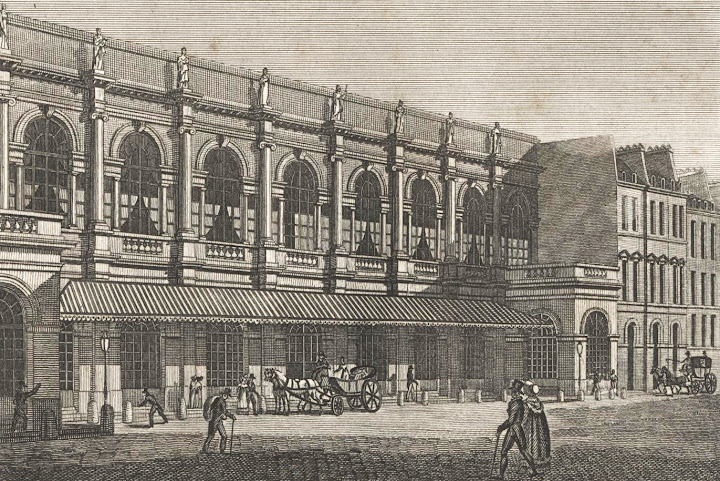
In 1793, Mlle Montansier finished building a theatre, the Theatre Nationale on the Rue de Richelieu, facing the Bibliotheque Nationale, dedicated to new plays. Unfortunately for Mlle Montansier, construction finished just as the Terror started and someone accused her of deliberately building her theatre facing the Bibliotheque Nationale so that she could better blow up the Bibliotheque Nationale.

She was released from prison two years later.

Tuesday, September 8, 2009

Les Egots de Paris

The Parisian sewers are, in their way, one of the enduring legacies of Napoleon III, who is Josephine's direct descendant and not Napoleon Bonaparte's. (Bref, Josephine's daughter, Hortense, married one of Napoleon's numerous brothers. Hortense's son became Napoleon III when Napoleon's son with his second wife, Marie Louise, the niece of Marie-Antoinette, died very young.)

Still, like his uncle, Napoleon III loved Paris and saw its glory as a reflection of his own. Therefore, there came Haussmann, widening the streets so that no one could pry the paving stones loose and build barricades again, the gilded Baroque-Era-ate-a-bit-of-romanticism-and-then-vomited-forth-a-building Opera Garnier and the sewer septic system that so fascinated Victor Hugo. It is, in fact, extremely important to have seperate pipes for drinking water and waste products. This became extremely clear after the 1832 influx of cholera, the (hated) government's powerlessness against it, and the resultant revolts. Ergo, Napoleon III decided that, though Napoleon I had introduced covered sewers (then a very innovative idea), it was probably a pretty bad idea for said covered sewers to dump everything in the Seine, and the complex warren of today's Parisian sewers had its birth.

It was such a technological marvel that visitors to Paris would flock below the newly enlarged streets to take a boat ride through the sewers.

Though one can no longer catch a very Romantic skin disease while making the Grand Tour, one can now visit the Paris Sewer Museum and discover that the Parisian sewer rats have only one natural predator, the pet turtles regular Parisians flush down their toilets. Apparently, there used to be an alligator in the sewers to eat the rats as well, but the alligator has since been captured and put into an aquarium in England. The Amateur Historian is not entirely sure why, but supposes it was because the turtles simply couldn't keep up with the competition.

However, the Musée des égouts de Paris has a sign nearby that reads, "Je bois de l'eau de Paris!", which is "I drink the waters of Paris!"

The Amateur Historian now knows that the drinking water of Paris is piped in directly from a mountain stream to the north, albeit in pipes first laid down in the latter half of the nineteenth century, but is still tempted to rip of Descartes: "Je bois de l'eau de Paris, donc, j'ai de choléra!", or, "I drink the waters of Paris, therefore, I have cholera."

Friday, August 28, 2009

Canning, How Could You?

Pitt was naturally reserved and called himself "the shyest man alive", so he spent a great deal of time listening to speeches made in the House or in the committees without saying a word or allowing the speaker to approach him. Though this annoyed the House and the committees, it allowed Pitt to display his remarkable capacity for spotting political talent. Of the hundreds of MPs Pitt convinced to either join Parliament to begin with, or to vote along with Pitt's policies, there were two future Prime Ministers and five future Cabinet Ministers. Pitt's ministry in the 1790s even included four of the five Prime Ministers that would take up office after Pitt had left it.


Of course, Pitt focused almost solely on political accumen and not personality. He was not inclined to expand his social circle, he disliked having to meet new people and be friendly to them and resented any intrusion of his privacy by people he a. did not know or b. did not wish to know better. One of these people was George Canning, who, after being discovered by Pitt, developed a devotion to the Prime Minister that bordered on fanatical. Pitt eventually warmed to him, but it took several years for Pitt to consider him a friend, and Pitt was occasionally thrown by Canning's enthusiasm.

At one point, Canning did the unthinkable and touched Pitt on the shoulder in the House of Commons. The other MPs were shocked, Pitt was alarmed and Canning was forced to defend himself in his journal:

"Once I was seen, when I wanted to speak with him, and he was looking another way, to put my hand on his shoulder. How can you conceive a more silly thing to trouble people's heads than this? ... I know indeed that I have, with people whom I like, old or young, great or small, something of a caressing manner... and so have a great many other people--a great many have it not... they consider Mr. Pitt, naturally enough, as one of the latter class, the non-shakers--whereas he is in fact a very hearty, salutation-giving, shake hands sort of person--and one therefore whom I feel it is natural to take by the arm, or to touch upon the shoulder even (which is the great offence)... But if it be wrong it must be altered."

Pitt made it clear that it must be altered and Canning did not touch him on the shoulder again.

Thursday, August 27, 2009

On Parliament

On visiting Parliament, by Carl Moritz:

"I was much shocked by the open abuse which Members of Parliament fling at each other... they enter the house in greatcoats, boots and spurs! It is not unusual to see a member stretched out on one of the benches while the rest are in debate. One Member may be cracking nuts, another eating an orange or whatever fruit may be in season; they are constantly going in and out... whenever one of them speaks badly or the matter of his speech lacks interest for the majority, the noise and laughter are such that the Member can hardly hear his own words."

This seems to be entirely accurate. Edmund Burke, today regarded as one of the best speech-makers of the 18th century, was violently hated in Parliament. The other MPs nicknamed him 'dinner bell' because when he got up to speak, everyone left.