
Friday, April 29, 2011

Thursday, April 28, 2011
Wednesday, April 27, 2011
Better Book Title!
The true meaning of The Age of Innocence:
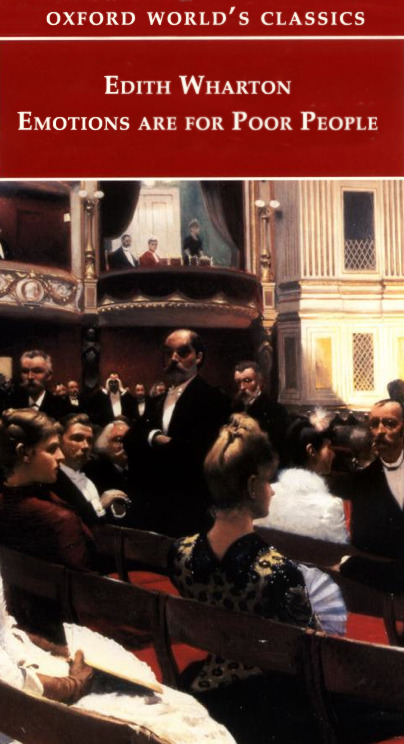
(From Better Book Titles: www.http://betterbooktitles.com)
(From Better Book Titles: www.http://betterbooktitles.com)
Tuesday, April 26, 2011
Oeuf!

The Marquis de Condorcet was widely held to be a philosophe and one of the last members of the Enlightenment. However, that did not keep him from moments of great stupidity.
While in hiding during the Terror, Condorcet, wounded in the leg and disheveled, ordered an omlette in an inn.
"How many eggs would you like?" asked the inn-keeper, somewhat alarmed by his guest's wild appearance.
Condorcet, being an aristocrat, had no idea, and thus said, "Twelve."
The inn-keeper then realized he was an aristocrat on the run, and reported him to the authorities.
Condorcet certainly had egg on his face for that one.
(Get the title? It's a pun! Oof/oeuf? They sound the same, but one is the French word for egg?Fine, Gentle Reader, you simply do not posses the sophisticated appreciation of wordplay that the Amateur Historian does.)
They had to earn their keep somehow...

The British response to French émigrés fleeing to their shores was mixed at best. Burke was very much sympathetic to the émigré population, in particular to the segment of the population set on armed overthrow of the French Revolutionary government. Pitt was officially neutral, as he was up until the point where the French government declared war on Great Britain, but his later refusal to support émigré armies and his cabinet's Alien Laws preventing any French republicans from coming to England, and the banning of speakers, visitors and speakers suggest that Pitt was not altogether keen on increasing the French percentage of the population.
By far the oddest reaction to the French émigrés was that of the Duke of Bridgewater, he of the famous canals, who, Madame de Stael reports, rescued what seems to be an abbey's worth of monks for the purpose of having them wander through his gardens. It certainly beats having a Weeping Angel entertaining your neighbors at a garden party.
Wednesday, April 20, 2011
Complete History Of The Soviet Union, Arranged To The Melody Of Tetris
This is technically not the right time period, but the Amateur Historian hopes that her Gentle Readers will forgive her because the video is so catchy and so clever. Anyone who has played as much Tetris on his or her phone as the Amateur Historian certainly does feel like an exploited proletariat. The work is never done, and when it is it vanishes!
(As a random aside, the Amateur Historian's favorite stanza is
I am the man who arranges the blocks
that are made by the men in Kazistan
They come two weeks late
and they don't tessellate
but we're working to Stalin's five-year-plan!)
Thursday, March 31, 2011
WHOOOO ARE YOU?

Madame de Pompadour!
If you haven't guessed by my self-indulgent punning, this is a review of the excellent Doctor Who episode, "The Girl in the Fireplace." Now, granted, this episode of Doctor Who came out a few years ago, but the Amateur Historian has only gotten into the series relatively recently and, for a while, was too caught up in the epicness of David Tennant's Doctor to think, "Gee, this episode takes place during the 18th century, maybe I should review it!"
Now, for those of my Gentle Readers unfamiliar with this British invasion from outerspace, the Doctor is a Time Lord, a race of aliens who control time and travel through time and space as it suits them. The Doctor generally has human companions and generally goes around being a Big Damn Hero all the time. Well, most of the time.
He is in this episode, at least.
Now, the Doctor and his two companions, Rose and Mickey, find themselves on a spaceship in another galaxy in the very far future. Grimdark!sci-fi right? Wrong! There is an 18th-century French fireplace in the spaceship linked to the 18th century bedroom of Madame de Pompadour. The Doctor can't say no to such an intriguing anomaly and so leaps through the fireplace, where he meets a young Madame de Pompadour and notices the clock is broken.
Weird thing to notice really, but then one realizes that one still hears ticking.
Enter the clockwork robots dressed like Venetian masqueraders!

The Amateur Historian will not spoil the rest of the episode for her Gentle Readers, but the dialogue was witty and snappy, the plotting was excellent and the moral of the story is... bizarre in a very interesting way. I loved their portrayal of Madame de Pompadour as a confident, intelligent woman, every inch the Doctor's equal and am stunned at their apparently enormous costume budget. All those robes à la françaises? I really don't have a single snarky thing to say about this, which is... quite rare.
The Amateur Historian personally found the idea of clockwork droids terrifying and wickedly, awesomely period. During the 18th century, the aristocracy was all about the clockwork machines. (That was one thing Gothic actually got right. Huzzah for the Turkish mechanical woman credited on imdb!) At the Madame Tussaud's in London, one can even see a wax and clockwork reproduction of an 18th century court lady.
You can watch Louis XV and Madame de Pompadour get threatened by clockwork androids here. If you have a spare 45 minutes, I highly recommend clicking the link.
Monday, March 28, 2011
Oh Give Me a Home....
Where the buffalo roam!
And the parrots and crocodiles plaaaaaay....
Chateaubriand's North America is one which may not exactly correspond with the real North America. You know, the one where New Orleans is geographically distinct from Niagara Falls.
Chateaubriand is a French Romantic and aristocrat who wisely decided to go on a voyage of exploration in America just as the French Revolution broke out. He thus uses America as the setting for many of his novels. Some passages, such as the one that describes Niagara Falls, are so famous that they are still the subject of analytic essays in French high schools the world over. Others, such as the beginning of Atala, where Chateaubriand lovingly describes the palm trees that adorn the banks of the upper Mississippi, and the crocodiles that apparently wander over the state of Kentucky, are not quite so famous.
One can tell quite easily where Chateaubriand actually visited, and where he made things up because his French audience didn't know what, if anything, lived in Kentucky.
And the parrots and crocodiles plaaaaaay....
Chateaubriand's North America is one which may not exactly correspond with the real North America. You know, the one where New Orleans is geographically distinct from Niagara Falls.
Chateaubriand is a French Romantic and aristocrat who wisely decided to go on a voyage of exploration in America just as the French Revolution broke out. He thus uses America as the setting for many of his novels. Some passages, such as the one that describes Niagara Falls, are so famous that they are still the subject of analytic essays in French high schools the world over. Others, such as the beginning of Atala, where Chateaubriand lovingly describes the palm trees that adorn the banks of the upper Mississippi, and the crocodiles that apparently wander over the state of Kentucky, are not quite so famous.
One can tell quite easily where Chateaubriand actually visited, and where he made things up because his French audience didn't know what, if anything, lived in Kentucky.
Thursday, March 17, 2011
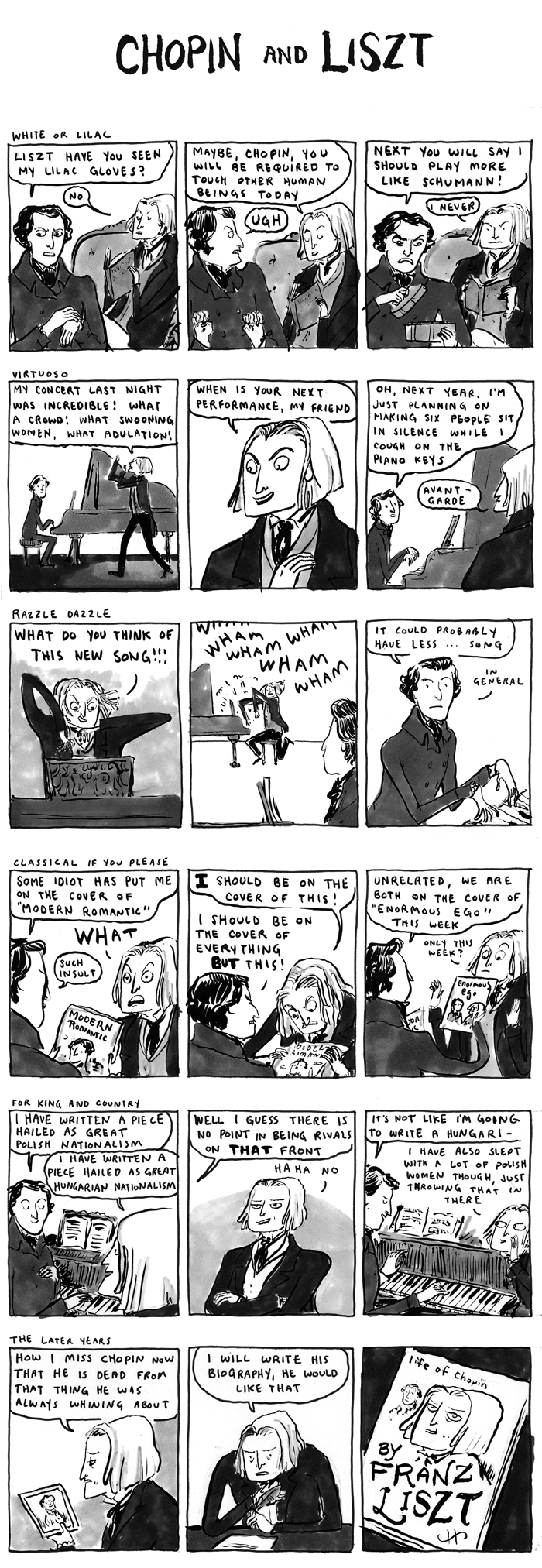
ROMANTIC MUSICIANS
Gentle Readers, if you have not discovered the amazing webcomic, "Hark, a vagrant" here is some incentive to do so:
Subscribe to:
Posts (Atom)