
Though, in reality, it is not really much fun unless you find physical deformity hilarious.
Lord Byron famously had somethng wrong with his foot but, however, he did not have a club-foot as popular accounts will have you believe! Historians have analyzed his boots and discovered that he really had a withered leg from birth. Byron enjoyed clothing said leg, and the other, healthy one in white linen trousers. He ordered dozens at a time and threw them out after being worn only once.
So the moral of this story, Gentle Readers, is if you wish to be a Romantic Poet and have a physical deformity of some kind, remember to clothe it well. Historians will pay an extraordinary amount of attention to whatever you leave behind, however, so conspicuous consumption can oddly maintain your privacy.
Showing posts with label #occupybondstreet. Show all posts
Showing posts with label #occupybondstreet. Show all posts
Monday, April 30, 2012

Monday, April 16, 2012
Thar she blows.

Soon after finishing Emma, Jane Austen's brother, Henry Austen got sick and got treated by the Prince of Wales's personal physician. Henry liked to brag about his clever sister and, despite Jane Austen's preference for anonymity, told his doctor that his sister was the author of Pride and Prejudice. The doctor passed on this information to the Prince Regent, who had a copy of all Austen's published works in each of his residences.
The end result was twofold: one, Jane Austen was invited to visit the Prince's librarian, who urged her multiple times to write a novel about himself, and two, said librarian conveyed to her His Royal Highness's permission to dedicate her next to work to him. Austen's letters show she wasn't exactly thrilled about either idea, and she asked if it was “incumbent on [her] to shew her sense of the Honour” by dedicating Emma to the Prince Regent. The librarian replied with an emphatic, but politely phrased, yes.
However, Austen got back the gallery prints and appears to have made a couple of changes to the novel to avail herself of her best and most perfect weapon: satire. This article phrases it more eloquently than the Amateur Historian ever could, but let us reflect a moment on the famous riddle in Emma:
My first displays the wealth and pomp of kings,
Lords of the earth! their luxury and ease.
Another view of man, my second brings,
Behold him there, the monarch of the seas!
But, ah! united, what reverse we have!
Man’s boasted power and freedom, all are flown;
Lord of the earth and sea, he bends a slave,
And woman, lovely woman, reigns alone.
This typical Lamb-pun thus gives us a second answer. The first two lines mean 'prince' and the second 'whales'. United, we have the Prince of Whales, who was more famous for his seductions than his statescraft, and the very subtle target of Jane Austen's amazingly clever wit. Clearly, the Prince of Whales ought to have thought twice before demanding Miss Austen dedicate a novel to him; she has skewered him more effectively than ever Captain Ahab did Moby Dick.
Tuesday, February 14, 2012
Well... it's... better than Napoloen's?
Here's hoping there are some lucky and unlucky tarts (according to one's preferences) this Valentine's Day! Ladies and gentlemen, take note on how to woo that special someone. Be bold, and always make the recipient question the composition of your DNA.
Sunday, February 12, 2012
A Bit of Fry and Laurie - The Duel
Once again proving a. that Hugh Laurie and Stephen Fry are made for silly period pieces and b. duels are a rather silly way of settling debts of honor.
Friday, February 10, 2012
Something Nobler and Moister Indeed
Sorry, Emma Thompson, Stephen Fry and Hugh Laurie cannot be kept apart no matter the era. Also of note, the truly questionable neckbeard the costume designers decided to give Stephen Fry.
Sunday, January 8, 2012
Jane Austen Fight Club
Jane Austen's Fight Club from Keith Paugh on Vimeo.
This is a few years late, but I remembered it after watching all the imagined sword-fighting scenes in the BBC's highly entertaining adaptation of Northanger Abbey. Hopefully the Gentle Readers will find this amusing.
Wednesday, January 4, 2012
Great... well, rather Bleak Expectations.
Ah Charles Dickens, that perennial Christmas favorite! This year, however, the BBC decided to adapt his Great Expectations instead of A Christmas Carol, for which the Amateur Historian is grateful, if only because it has given us another Gorgeous Man in Period Costume. Or Beautiful Man in a Cravat. The title of this tag will need work.

At any rate, the Amateur Historian freely admits that Dickens is not her favorite social justice nineteenth century novelist. Victor Hugo does it better, on a more epic scale, Balzac is frankly more ballsy, and George Elliot can actually write female characters. Sorry Dickens. You earned my enmity with Lucy Manette and that horrible Purity Sue Agnes in David Copperfield. The best I can say for your angels in the house is that at least they don't turn into hideous copies of their husbands, a la Tolstoy. However, the Amateur Historian does like Great Expectations best out of Dickens's oeuvre. Though unfortunately Miss Havisham is again a Dickensian heroine defined by her reactions to men, she is still a very intriguing figure, and Estella is wonderful. Pip is well... a Dickensian hero. He is pretty generic, the Everyman who is supposed to guide us, the readers, on a journey to middle-class morality and propriety.
The new production takes a few interesting spins on these popular characters, namely, Pip is better looking than Estella.

As one British reviewer put it, if she was Miss Havishmam, she would be tempted to say to hell with the experiment and marry Pip, so she could look at him over the breakfast table every morning. However, it astonishingly makes Pip less likable. The child actor they have for Pip turned out a really excellent performance and adult Pip's early earnestness at the end of the first episode (and his lovely blacksmith costume) make one (or rather, the Amateur Historian) really want him to be a decent person who deserves a happy ending. However, he's not. Great Expectations is about vengeance and class snobbery, so Pip gives off the impression of being a useless pretty boy sponging off of the misery of others rather than a confused young man desperate to understand society and to succeed. Yay corrupting capitalism? Yay Marx was right? It rather made me want to #occupybondstreet.

It is sometimes painful to watch, though if one mutes the sound and watches Burberry model-turned-actor Douglass Booth angsting in tailcoats and top hats, it becomes ever so much more enjoyable. The final return to the forge and to, you know, decent, thoughtful, humanitarian and compassionate behavior much more satisfying, but the little changes to Joe (I love Joe!) made it less cathartic than one needed after the poorly-lit but beautifully dressed angst preceding it.

Estella left me cold, which I think she was supposed to do. I have nothing to say against her performance, but it did not particularly dazzle. This was not entirely her fault, since the tone of the whole series was incredibly bleak. There was no leavening of Dickens's usual humor to make Estella's coldness and lack of a heart more noticeable. Her child incarnation was charmingly awful, but her adult form... well, when Pip is prettier, there really isn't much one can do, is there, aside think of how awful 1830s sleeves were and wish for a return of Pip's fabulous waistcoats and his questionable pinky-rings. In fact, I rather enjoyed the child actors better than the adult actors. They were much more fun to watch, and actually seemed to enjoy their parts. Pip and Estella spent most of their screen time looking tortured. This isn't out of line with the script, but it does become a little dull after a while.

Gillian Anderson makes an interesting spin on Miss Havisham, portraying her in rather a J.M. Barrie sort of way, as a woman who refuses to grow up. She also self-immolates on a bonfire made of her ersatz-fiance's letters, which was incredibly disturbing to watch, if one is easily squicked out by things going wrong with the human body, like the Amateur Historian is. Seriously, I cannot sit through an episode of House without having to hide my eyes at least twice.
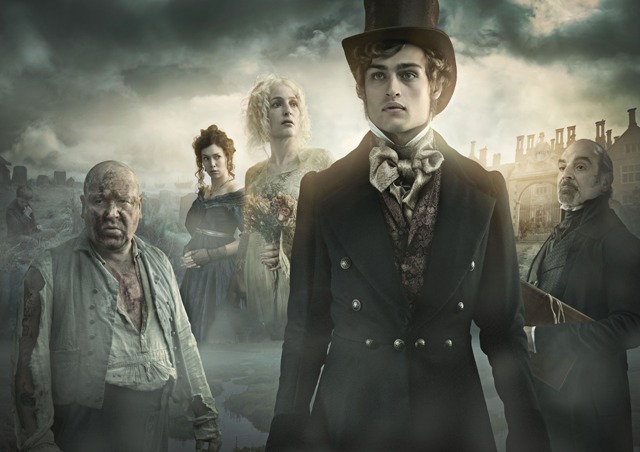
Ah, and what would a Dickens novel be without a cast of supporting characters who are much more interesting than Blandy McBland, the hero of the piece? Joe was as good-hearted an incarnation as he usually is, though I was disappointed they cut out all of his little games with Pip, to alleviate the misery of a poor childhood, and his backstory as an abused child who had forgiven his own awful father and was determined to prevent the miseries of his old childhood with Pip. He was such a breath of fresh air when he appeared, however. There was no Biddy (I can't say that I missed her), just Joe with his kindness and decency. Pip's uncle was enjoyably snobbish, but Mrs. Joe was not as funny as I read her in the novel. During some of her scenes, I kept thinking, 'haha, child abuse? Is that what the BBC wants me to laugh at?' Still, she turned in a fine performance, as can be said for all of the secondary actors. Mr. Jaggers seemed to really enjoy his role, and his final monologue was excellently filmed and so dramatically satisfying, I rather wished the episode would end there. Mr. Wemmik and Herbert Pocket were a nice mix of materialistic and sympathetic, though Ray Winstone, as the mysterious convict, seemed to be playing Ray Winstone more than anything else. I'm not altogether familiar with British actors, but I suppose there must be people like John Malkovitch everywhere, who are famous for playing themselves in every single role. Indeed, there is no arguing with the casting or the filming, which was rather beautifully grim, with mud, fog, shadows and rot vying for time on screen, but with the little changes to the script and therefore the characters. What's the point of a lot of the little changes? Why have Pip's scene with the convict over a bridge instead of in a graveyard (I guess to nicely bookend it, considering what ends up happening to the convict)?
All in all, it was a decent adaptation, and if one has a few idle hours, one could do worse than watch Douglas Booth in period clothing. However, it hardly achieves the brilliance of past adaptions of Dickens, and past BBC adapations. It feels all at once too artsy and too grim to be Dickens, and for those like the Amateur Historian, who loves the satire in nineteenth century novels above all, there is none to be found.

Pip sure did grow up nicely.
At any rate, the Amateur Historian freely admits that Dickens is not her favorite social justice nineteenth century novelist. Victor Hugo does it better, on a more epic scale, Balzac is frankly more ballsy, and George Elliot can actually write female characters. Sorry Dickens. You earned my enmity with Lucy Manette and that horrible Purity Sue Agnes in David Copperfield. The best I can say for your angels in the house is that at least they don't turn into hideous copies of their husbands, a la Tolstoy. However, the Amateur Historian does like Great Expectations best out of Dickens's oeuvre. Though unfortunately Miss Havisham is again a Dickensian heroine defined by her reactions to men, she is still a very intriguing figure, and Estella is wonderful. Pip is well... a Dickensian hero. He is pretty generic, the Everyman who is supposed to guide us, the readers, on a journey to middle-class morality and propriety.
The new production takes a few interesting spins on these popular characters, namely, Pip is better looking than Estella.
As one British reviewer put it, if she was Miss Havishmam, she would be tempted to say to hell with the experiment and marry Pip, so she could look at him over the breakfast table every morning. However, it astonishingly makes Pip less likable. The child actor they have for Pip turned out a really excellent performance and adult Pip's early earnestness at the end of the first episode (and his lovely blacksmith costume) make one (or rather, the Amateur Historian) really want him to be a decent person who deserves a happy ending. However, he's not. Great Expectations is about vengeance and class snobbery, so Pip gives off the impression of being a useless pretty boy sponging off of the misery of others rather than a confused young man desperate to understand society and to succeed. Yay corrupting capitalism? Yay Marx was right? It rather made me want to #occupybondstreet.
It is sometimes painful to watch, though if one mutes the sound and watches Burberry model-turned-actor Douglass Booth angsting in tailcoats and top hats, it becomes ever so much more enjoyable. The final return to the forge and to, you know, decent, thoughtful, humanitarian and compassionate behavior much more satisfying, but the little changes to Joe (I love Joe!) made it less cathartic than one needed after the poorly-lit but beautifully dressed angst preceding it.

Estella left me cold, which I think she was supposed to do. I have nothing to say against her performance, but it did not particularly dazzle. This was not entirely her fault, since the tone of the whole series was incredibly bleak. There was no leavening of Dickens's usual humor to make Estella's coldness and lack of a heart more noticeable. Her child incarnation was charmingly awful, but her adult form... well, when Pip is prettier, there really isn't much one can do, is there, aside think of how awful 1830s sleeves were and wish for a return of Pip's fabulous waistcoats and his questionable pinky-rings. In fact, I rather enjoyed the child actors better than the adult actors. They were much more fun to watch, and actually seemed to enjoy their parts. Pip and Estella spent most of their screen time looking tortured. This isn't out of line with the script, but it does become a little dull after a while.

Gillian Anderson makes an interesting spin on Miss Havisham, portraying her in rather a J.M. Barrie sort of way, as a woman who refuses to grow up. She also self-immolates on a bonfire made of her ersatz-fiance's letters, which was incredibly disturbing to watch, if one is easily squicked out by things going wrong with the human body, like the Amateur Historian is. Seriously, I cannot sit through an episode of House without having to hide my eyes at least twice.
Ah, and what would a Dickens novel be without a cast of supporting characters who are much more interesting than Blandy McBland, the hero of the piece? Joe was as good-hearted an incarnation as he usually is, though I was disappointed they cut out all of his little games with Pip, to alleviate the misery of a poor childhood, and his backstory as an abused child who had forgiven his own awful father and was determined to prevent the miseries of his old childhood with Pip. He was such a breath of fresh air when he appeared, however. There was no Biddy (I can't say that I missed her), just Joe with his kindness and decency. Pip's uncle was enjoyably snobbish, but Mrs. Joe was not as funny as I read her in the novel. During some of her scenes, I kept thinking, 'haha, child abuse? Is that what the BBC wants me to laugh at?' Still, she turned in a fine performance, as can be said for all of the secondary actors. Mr. Jaggers seemed to really enjoy his role, and his final monologue was excellently filmed and so dramatically satisfying, I rather wished the episode would end there. Mr. Wemmik and Herbert Pocket were a nice mix of materialistic and sympathetic, though Ray Winstone, as the mysterious convict, seemed to be playing Ray Winstone more than anything else. I'm not altogether familiar with British actors, but I suppose there must be people like John Malkovitch everywhere, who are famous for playing themselves in every single role. Indeed, there is no arguing with the casting or the filming, which was rather beautifully grim, with mud, fog, shadows and rot vying for time on screen, but with the little changes to the script and therefore the characters. What's the point of a lot of the little changes? Why have Pip's scene with the convict over a bridge instead of in a graveyard (I guess to nicely bookend it, considering what ends up happening to the convict)?
All in all, it was a decent adaptation, and if one has a few idle hours, one could do worse than watch Douglas Booth in period clothing. However, it hardly achieves the brilliance of past adaptions of Dickens, and past BBC adapations. It feels all at once too artsy and too grim to be Dickens, and for those like the Amateur Historian, who loves the satire in nineteenth century novels above all, there is none to be found.
Subscribe to:
Posts (Atom)