
Once again proving a. that Hugh Laurie and Stephen Fry are made for silly period pieces and b. duels are a rather silly way of settling debts of honor.
Showing posts with label Beautiful Men in Cravats. Show all posts
Showing posts with label Beautiful Men in Cravats. Show all posts
Sunday, February 12, 2012

Friday, February 10, 2012
Something Nobler and Moister Indeed
Sorry, Emma Thompson, Stephen Fry and Hugh Laurie cannot be kept apart no matter the era. Also of note, the truly questionable neckbeard the costume designers decided to give Stephen Fry.
Friday, February 3, 2012
All that must please!
February gives us Valentine's Day, a day which the Amateur Historian's friends tend to spend watching Jane Austen and Bronte adaptations. I think any adaptation of a nineteenth century novel would benefit from having Hugh Laurie and Stephen Fry derail the accepted script, and, of course, Emma Thompson makes everything better just by being in the shot.
Wednesday, February 1, 2012
Pride & Prejudice - Bloopers
The best way to celebrate the run-up to Valentine's Day, I believe, is through period dramas. Particularly things going not quite as expected in period dramas. The Amateur Historian would just like to say that Mr. Bingley is wonderful.
Wednesday, January 4, 2012
Great... well, rather Bleak Expectations.
Ah Charles Dickens, that perennial Christmas favorite! This year, however, the BBC decided to adapt his Great Expectations instead of A Christmas Carol, for which the Amateur Historian is grateful, if only because it has given us another Gorgeous Man in Period Costume. Or Beautiful Man in a Cravat. The title of this tag will need work.

At any rate, the Amateur Historian freely admits that Dickens is not her favorite social justice nineteenth century novelist. Victor Hugo does it better, on a more epic scale, Balzac is frankly more ballsy, and George Elliot can actually write female characters. Sorry Dickens. You earned my enmity with Lucy Manette and that horrible Purity Sue Agnes in David Copperfield. The best I can say for your angels in the house is that at least they don't turn into hideous copies of their husbands, a la Tolstoy. However, the Amateur Historian does like Great Expectations best out of Dickens's oeuvre. Though unfortunately Miss Havisham is again a Dickensian heroine defined by her reactions to men, she is still a very intriguing figure, and Estella is wonderful. Pip is well... a Dickensian hero. He is pretty generic, the Everyman who is supposed to guide us, the readers, on a journey to middle-class morality and propriety.
The new production takes a few interesting spins on these popular characters, namely, Pip is better looking than Estella.

As one British reviewer put it, if she was Miss Havishmam, she would be tempted to say to hell with the experiment and marry Pip, so she could look at him over the breakfast table every morning. However, it astonishingly makes Pip less likable. The child actor they have for Pip turned out a really excellent performance and adult Pip's early earnestness at the end of the first episode (and his lovely blacksmith costume) make one (or rather, the Amateur Historian) really want him to be a decent person who deserves a happy ending. However, he's not. Great Expectations is about vengeance and class snobbery, so Pip gives off the impression of being a useless pretty boy sponging off of the misery of others rather than a confused young man desperate to understand society and to succeed. Yay corrupting capitalism? Yay Marx was right? It rather made me want to #occupybondstreet.

It is sometimes painful to watch, though if one mutes the sound and watches Burberry model-turned-actor Douglass Booth angsting in tailcoats and top hats, it becomes ever so much more enjoyable. The final return to the forge and to, you know, decent, thoughtful, humanitarian and compassionate behavior much more satisfying, but the little changes to Joe (I love Joe!) made it less cathartic than one needed after the poorly-lit but beautifully dressed angst preceding it.

Estella left me cold, which I think she was supposed to do. I have nothing to say against her performance, but it did not particularly dazzle. This was not entirely her fault, since the tone of the whole series was incredibly bleak. There was no leavening of Dickens's usual humor to make Estella's coldness and lack of a heart more noticeable. Her child incarnation was charmingly awful, but her adult form... well, when Pip is prettier, there really isn't much one can do, is there, aside think of how awful 1830s sleeves were and wish for a return of Pip's fabulous waistcoats and his questionable pinky-rings. In fact, I rather enjoyed the child actors better than the adult actors. They were much more fun to watch, and actually seemed to enjoy their parts. Pip and Estella spent most of their screen time looking tortured. This isn't out of line with the script, but it does become a little dull after a while.

Gillian Anderson makes an interesting spin on Miss Havisham, portraying her in rather a J.M. Barrie sort of way, as a woman who refuses to grow up. She also self-immolates on a bonfire made of her ersatz-fiance's letters, which was incredibly disturbing to watch, if one is easily squicked out by things going wrong with the human body, like the Amateur Historian is. Seriously, I cannot sit through an episode of House without having to hide my eyes at least twice.

Ah, and what would a Dickens novel be without a cast of supporting characters who are much more interesting than Blandy McBland, the hero of the piece? Joe was as good-hearted an incarnation as he usually is, though I was disappointed they cut out all of his little games with Pip, to alleviate the misery of a poor childhood, and his backstory as an abused child who had forgiven his own awful father and was determined to prevent the miseries of his old childhood with Pip. He was such a breath of fresh air when he appeared, however. There was no Biddy (I can't say that I missed her), just Joe with his kindness and decency. Pip's uncle was enjoyably snobbish, but Mrs. Joe was not as funny as I read her in the novel. During some of her scenes, I kept thinking, 'haha, child abuse? Is that what the BBC wants me to laugh at?' Still, she turned in a fine performance, as can be said for all of the secondary actors. Mr. Jaggers seemed to really enjoy his role, and his final monologue was excellently filmed and so dramatically satisfying, I rather wished the episode would end there. Mr. Wemmik and Herbert Pocket were a nice mix of materialistic and sympathetic, though Ray Winstone, as the mysterious convict, seemed to be playing Ray Winstone more than anything else. I'm not altogether familiar with British actors, but I suppose there must be people like John Malkovitch everywhere, who are famous for playing themselves in every single role. Indeed, there is no arguing with the casting or the filming, which was rather beautifully grim, with mud, fog, shadows and rot vying for time on screen, but with the little changes to the script and therefore the characters. What's the point of a lot of the little changes? Why have Pip's scene with the convict over a bridge instead of in a graveyard (I guess to nicely bookend it, considering what ends up happening to the convict)?
All in all, it was a decent adaptation, and if one has a few idle hours, one could do worse than watch Douglas Booth in period clothing. However, it hardly achieves the brilliance of past adaptions of Dickens, and past BBC adapations. It feels all at once too artsy and too grim to be Dickens, and for those like the Amateur Historian, who loves the satire in nineteenth century novels above all, there is none to be found.

Pip sure did grow up nicely.
At any rate, the Amateur Historian freely admits that Dickens is not her favorite social justice nineteenth century novelist. Victor Hugo does it better, on a more epic scale, Balzac is frankly more ballsy, and George Elliot can actually write female characters. Sorry Dickens. You earned my enmity with Lucy Manette and that horrible Purity Sue Agnes in David Copperfield. The best I can say for your angels in the house is that at least they don't turn into hideous copies of their husbands, a la Tolstoy. However, the Amateur Historian does like Great Expectations best out of Dickens's oeuvre. Though unfortunately Miss Havisham is again a Dickensian heroine defined by her reactions to men, she is still a very intriguing figure, and Estella is wonderful. Pip is well... a Dickensian hero. He is pretty generic, the Everyman who is supposed to guide us, the readers, on a journey to middle-class morality and propriety.
The new production takes a few interesting spins on these popular characters, namely, Pip is better looking than Estella.

As one British reviewer put it, if she was Miss Havishmam, she would be tempted to say to hell with the experiment and marry Pip, so she could look at him over the breakfast table every morning. However, it astonishingly makes Pip less likable. The child actor they have for Pip turned out a really excellent performance and adult Pip's early earnestness at the end of the first episode (and his lovely blacksmith costume) make one (or rather, the Amateur Historian) really want him to be a decent person who deserves a happy ending. However, he's not. Great Expectations is about vengeance and class snobbery, so Pip gives off the impression of being a useless pretty boy sponging off of the misery of others rather than a confused young man desperate to understand society and to succeed. Yay corrupting capitalism? Yay Marx was right? It rather made me want to #occupybondstreet.

It is sometimes painful to watch, though if one mutes the sound and watches Burberry model-turned-actor Douglass Booth angsting in tailcoats and top hats, it becomes ever so much more enjoyable. The final return to the forge and to, you know, decent, thoughtful, humanitarian and compassionate behavior much more satisfying, but the little changes to Joe (I love Joe!) made it less cathartic than one needed after the poorly-lit but beautifully dressed angst preceding it.

Estella left me cold, which I think she was supposed to do. I have nothing to say against her performance, but it did not particularly dazzle. This was not entirely her fault, since the tone of the whole series was incredibly bleak. There was no leavening of Dickens's usual humor to make Estella's coldness and lack of a heart more noticeable. Her child incarnation was charmingly awful, but her adult form... well, when Pip is prettier, there really isn't much one can do, is there, aside think of how awful 1830s sleeves were and wish for a return of Pip's fabulous waistcoats and his questionable pinky-rings. In fact, I rather enjoyed the child actors better than the adult actors. They were much more fun to watch, and actually seemed to enjoy their parts. Pip and Estella spent most of their screen time looking tortured. This isn't out of line with the script, but it does become a little dull after a while.

Gillian Anderson makes an interesting spin on Miss Havisham, portraying her in rather a J.M. Barrie sort of way, as a woman who refuses to grow up. She also self-immolates on a bonfire made of her ersatz-fiance's letters, which was incredibly disturbing to watch, if one is easily squicked out by things going wrong with the human body, like the Amateur Historian is. Seriously, I cannot sit through an episode of House without having to hide my eyes at least twice.
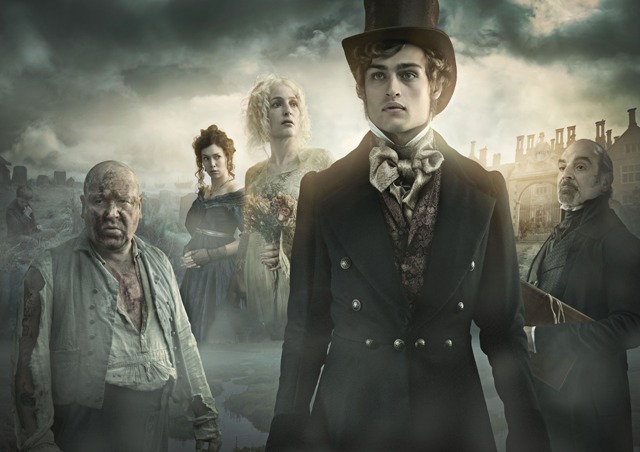
Ah, and what would a Dickens novel be without a cast of supporting characters who are much more interesting than Blandy McBland, the hero of the piece? Joe was as good-hearted an incarnation as he usually is, though I was disappointed they cut out all of his little games with Pip, to alleviate the misery of a poor childhood, and his backstory as an abused child who had forgiven his own awful father and was determined to prevent the miseries of his old childhood with Pip. He was such a breath of fresh air when he appeared, however. There was no Biddy (I can't say that I missed her), just Joe with his kindness and decency. Pip's uncle was enjoyably snobbish, but Mrs. Joe was not as funny as I read her in the novel. During some of her scenes, I kept thinking, 'haha, child abuse? Is that what the BBC wants me to laugh at?' Still, she turned in a fine performance, as can be said for all of the secondary actors. Mr. Jaggers seemed to really enjoy his role, and his final monologue was excellently filmed and so dramatically satisfying, I rather wished the episode would end there. Mr. Wemmik and Herbert Pocket were a nice mix of materialistic and sympathetic, though Ray Winstone, as the mysterious convict, seemed to be playing Ray Winstone more than anything else. I'm not altogether familiar with British actors, but I suppose there must be people like John Malkovitch everywhere, who are famous for playing themselves in every single role. Indeed, there is no arguing with the casting or the filming, which was rather beautifully grim, with mud, fog, shadows and rot vying for time on screen, but with the little changes to the script and therefore the characters. What's the point of a lot of the little changes? Why have Pip's scene with the convict over a bridge instead of in a graveyard (I guess to nicely bookend it, considering what ends up happening to the convict)?
All in all, it was a decent adaptation, and if one has a few idle hours, one could do worse than watch Douglas Booth in period clothing. However, it hardly achieves the brilliance of past adaptions of Dickens, and past BBC adapations. It feels all at once too artsy and too grim to be Dickens, and for those like the Amateur Historian, who loves the satire in nineteenth century novels above all, there is none to be found.
Friday, July 22, 2011
Immortal Beloved Review
It is always difficult dealing with a mystery that has plagued the academic community for years. When one is... not actually an academic, it most likely necessarily follows that the answer to that mystery is going to be a) academically unfounded and b) a little bizarre. However, to give credit where credit is due, the director a) brilliantly picked Gary Oldman to play Beethoven, b) did an extremely good, if sometimes overtly violent job at matching images to Beethoven's music, c) has a beautiful first act where one of Beethoven's potential Immortal Beloveds falls in love with him and realizes that he is deaf, and d) cast Gary Oldman in a cravat role.
Take a look, Gentle Readers:
The director performed a service to humanity with that bit of casting. The Amateur Historian, at least, personally feels that her life was better for seeing Gary Oldman storm about Romantically in period costume.
The plot is relatively simple. After Beethoven's dramatic death in the middle of a thunderstorm, underscored by the beginnings of his 5th Symphony, his biographer, Anton Schindler (actually Beethoven's first biographer, so good job movie) finds three letters addressed to Beethoven's Immortal Beloved. This leads Schindler on a quest throughout Austria and through the flashbacks of the candidates for the title of Immortal Beloved. It is a very different and ingenious way to explore the tumultuous life of a great composer, and, to the movie's credit and certainly to Mr. Oldman's, Beethoven is presented precisely as he was in life: passionate, paranoid, tumultuous, brilliant and completely over-the-top. Whether it's music or life, Beethoven must HAVE IT ALL and he must HAVE IT HIS WAY OR HE WILL BREAK SOMETHING.
However, like Beethoven, the movie is not without its flaws. It is extremely bloody-- a trait which will perhaps recommend it to certain Gentle Readers, but not to the Amateur Historian-- and the third act of the film is an incredible disappointment. When the dramatic denouement, underscored with Beethoven's own music and the apparently requisite thunderstorm, unfurls, the end is somewhat inexplicable and disappointing. For no easily discernible reason, Beethoven's Immortal Beloved agrees to meet Beethoven in a hotel, where he will presumably propose, but then she leaves the hotel and then marries someone else, leaving Beethoven to hurl chairs about in rage.
Jeez, Immortal Beloved, I know your boyfriend has hearing problems, but you should have just invested in a fan.
Bref, the movie is not without its merits, though it fails to live up to the high standard it set for itself in its first act, where Beethoven's loss of hearing is handled with such beautiful artistic delicacy. For the romance novelists out there, the first act is also very helpful in terms of very late 18th century undergarments, as there is a surprising amount of nudity, dressing and undressing that occurs. However, the ending does not make very much sense once the film is over and the final moment of beauty, where Beethoven's Ode to Joy is playing in the background as Beethoven, as a young boy, lays in a lake reflecting the stars and the camera pans back to see the entire Milky Way, is eclipsed by the randomness of the script's solution. Immortal Beloved, you are not who all the actual scholars say you are.
Take a look, Gentle Readers:

The director performed a service to humanity with that bit of casting. The Amateur Historian, at least, personally feels that her life was better for seeing Gary Oldman storm about Romantically in period costume.
The plot is relatively simple. After Beethoven's dramatic death in the middle of a thunderstorm, underscored by the beginnings of his 5th Symphony, his biographer, Anton Schindler (actually Beethoven's first biographer, so good job movie) finds three letters addressed to Beethoven's Immortal Beloved. This leads Schindler on a quest throughout Austria and through the flashbacks of the candidates for the title of Immortal Beloved. It is a very different and ingenious way to explore the tumultuous life of a great composer, and, to the movie's credit and certainly to Mr. Oldman's, Beethoven is presented precisely as he was in life: passionate, paranoid, tumultuous, brilliant and completely over-the-top. Whether it's music or life, Beethoven must HAVE IT ALL and he must HAVE IT HIS WAY OR HE WILL BREAK SOMETHING.
However, like Beethoven, the movie is not without its flaws. It is extremely bloody-- a trait which will perhaps recommend it to certain Gentle Readers, but not to the Amateur Historian-- and the third act of the film is an incredible disappointment. When the dramatic denouement, underscored with Beethoven's own music and the apparently requisite thunderstorm, unfurls, the end is somewhat inexplicable and disappointing. For no easily discernible reason, Beethoven's Immortal Beloved agrees to meet Beethoven in a hotel, where he will presumably propose, but then she leaves the hotel and then marries someone else, leaving Beethoven to hurl chairs about in rage.
Jeez, Immortal Beloved, I know your boyfriend has hearing problems, but you should have just invested in a fan.
Bref, the movie is not without its merits, though it fails to live up to the high standard it set for itself in its first act, where Beethoven's loss of hearing is handled with such beautiful artistic delicacy. For the romance novelists out there, the first act is also very helpful in terms of very late 18th century undergarments, as there is a surprising amount of nudity, dressing and undressing that occurs. However, the ending does not make very much sense once the film is over and the final moment of beauty, where Beethoven's Ode to Joy is playing in the background as Beethoven, as a young boy, lays in a lake reflecting the stars and the camera pans back to see the entire Milky Way, is eclipsed by the randomness of the script's solution. Immortal Beloved, you are not who all the actual scholars say you are.
Monday, June 15, 2009
Beau Brummel: This Charming Man
 Beau Brummel was almost The Celebrity of the early Regency period, even though, to the Amateur Historian's mind, his claim to fame was really only getting dressed in the morning. Granted, as Queen of Fashion or any biography will tell you, clothing was of significant symbolic importance during said time-period. Wear knee-breeches (culottes, in French) and you would be considered a part of the repressive Ancien Regime, and pretty much an open target to the sans-culottes who disapprove of your fashion choices. Wear a gaulle, and alternately be accused of immorality or be a paragon of Roussean simplicity. Wear a fox-tail in your hat to show your Whiggish leanings and support for Charles James Fox! I suppose Brummel was sort of the first hipster, making ironic detachment and cool, and a look of careless (but cultivated) elegance the way to go.
The film stars the amazing-in-period-costume James Purefoy, who seems to be contractually obligated by the BBC to end his roles in a dazed, drunken stupor while depressed, abandoned and crying. (Marc Antony, why did it have to end the way it did?). The man is gorgeous in a cravat and plays Beau Brummel with an understated charm and quiet friendliness. He is the epitome of a dandy. Hugh Bonneville plays a sadly realistic Prince Regent, and Matthew Rhys plays a very pretty Lord Byron. I have absolutely no complaints with the costumes, which were drool-worthy, or the sets, which were equally fantastic. I do, however, have some quibbles with the plot.

The biopic is a tragedy, wherein the viewer believes Brummel will win and then Brummel pretty much commits social suicide, and James Purefoy is left brokenly (and, the Amateur Historian must admit, beautifully) sobbing all by himself. To be more specific, Brummel starts out as biffles with the Prince Regent, to the point where the prince calls him over in the middle of the night to read Henry IV out loud. Brummel has to read Falstaff, whom he dubs, "Fat-staff", but gets to use his biffle status to spook his creditors into never collecting on his debt. Alas, however. The good times, symbolized by shaky, quasi-artistic shots that looked either like the camera or the cameraman was on speed, or that they had blown their budget on the totally fab costumes and were forced to use hand-held cameras, had to come to an end.

Brummel, while living the high-life, falls madly in love with Lord Byron, in an incredibly hot but historically dubious turn of events that alienates Beau from Prince George. Beau loses his reputation and his money, luck and friends, has an artistic flashback while watching's Sheridan's glorious School for Scandal, and then vanishes, leaving the credits to inform us that he fled to France. (To die in poverty, but they left that bit out. Considering what an angst fest the film because, with a tearful Brummel begging Byron to stay, and falling apart at the seams-- not literally, of course. Dandies don't let a little thing like total ruin affect their wardrobes-- the Amateur Historian did expect it. Seriously, one of the scenes was along the lines of:
Brummel: You were amazing in our historically inaccurate threesome with a courtesan named Julia, wherein she was the conduit for our socially unacceptable homoerotic passion for one another. I love you.
Byron: I love me too.
Brummel: Will you stay?
Byron: *poetic blather*
Brummel: Will you stay?
Byron: *poetic blather* Life is art, you are art in motion, Beau. You are art itself! That is why you are famous when you have contributed next to nothing to society. You are walking art.
Brummel: But will you stay?
Byron: I say, my half-sister's very pretty, isn't she?
Brummel: Will you stay, George?
Byron: ... let's see if we can start an orgy, eh? *wanders off*
Brummel: *tearfully* He won't stay.
Amateur Historian: NO DUH.)
Amateur Historian: NO DUH.)
The Amateur Historian's personal favorite part of the piece was the war to the death between the fops and the dandies. Two fops attempt to go head-to-head with Brummel on the street, at which point Brummel pummels them. Dandies, after all, do what they please whenever they please and look carelessly elegant while doing so. Though the Amateur Historian has a soft spot for fops (see The Scarlet Pimpernel as to why, and then tell me you don't love Sir Percy), it is amusing to see a bunch of them thumbing their noses at Brummel, who pioneered today's standard male dress-clothes in the form of a dark suit (with trousers), boots or black shoes, and a neat tie. Real men, you see, wore perfume, lace, high heels and rouge.
Now, what can we take from this film, aside from the fact that fops and dandies are mortal enemies and that Byron's love affairs just cannot be contained by such a silly thing as historical fact? The morals of the story seem to be: a. don't sleep with Lord Byron, b. don't call your biffle fat, and c. DON'T SLEEP WITH LORD BYRON. Seriously. You lose all your friends, fortune, and fame and flee to France to escape your creditors. Not a glamourous end, really.
The film itself is very glamorous, however, and has moments of wit (some from Brummel himself, some stolen from Oscar Wilde-- oh subtext, how the BBC doth love thee) in between the shaky good-times shots and the descent into wrist-gnawingly intense angst. As with Gothic, there are some lovely, tasteful scenes of a beautiful naked man and a nymphomanic Byron. However, unlike Gothic, there is a plot and actual logic to the story. It isn't the best period film I've ever seen, since I don't really enjoy maudlin pieces unless they are over-the-top and hilarious, but it is worth a rent for the costumes (and lack thereof. Oh James Purefoy! If Beau Brummel looked like you, no wonder people lined up to watch him dress each morning).


Subscribe to:
Posts (Atom)