
Showing posts with label Romantic Army on the March. Show all posts
Showing posts with label Romantic Army on the March. Show all posts
Sunday, January 8, 2012
Jane Austen Fight Club
Jane Austen's Fight Club from Keith Paugh on Vimeo.
This is a few years late, but I remembered it after watching all the imagined sword-fighting scenes in the BBC's highly entertaining adaptation of Northanger Abbey. Hopefully the Gentle Readers will find this amusing.

Monday, August 15, 2011
Our Daily Bread> Your Angst
The Amateur Historian has a particular fondness for literary feuds. Though Mark Twain's scathing criticisms of the literary offenses of the Deerslayer tales are still the Amateur Historian's favorite, William Makepeace Thackeray had some salient criticisms of Goethe's The Sorrows of Young Werther:
Werther had a love for Charlotte
Such as words could never utter;
Would you know how first he met her?
She was cutting bread and butter.
Charlotte was a married lady,
And a moral man was Werther,
And, for all the wealth of Indies,
Would do nothing for to hurt her.
So he sighed and pined and ogled,
And his passion boiled and bubbled,
Till he blew his silly brains out,
And no more was by it troubled.
Charlotte, having seen his body
Borne before her on a shutter,
Like a well-conducted person,
Went on cutting bread and butter.
Werther had a love for Charlotte
Such as words could never utter;
Would you know how first he met her?
She was cutting bread and butter.
Charlotte was a married lady,
And a moral man was Werther,
And, for all the wealth of Indies,
Would do nothing for to hurt her.
So he sighed and pined and ogled,
And his passion boiled and bubbled,
Till he blew his silly brains out,
And no more was by it troubled.
Charlotte, having seen his body
Borne before her on a shutter,
Like a well-conducted person,
Went on cutting bread and butter.
Friday, July 22, 2011
Immortal Beloved Review
It is always difficult dealing with a mystery that has plagued the academic community for years. When one is... not actually an academic, it most likely necessarily follows that the answer to that mystery is going to be a) academically unfounded and b) a little bizarre. However, to give credit where credit is due, the director a) brilliantly picked Gary Oldman to play Beethoven, b) did an extremely good, if sometimes overtly violent job at matching images to Beethoven's music, c) has a beautiful first act where one of Beethoven's potential Immortal Beloveds falls in love with him and realizes that he is deaf, and d) cast Gary Oldman in a cravat role.
Take a look, Gentle Readers:
The director performed a service to humanity with that bit of casting. The Amateur Historian, at least, personally feels that her life was better for seeing Gary Oldman storm about Romantically in period costume.
The plot is relatively simple. After Beethoven's dramatic death in the middle of a thunderstorm, underscored by the beginnings of his 5th Symphony, his biographer, Anton Schindler (actually Beethoven's first biographer, so good job movie) finds three letters addressed to Beethoven's Immortal Beloved. This leads Schindler on a quest throughout Austria and through the flashbacks of the candidates for the title of Immortal Beloved. It is a very different and ingenious way to explore the tumultuous life of a great composer, and, to the movie's credit and certainly to Mr. Oldman's, Beethoven is presented precisely as he was in life: passionate, paranoid, tumultuous, brilliant and completely over-the-top. Whether it's music or life, Beethoven must HAVE IT ALL and he must HAVE IT HIS WAY OR HE WILL BREAK SOMETHING.
However, like Beethoven, the movie is not without its flaws. It is extremely bloody-- a trait which will perhaps recommend it to certain Gentle Readers, but not to the Amateur Historian-- and the third act of the film is an incredible disappointment. When the dramatic denouement, underscored with Beethoven's own music and the apparently requisite thunderstorm, unfurls, the end is somewhat inexplicable and disappointing. For no easily discernible reason, Beethoven's Immortal Beloved agrees to meet Beethoven in a hotel, where he will presumably propose, but then she leaves the hotel and then marries someone else, leaving Beethoven to hurl chairs about in rage.
Jeez, Immortal Beloved, I know your boyfriend has hearing problems, but you should have just invested in a fan.
Bref, the movie is not without its merits, though it fails to live up to the high standard it set for itself in its first act, where Beethoven's loss of hearing is handled with such beautiful artistic delicacy. For the romance novelists out there, the first act is also very helpful in terms of very late 18th century undergarments, as there is a surprising amount of nudity, dressing and undressing that occurs. However, the ending does not make very much sense once the film is over and the final moment of beauty, where Beethoven's Ode to Joy is playing in the background as Beethoven, as a young boy, lays in a lake reflecting the stars and the camera pans back to see the entire Milky Way, is eclipsed by the randomness of the script's solution. Immortal Beloved, you are not who all the actual scholars say you are.
Take a look, Gentle Readers:

The director performed a service to humanity with that bit of casting. The Amateur Historian, at least, personally feels that her life was better for seeing Gary Oldman storm about Romantically in period costume.
The plot is relatively simple. After Beethoven's dramatic death in the middle of a thunderstorm, underscored by the beginnings of his 5th Symphony, his biographer, Anton Schindler (actually Beethoven's first biographer, so good job movie) finds three letters addressed to Beethoven's Immortal Beloved. This leads Schindler on a quest throughout Austria and through the flashbacks of the candidates for the title of Immortal Beloved. It is a very different and ingenious way to explore the tumultuous life of a great composer, and, to the movie's credit and certainly to Mr. Oldman's, Beethoven is presented precisely as he was in life: passionate, paranoid, tumultuous, brilliant and completely over-the-top. Whether it's music or life, Beethoven must HAVE IT ALL and he must HAVE IT HIS WAY OR HE WILL BREAK SOMETHING.
However, like Beethoven, the movie is not without its flaws. It is extremely bloody-- a trait which will perhaps recommend it to certain Gentle Readers, but not to the Amateur Historian-- and the third act of the film is an incredible disappointment. When the dramatic denouement, underscored with Beethoven's own music and the apparently requisite thunderstorm, unfurls, the end is somewhat inexplicable and disappointing. For no easily discernible reason, Beethoven's Immortal Beloved agrees to meet Beethoven in a hotel, where he will presumably propose, but then she leaves the hotel and then marries someone else, leaving Beethoven to hurl chairs about in rage.
Jeez, Immortal Beloved, I know your boyfriend has hearing problems, but you should have just invested in a fan.
Bref, the movie is not without its merits, though it fails to live up to the high standard it set for itself in its first act, where Beethoven's loss of hearing is handled with such beautiful artistic delicacy. For the romance novelists out there, the first act is also very helpful in terms of very late 18th century undergarments, as there is a surprising amount of nudity, dressing and undressing that occurs. However, the ending does not make very much sense once the film is over and the final moment of beauty, where Beethoven's Ode to Joy is playing in the background as Beethoven, as a young boy, lays in a lake reflecting the stars and the camera pans back to see the entire Milky Way, is eclipsed by the randomness of the script's solution. Immortal Beloved, you are not who all the actual scholars say you are.
Wednesday, June 30, 2010
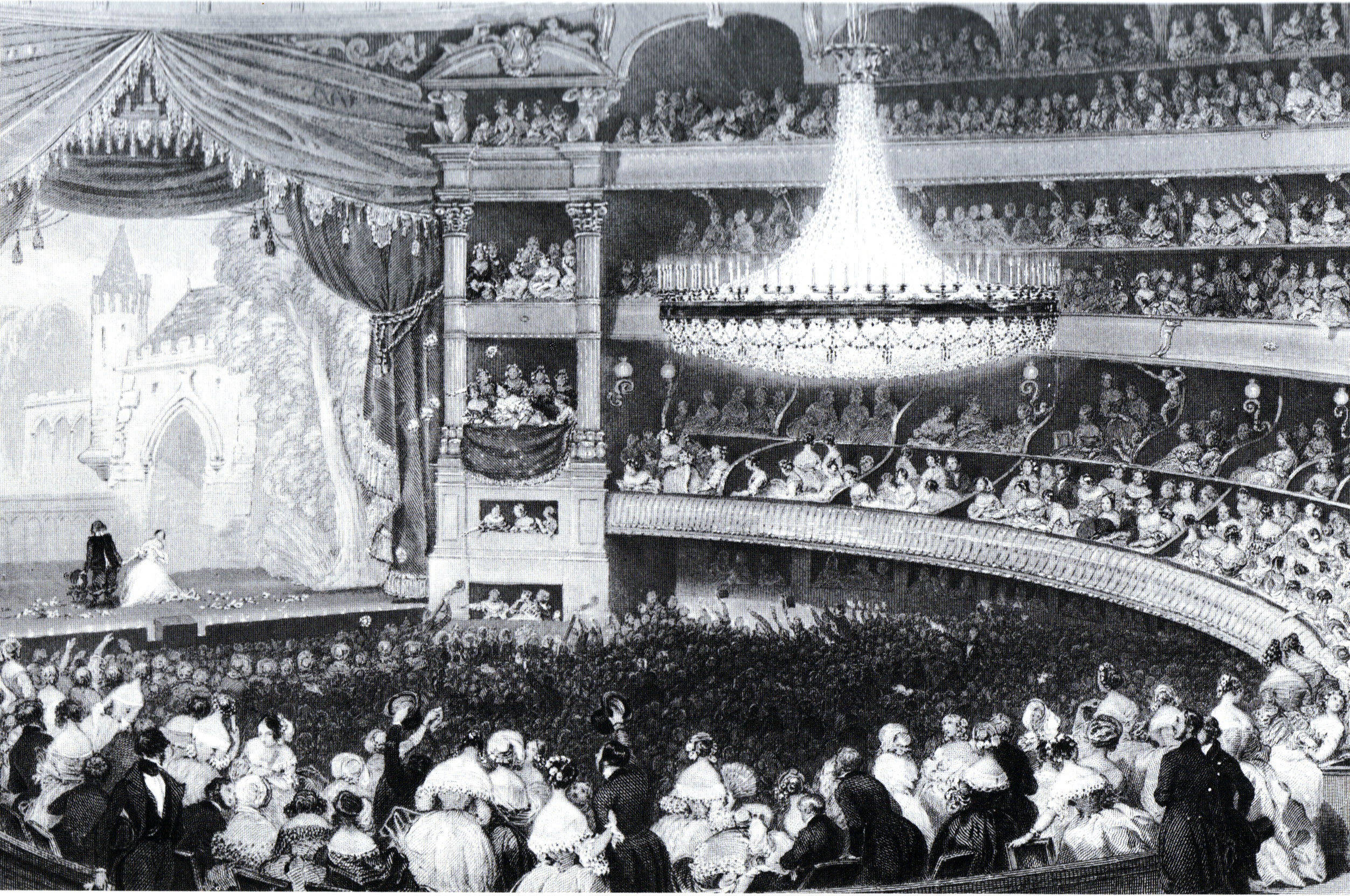
For the French Romantics, theatre tended to be Very Serious Business indeed. The Battle of Hernani was, indeed, the flowering of the Romantic decision that in the debate of whether art reflects, or life reflects art, the answer is 'art is life'.
Certain Romantics were so dedicated to certain performers, plays or ensembles that they reserved the same seats for every performance, every evening at a given venue. For example, at the Théâtre-Italien, Ernest Legouvé reported that there were about sixty or so men of different ages and professions (though mostly lawyers, magistrates and writers), formed a sort of Romantic phalanx whose only law was to never miss a performance. They generally arrived an hour early, to discuss the upcoming performance and compare it with past ones that they had seen, and acted as a sort of jury, leading the rest of the audience in applause or silence.
If someone was so gauche as to start up a round of applause when the Romantic Regulars did not think an actor had merited one, an appointed spokesperson would say, quite sharply, "Is that one of the regulars of the Théâtre-Italien?"
At that point, the applause usually stopped.
Wednesday, June 9, 2010
An Uncommonly Fun Funeral
If there was one thing that Victor Hugo loved more than himself, it was women. Though a great champion of social justice he was the patron of a number of Parisian brothels. Therefore, during his funeral, the policemen that the French government had brought in to keep the funeral from getting violent were upset that said government wished to shut down all the bars/ billiard rooms/ brothels in honor of Victor Hugo. The government then seemed to realize that Hugo would have wished for the brothels to remain open (some brothels even offered their services for free, in honor of the loss of so great a patron), or, rather, that the riot they wished to avoid would have started if said brothels closed and allowed them to remain open.
They did however, respectfully request all the prostitutes to wear mourning.
FUN FACT: The Place des Vosages, where Hugo spent a significant portion of his adult life used to be called the Place Royale. After the 1848 revolution, the department of Vosages was the first to send their taxes into the republican government, so the government changed the Place Royale to the Place des Vosages. See, good things come out of paying your taxes in a timely fashion!
They did however, respectfully request all the prostitutes to wear mourning.
FUN FACT: The Place des Vosages, where Hugo spent a significant portion of his adult life used to be called the Place Royale. After the 1848 revolution, the department of Vosages was the first to send their taxes into the republican government, so the government changed the Place Royale to the Place des Vosages. See, good things come out of paying your taxes in a timely fashion!
Monday, May 10, 2010
Les Misérables: Letting the Disenfranchised Hit Back. In Green Minis, Apparently.

The Amateur Historian makes no secret of the fact that her favorite novel is Victor Hugo's Les Misérables, an epically long novel that at once presents the serious social problems of 19th century France and mythologizes them. Les Misérables has many interpretations (i.e. the musical, the multiple films and TV series) but the Amateur Historian finds that the Japanese have created by far the most absurd.
The Japanese company Takase has created a free downloadable 2D fighting game based on Les Miserables called ArmJoe, after the novel's Japanese title, Aa Mujou (ああ無情). The game features most of Victor Hugo's major characters, such as Jean Valjean, Enjolras (spelled Enjorlas, for whatever reason), Marius, Cosette, Éponine, Thénardier, and Javert, but also adds the characters Hugo was so negligent as to forget to include in his manuscript. These new additions consist of a policeman, a robotic clone of Valjean called RoboJean, an embodiment of Judgement, and, the Amateur Historian's personal favorite, a tea-drinking rabbit named Ponpon.
Enjoy, Gentle Readers. Everyone should have the experience of letting a tea-drinking rabbit run over Inspector Javert in a green Mini.


Sunday, February 14, 2010
How Very... Romantic

Happy Valentine's Day, Gentle Readers! The Amateur Historian will admit to preferring February 15th over February 14th, as, on the 15th, one can purchase pink-wrappered candy for 50% off. It is a very pleasant way to boost one's endorphin levels (and one's cholesterol, but no matter).
In honor of a very romantic holiday, the Amateur Historian would like to offer up quite possibly one of the most Romantic (in the sense of the literary and philosophic movement where one's demise was considered a perfectly reasonable subject of conversation, as long as one did not adhere to classical meter while doing so) gestures ever made by The French Romantic himself, Victor Hugo. The portrait of Hugo, to the left, was drawn by his then wife-to-be, Adèle Foucher, whom the young Hugo adored beyond reason. When his mother died and Hugo began spending his days standing across the street from the Foucher household, waiting to see Adéle come to the window, Adéle's parents became understandably alarmed. They whisked Adéle off to Dreux, ostensibly to visit a relative, but really to put a 25 franc coach ride between her and her poetic stalker.
A week later, Hugo arrived in Dreux, having marched on foot for fifty miles from Paris. After bathing in a river, he went to the Hôtel du Paradis, where the Fouchers were staying, and wrote a note to them about the remarkable coincidence that they should also be in Dreux, since he just happened to be there "in search of Druidic monuments".
M. Foucher was, to his credit, extremely impressed and invited Hugo to stay with them and write Gothic odes, provided they were about their rented holiday home instead of Adéle. Hugo and Adéle were married a year later.
Monday, February 8, 2010
Romantic Army on the March off Cliffs!
In belated honor of this blog's one year birthday, have a free opera from Paris! This is Massenet's Werther. Unfortunately the subtitles are in French, but the Amateur Historian would like to point out two scenes of Romantic OTT that need to be seen- 82:16-83:00 where Werther falls to the floor and curls into a fetal position at the loss of Charlotte, and 88:18-30, where Werther jumps off a wall in lieu of any other civilized way of ending a conversation. I highly recommend the opera, which is lovely, musically speaking, and suffers only slightly from being a Romantic work of literature that got reinterpreted into Victorian sentimentalism.
The Amateur Historian adores Romanticism, but is more of Byron's camp than Wordsworth's. The best Romanticism is done with a straight-face, but with tongue firmly in cheek.
Friday, October 9, 2009
It also tastes delicious with butter
 The French Romantic period had a number of authors who took Romanticism to its illogical extremes. One such poet was Gerard de Nerval, who, like many young writers, took it upon himself to shock the bourgoise in order to display the falseness of society and his role, as a poet, in breaking them free of their shackles. To this end, he joined the 'bosingos', which, though an important force in the 1830s Revolution, spent a lot of time doing the weirdest things they could imagine. Since the group de Nerval belonged to was an offshoot, the 'bouzingos', were mostly poets who placed art above politics and tended to annoy the monarchists just for the hell of it instead of out of legitimate political protest, they came up with some pretty bizarre stuff even for Romantics. The Amateur Historian believes that at one point the 'bouzingos' decided it would be a great idea to hold a literary salon in the nude and then any follow it up with a concert, despite, or perhaps because of, the fact that none of them could play an instrument. The Amateur Historian believes that the 'bouzingos' were still nude when they did this.
De Nerval fit in with the bouzingos perfectly. He liked to go out walking with a lobster on a pale blue ribbon and, when asked why, replied that the lobster did not bark and that it knew the secrets of the deep.
Tuesday, September 29, 2009
Hernani: The Play Where the Audience is SUPPOSED to Be More Interesting Than the Actors

The Romantic movement came to France much later than it did to England in Germany, and the backlash was correspondingly more severe. The elements of French culture that proved resistant to Romanticism, i.e. the Academie Francaise, and the wide-spread use and popularity of classical form, also proved extremely reactionary, as could be seen on Feb. 25, 1830, when a young Victor Hugo decided to stage a play.
Victor Hugo, who is pretty much The Romantic of the French Romantic movement, broke with tradition when he wrote Hernani, a play that can be summed up as, "Oops, I am in love with someone who is in love with/engaged to someone else and now I have killed myself for no easily discernable reason." Though the main cast was dead in the end, as happens with most French tragedy, Hugo made the great mistake of using forbidden words such as "handkerchief" and forcing the actors to express grand sweeps of Romantic passion while in period costume. One actress was so appalled by her period costume she refused to go onstage without wearing her contemporary but hideous 1830s hat. Since the Comedie Francaise, i.e. the Maison de Moliere, i.e. the oldest theatre company in Europe, i.e. The Be All and End All of French Drama, was deigning to stage a (gasp) Romantic piece, Hugo was understandably nervous about its reception. He therefore passed out red tickets (normally given to the author of any staged drama, like a courtesy copy of a book) to his friends, who formed a Romantic Army and invaded the Comedie Francaise on the opening night.
To make sure the production would begin on time and sans interference from the classicists, the Romantic Army got to the building at three-o-clock and locked themselves in for the next four hours with provisions and their cosplay get-up (Seriously, Hugo himself describes the Romantic Army as full of "wild whimsical characters, bearded, long-haired, dressed in every fashion except the reigning one, in pea-jackets, Spanish cloaks, in waistcoats a la Robespierre, in Henry III bonnets...and this in the middle of Paris in broad daylight"). Sometime before seven-o-clock, they realized that they had no bathrooms, as they had locked themselves into the auditorium, and just did their business in the boxes of the classicists.
The classicists were understandably pissy (in all senses of the word, thanks to the lack of bathrooms) and began having fistfights in the pit. The actors, already unhappy with having to go Romantic and forsake their 1830s habberdashery, were made further unhappy by the fact that they could not get through a single performance without someone in the audience :
a. challenging someone else to a duel,
b. starting a fistfight,
c. hissing at the stage loud enough to drown out the actors,
d. arguing over classical vs. Romantic forms and politics very, very loudly, or
e. getting up onstage in a red waistcoat and lime green pants before the curtain to sing praises of the Romantic, bohemian lifestyle. (Not like that, though. More the songs of angry men.)
Hernani ran for a hundred full-house performances. The Amateur Historian is willing to bet that the actors of the Comedie Francaise hated every one of them.
a. challenging someone else to a duel,
b. starting a fistfight,
c. hissing at the stage loud enough to drown out the actors,
d. arguing over classical vs. Romantic forms and politics very, very loudly, or
e. getting up onstage in a red waistcoat and lime green pants before the curtain to sing praises of the Romantic, bohemian lifestyle. (Not like that, though. More the songs of angry men.)
Hernani ran for a hundred full-house performances. The Amateur Historian is willing to bet that the actors of the Comedie Francaise hated every one of them.
Subscribe to:
Posts (Atom)