
On the subject of scathing reviews, George Elliot, though not as vitriolic about one novel in particular, released her considerable hatred of silly novels in the absolutely brilliant essay "Silly Novels by Silly Lady Novelists". Though the Amateur Historian is not entirely sure if it was intended to do so, the essay also reads like a very good argument for female education. Educate ladies or they, in turn; will write incredibly stupid novels and give all female novelists a bad name.
The Amateur Historian almost wishes to copy-paste the entire thing, but have a few gems before going off to read this masterpiece yourself:
-The heroine's eyes and her wit are both dazzling; her nose and her morals are alike free from any tendency to irregularity.
-The men play a very subordinate part by her side. You are consoled now and then by a hint that they have affairs, which keeps you in mind that the working-day business of the world is somehow being carried on, but ostensibly the final cause of their existence is that they may accompany the heroine on her 'starring' expedition through life.
-The fair writers have evidently never talked to a tradesman except from a carriage window; they have no notion of the working-classes except as 'dependents'; they think five hundred a-year a miserable pittance; Belgravia and 'baronial halls' are their primary truths; and they have no idea of feeling interest in any man who is not at least a great landed proprietor, if not a prime minister. [Watch out Pitt the Younger!] It is clear that they write in elegant boudoirs, with violet-coloured ink and a ruby pen; that they must be entirely indifferent to publishers' accounts, and inexperienced in every form of poverty except poverty of brains.
-Their intellect seems to have the peculiar impartiality of reproducing both what they have seen and heard, and what they have not seen and heard, with equal unfaithfulness.
- We are not surprised to learn that the mother of this infant phenomenon, who exhibits symptoms so alarmingly like those of adolescence repressed by gin, is herself a phoenix... she can talk with perfect correctness in any language except English.
-This enthusiastic young lady, by dint of reading the newspaper to her father, falls in love with the prime minister, who, through the medium of leading articles and "the resumé of the debates," shines upon her imagination as a bright particular star, which has no parallax for her.... Perhaps the words "prime minister" suggest to you a wrinkled or obese sexagenarian; but pray dismiss the image. Lord Rupert Conway has been "called while still almost a youth to the first situation which a subject can hold in the universe," and even leading articles and a resumé of the debates have not conjured up a dream that surpasses the fact. [Either someone has fangirled William Pitt the Younger to an alarming extent and thus either 'forgot' that his emotional life more-or-less stopped developing as soon as he entered office and ignored the fact that he was more-or-less asexual, or they have decided that just any old 24-year-old can be Prime Minister without having a successful Prime Minister for a father, a genius for mathematics and economics, a childhood education structured around the goal of becoming Prime Minister or the extraordinary set of personality-driven power-struggles plaguing the House of Commons that paved Pitt's way to power.]
-(a quote from a novel): "Was this reality?"
Very little like it, certainly.
-He is not only a romantic poet, but a hardened rake and a cynical wit; yet his deep passion for Lady Umfraville has so impoverished his epigrammatic talent, that he cuts an extremely poor figure in conversation. When she rejects him, he rushes into the shrubbery, and rolls himself in the dirt.
-To judge from their writings, there are certain ladies who think that an amazing ignorance, both of science and of life, is the best possible qualification for forming an opinion on the knottiest moral and speculative questions. Apparently, their recipe for solving all such difficulties is something like this:–Take a woman's head, stuff it with a smattering of philosophy and literature chopped small, and with false notions of society baked hard, let it hang over a desk a few hours every day, and serve up hot in feeble English, when not required.
-In such cases, sons are often sulky or fiery, mothers are alternately manoeuvring and waspish, and the portionless young lady often lies awake at night and cries a good deal. We are getting used to these things now, just as we are used to eclipses of the moon, which no longer set us howling and beating tin kettles.
-A recent example of this heavy imbecility is, "Adonijah, a Tale of the Jewish Dispersion," which forms part of a series, "uniting," we are told, "taste, humour, and sound principles." "Adonijah," we presume, exemplifies the tale of "sound principles;" the taste and humour are to be found in other members of the series.
You can read the rest of Eliot's essay here.
Thursday, December 10, 2009

Sunday, December 6, 2009

There were a lot of very stupid monarchs running around during the eighteenth and nineteenth centuries, but, in the Amateur Historian's opinion, the award for "Wow, I Hope That Was the Fault of Inbreeding" goes to Marie-Caroline, queen of Naples.
Marie-Caroline was not a fan of Bonaparte, who she saw as a parvenu, undeserving of a place among all the Hapsburg-jawed monarchs feasting at the European banquet table. Moreover, she was the sister of Marie-Antoinette and never forgave France for killing off her favorite sibling. Therefore, Marie-Caroline (who ran Naples while her indolent husband went slumming) liked to pit Naples against France whenever the other nations were feeling up to forming a new coalition. However, Marie-Caroline did not seem to learn, as each coalition got their royal backsides handed to them with a side-helping of localized republican uprisings. Marie-Caroline actually lost her kingdom twice thanks to her ill-informed attempts at trying to make Naples into a world power (which royally pissed off everyone in Naples) and at fighting the French (which pissed off Napoleon Bonaparte, which is never a good idea).
After the collapse of the second coalition, Marie-Caroline apparently learned nothing and tried again to a. make Naples (which hated her) a world power and b. defeat Bonaparte. This led to quite possibly one of the stupidest stunts she could have pulled: trying to flatter Napoleon and therefore France into submission while forming a "secret" alliance with Great Britain. Or course, Marie-Caroline did an extremely poor job of covering her tracks and did not appear to notice that Napoleon had one of the best spy networks in all of Europe (coming in a very, very close second to Britain, who simply had more money to buy off officials and the like).
Napoleon sent her a very pointed letter, which she unwisely ignored: "Your Majesty has already lost her kingdom twice, would she like to lose it a third time?"
She did.
Thursday, December 3, 2009

On the subject of Napoleon and letters, the first year of his Italian Campaign produced some absolute doozies of love letters to Josephine, who was extremely turned off by Napoleon's phonetic spelling, dreadful grammar, abysmal diction and horrible habit of underlining erotic passages so violently that he occasionally scratched through the stationary.
She was therefore extremely disinclined to write back to Napoleon and even less inclined to write to him as he wished her to, i.e. "Make sure you tell me that you are convinced you love me beyond what it is possible to imagine."
Napoleon eventually went somewhat mad at the lack of response, to the point where the Directory began to worry that the Republic's best and most successful general might actually quit his post, abandon Italy and march on Paris. Barras personally sent Josephine to Italy, which at least saved Josephine the indignity of having to answer letters begging her not to bathe.
Tuesday, December 1, 2009
Bridge of Lodi

Napoleon kept up a voluminous correspondence, but, in doing so, provided future scholars with records of pretty strange and varying reactions to major life events. His earliest letters, written before Napoleon became the practial, almost Machevallian politician who enjoyed demolishing opposing armies that frightens English historians to this day, are particularly bewildering in range.
Take, for example, four reactions to the Battle of Lodi, one of Napoleon's first battles during his famous Italian Campaign:
1. To the bishop of Lodi, in response to a general, 'Oh, what was all that fighting yesterday, was it important?: "Non fu grancosa." (It was no big deal.)
2. To Carnot, the head of the Directory's military operations: "The battle of Lodi gives the whole of Italy to the Republic."
3. To Marmont, an aide-de-camp who later became a Mareshal: "They [the directory] haven't seen anything yet... In our time, no one has the slightest conception of what is great. It is up to me to give them an example."
4. To Josephine, his adored wife: "I shall go berserk if I do not have a letter from you."
Sunday, November 29, 2009
Should Have Listened to Barras....
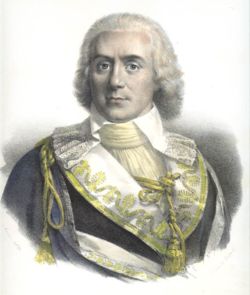
During the chaotic, economically horrendous days of the Directory, the five member executive branch had a difficult time making decisions. They did not like the centralized republic that had come before, they did not like the constitutional monarchy that had come before that, and they did not like the absolute monarchy that came before that. The directors were generally aware that there needed to be Change, particularly since their really stupid economic and military policies led to disasters unheard of under the Committee of Public Safety and it was pissing off the Parisian mobs, the chouans (Royalist peasant armies), the Jacobins, the royalists, the peasants, the workers and just about anyone who was not more-or-less middle class or higher and who was not more-or-less corrupt and making money off of the chaos.
Thus, it came as no surprise that the directors hemmed and hawed and shuffled their papers when it came to making decisions about who would take up various governmental positions. Barras, who became a director after the fall of Robespierre and remained one until the fall of the directory, got immensely frustrated over in-directory quarreling over military positions, particularly as they pertained to one Napoleone Buonaparte, an upstart Corsican who was, shockingly, actually winning battles.
The directors were reluctant to make Buonaparte head of the Army of Italy, which was doing abysmally, mostly because Buonaparte, at that time, was considered to be Barras's pet project and the directors spent most of their time hating one another rather than doing anything more productive.
Barras, however, won the day by stating, quite flatly, "Promote this man or he will promote himself."
Unfortunately the directors did not listen later on, and Napoleone Buonaparte promoted himself to the position of Emperor.
Saturday, November 21, 2009
OF THE WIN


The talented and terribly funny Madame Berg has just won herself an internet by creating what one hopes will be a new internet sensation- the lolpitt. You too, can make William Pitt the Younger smile and preserve such a rarity for posterity!
The Amateur Historian wishes anew that she had photoshop skillz.
Go here to tell Madame Berg just how incredibly awesome she is or to see her incredibly cool costumes.
Friday, November 20, 2009
Fenimore Cooper's Literary Offenses
There is nothing the Amateur Historian likes more than a scathing review of a ridiculous novel and, though the British Romantics had some doozies, the prize for scathing reviews must go to Mark Twain, for outlining Fenimore Cooper's Literary Offenses, which, alas, were great indeed.
Fenimore Cooper was at the forefront of American Romanticism, whose variation on the return to nature and the exploration of the history of one's nation was an exploration (with varying degrees of success) of colonial days, where one could give blankets full of smallpox to natives so one could build oneself a little Roussean paradise in the now vacant backwoods. Cooper's adventure stories were extremely popular, but, in Mark Twain's opinion, an insult to the reader, to the Native Americans, to literature, to Romanticism, and to the English language itself.
Here are some particular gems:
- [The rules governing literary fiction] require that the personages in a tale shall be alive, except in the case of corpses, and that always the reader shall be able to tell the corpses from the others. But this detail has often been overlooked in the Deerslayer tale.
- [The rules also] require that crass stupidities shall not be played upon the reader as "the craft of the woodsman, the delicate art of the forest," by either the author or the people in the tale. But this rule is persistently violated in the Deerslayer tale.
-Cooper's gift in the way of invention was not a rich endowment; but such as it was he liked to work it, he was pleased with the effects, and indeed he did some quite sweet things with it. In his little box of stage-properties he kept six or eight cunning devices, tricks, artifices for his savages and woodsmen to deceive and circumvent each other with... He prized his broken twig above all the rest of his effects, and worked it the hardest. It is a restful chapter in any book of his when somebody doesn't step on a dry twig and alarm all the reds and whites for two hundred yards around. Every time a Cooper person is in peril, and absolute silence is worth four dollars a minute, he is sure to step on a dry twig. There may be a hundred other handier things to step on, but that wouldn't satisfy Cooper. Cooper requires him to turn out and find a dry twig; and if he can't do it, go and borrow one. In fact, the Leatherstocking Series ought to have been called the Broken Twig Series.
-In the matter of intellect, the difference between a Cooper Indian and the Indian that stands in front of the cigar-shop is not spacious.
-To believe that such talk really ever came out of people's mouths would be to believe that there was a time when time was of no value to a person who thought he had something to say; when it was the custom to spread a two-minute remark out to ten; when a man's mouth was a rolling-mill, and busied itself all day long in turning four-foot pigs of thought into thirty-foot bars of conversational railroad iron by attenuation; when subjects were seldom faithfully stuck to, but the talk wandered all around and arrived nowhere; when conversations consisted mainly of irrelevancies, with here and there a relevancy, a relevancy with an embarrassed look, as not being able to explain how it got there.
-There have been daring people in the world who claimed that Cooper could write English, but they are all dead now.
-. Now I feel sure, deep down in my heart, that Cooper wrote about the poorest English that exists in our language, and that the English of Deerslayer is the very worst that even Cooper ever wrote.
- I may be mistaken, but it does seem to me that Deerslayer is not a work of art in any sense; it does seem to me that it is destitute of every detail that goes to the making of a work of art; in truth, it seems to me that Deerslayer is just simply a literary delirium tremens.
One can read the review here.
Fenimore Cooper was at the forefront of American Romanticism, whose variation on the return to nature and the exploration of the history of one's nation was an exploration (with varying degrees of success) of colonial days, where one could give blankets full of smallpox to natives so one could build oneself a little Roussean paradise in the now vacant backwoods. Cooper's adventure stories were extremely popular, but, in Mark Twain's opinion, an insult to the reader, to the Native Americans, to literature, to Romanticism, and to the English language itself.
Here are some particular gems:
- [The rules governing literary fiction] require that the personages in a tale shall be alive, except in the case of corpses, and that always the reader shall be able to tell the corpses from the others. But this detail has often been overlooked in the Deerslayer tale.
- [The rules also] require that crass stupidities shall not be played upon the reader as "the craft of the woodsman, the delicate art of the forest," by either the author or the people in the tale. But this rule is persistently violated in the Deerslayer tale.
-Cooper's gift in the way of invention was not a rich endowment; but such as it was he liked to work it, he was pleased with the effects, and indeed he did some quite sweet things with it. In his little box of stage-properties he kept six or eight cunning devices, tricks, artifices for his savages and woodsmen to deceive and circumvent each other with... He prized his broken twig above all the rest of his effects, and worked it the hardest. It is a restful chapter in any book of his when somebody doesn't step on a dry twig and alarm all the reds and whites for two hundred yards around. Every time a Cooper person is in peril, and absolute silence is worth four dollars a minute, he is sure to step on a dry twig. There may be a hundred other handier things to step on, but that wouldn't satisfy Cooper. Cooper requires him to turn out and find a dry twig; and if he can't do it, go and borrow one. In fact, the Leatherstocking Series ought to have been called the Broken Twig Series.
-In the matter of intellect, the difference between a Cooper Indian and the Indian that stands in front of the cigar-shop is not spacious.
-To believe that such talk really ever came out of people's mouths would be to believe that there was a time when time was of no value to a person who thought he had something to say; when it was the custom to spread a two-minute remark out to ten; when a man's mouth was a rolling-mill, and busied itself all day long in turning four-foot pigs of thought into thirty-foot bars of conversational railroad iron by attenuation; when subjects were seldom faithfully stuck to, but the talk wandered all around and arrived nowhere; when conversations consisted mainly of irrelevancies, with here and there a relevancy, a relevancy with an embarrassed look, as not being able to explain how it got there.
-There have been daring people in the world who claimed that Cooper could write English, but they are all dead now.
-. Now I feel sure, deep down in my heart, that Cooper wrote about the poorest English that exists in our language, and that the English of Deerslayer is the very worst that even Cooper ever wrote.
- I may be mistaken, but it does seem to me that Deerslayer is not a work of art in any sense; it does seem to me that it is destitute of every detail that goes to the making of a work of art; in truth, it seems to me that Deerslayer is just simply a literary delirium tremens.
One can read the review here.
Thursday, November 19, 2009
Going for a swim?

Ah, Bonaparte on the Bridge of Arcole, Antoine-Jean Gros's most famous work, and one of the earliest bits of propaganda for the Napoleonic legend! This portrait of Napoleon, looking much more handsome than he probably was in real life, leads the way across the bridge at Arcole to seize Austrian Italy and set up numerous sister republics within a more-or-less benevolent system of French cultural hegemony. Note how the zeitgeist of the era disorders his hair and how he moves forward, sword extended, carrying the French flag of quasi-republicanism and cultural dominance.
Please also note that, instead of tearing through the mist with sword and flag upraised, the future Emperor actually fell off the bridge at Arcole and into a swampy canal where he would have drowned had he not been fished out, with quite a lot of difficulty, by his panicked aides-de-camp.
Tuesday, November 17, 2009
He had to resume hostilities to maintain the balance of power

William Pitt was an extremely reserved, almost haughty person in public, but, in private was extraordinarily affectionate. He did not make friends easily, but Pitt held on tenaciously to those who managed to break past his reserve, and to a point where his Romantic friendships still puzzle scholars (ex. William Wilberforce, who became an outspoken opponent of Pitt's draconian policies during the Wars of the French Revolution but whom Pitt still considered one of his closest friends, and with whom Pitt had an odd but extremely enjoyable amount of slashy subtext in the 2006 film Amazing Grace).
Pitt was willing to bend over backwards for his family, as well, and adored his nieces and nephews. At one point, his niece, Lady Hester Stanhope blacked Pitt's face, while some other family members pinned him down, to amuse the youngest members of the family. This struggle, which evolved into a pillow fight, was interrupted by several members of Pitt's cabinet, including Lord Castlereagh. Pitt's transformation of demeanor was remarkable; he wiped off his face, and straightened up to the point where Lord Roseberry said that, after Pitt had assumed his working personna, "his tall figure seemed to stretch to the ceiling and all these powerful men who came calling bent like willows before him".
Immediately afterwards, Pitt resumed the pillowfight. One wonders if the Cabinet Ministers were asked to join in.
Friday, November 13, 2009
Is the worse punishment living under Napoleon III or having to live with his textile choices?
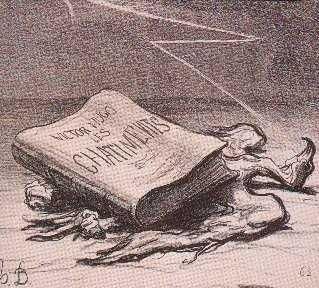
On the subject of Napoleon III's questionable taste, the Amateur Historian cannot help but mention one Victor Hugo, author of Les Miserables, Notre Dame de Paris and more Romantic poetry than Coleridge, Shelley and Keats combined could have produced. Granted, of the three mentioned here, two died young and one was addicted to opium and probably spent days on end watching his hand move, but the point remains: Hugo was a prolific Romantic. Why say, "The cannon broke free of its restraints" when you can stretch out such an action for an entire chapter?
Therefore, when Hugo believed Napoleon III had questionable taste, he did not merely say, "I hate you and everything you stand for, Napoleon III", he:
a. single-handedly forced a revolution (it did not work)
b. got exiled
c. wrote a 300 page volume of poetry called Les Chatiments, which can be translated either as The Punishments or Dear Napoleon III I Hate You and Everything You Stand For, And You Exiled Me to Jersey, Where There Is Nothing To Do Besides Nurture My Deep Hatred For You In Alexandrine Rhyming Couplets Filled With Classical Allusions No One Else Will Understand.
In Les Chatiments, Hugo takes a gleeful delight in calling Napoleon III Napoleon le petit (as opposed to Napoleon Bonaparte, who gets the better moniker of Napoleon le grand), a hypocritical murderer with the blood of mothers and children on his hands, the Judas Iscariot of French political theory and a mustachioed Caesar. He also points out the the style Napoleon III looks as if it is a melange of all styles that came before it- or rather, a melange of all the worst parts of the styles that came before, much in the same way that Napoleon III's regime was a melange of all the worst parts of all the governments that came before.
However, it is best not to take Hugo's criticisms at face value as, if one goes to the Maison Hugo in Paris, one can see that Hugo's idea of style was to carpet his ceilings.
Subscribe to:
Posts (Atom)