Showing posts with label Napoleon III. Show all posts

Wednesday, April 21, 2010


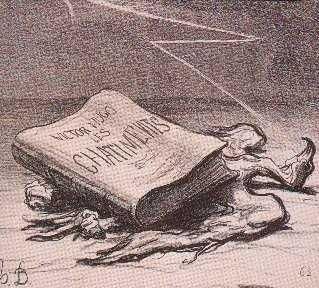
It is always difficult to smuggle a banned book into a country in which it is banned, particularly when said banned book is Victor Hugo's Napoleon-le-Petit, which was obviously critical of Napoleon III, who exiled the author, and that country is France, ruled by said Napoleon III. Hugo's work reached Paris:
-tucked in barrels of hay
-wrapped around tobacco leaves
-stuffed in carriage clocks
-sandwhiched between two sheets of metal, i.e. as a sardine
-in bundles of pages strapped to the legs of tourists in baggy trousers
-hidden in the bindings of prayer books
-in women's garters

Perhaps the most outlandish method of dissemination reads like something out of Dumas novel, though it comes straight from the French Foreign Office:

"The latest mode of clandestine transmission consists of small balloons fashioned from sheets of printed paper which will be launched whenever the wind stands fair for France."

Thursday, February 11, 2010

How Eloquent, M. Hugo

Victor Hugo was never one for staying silent when he could make speeches, and the mini-rebellion against Napoleon III's coup d'etat in 1851 was no exception. Upon hearing that several representatives had been arrested, troops had invaded the National Assembly, posters had been put up declaring a state of siege against the machination of liberal deputies and socialists, the bell-towers had been guarded, and all municipal drums (used to call people to arms, like the bell towers) had been punctured, Victor Hugo knew what to do. He grabbed his representative's sash and started agitating for rebellion.

Sure enough, Victor Hugo's quartier erected barricades (and was one of the few quartiers to do so). Victor Hugo dashed off wordy counter proclaimations, printed on an early form of carbon paper by illegal printing presses and attempted to harangue other quartiers into open rebellion. He was not very successful, as he admits in his memoirs:

Hugo: Follow my sash to the barricades.
A Worker: That's not going to put another forty sous in my pocket, is it?
Hugo: You are a cur.

Sometimes, the Amateur Historian admits, one ought to let history speak for itself.

Friday, November 13, 2009

Is the worse punishment living under Napoleon III or having to live with his textile choices?


On the subject of Napoleon III's questionable taste, the Amateur Historian cannot help but mention one Victor Hugo, author of Les Miserables, Notre Dame de Paris and more Romantic poetry than Coleridge, Shelley and Keats combined could have produced. Granted, of the three mentioned here, two died young and one was addicted to opium and probably spent days on end watching his hand move, but the point remains: Hugo was a prolific Romantic. Why say, "The cannon broke free of its restraints" when you can stretch out such an action for an entire chapter?

Therefore, when Hugo believed Napoleon III had questionable taste, he did not merely say, "I hate you and everything you stand for, Napoleon III", he:

a. single-handedly forced a revolution (it did not work)
b. got exiled
c. wrote a 300 page volume of poetry called Les Chatiments, which can be translated either as The Punishments or Dear Napoleon III I Hate You and Everything You Stand For, And You Exiled Me to Jersey, Where There Is Nothing To Do Besides Nurture My Deep Hatred For You In Alexandrine Rhyming Couplets Filled With Classical Allusions No One Else Will Understand.

In Les Chatiments, Hugo takes a gleeful delight in calling Napoleon III Napoleon le petit (as opposed to Napoleon Bonaparte, who gets the better moniker of Napoleon le grand), a hypocritical murderer with the blood of mothers and children on his hands, the Judas Iscariot of French political theory and a mustachioed Caesar. He also points out the the style Napoleon III looks as if it is a melange of all styles that came before it- or rather, a melange of all the worst parts of the styles that came before, much in the same way that Napoleon III's regime was a melange of all the worst parts of all the governments that came before.

However, it is best not to take Hugo's criticisms at face value as, if one goes to the Maison Hugo in Paris, one can see that Hugo's idea of style was to carpet his ceilings.

Wednesday, November 11, 2009

The Style Napoleon III


The Amateur Historian is not a fan of the Opera Garnier, which, in the Amateur Historian's humble opinion, looks as if the Baroque Era ate a bit of Romanticism that disagreed with it, then puked it up in the form of a building, then got so ashamed of what it had done, it kept flinging gold leaf, drapes, tassels, mirrors, tapestries and paintings at its mess. The Empress Eugenie, the wife of Emperor Napoleon III, during whose reign the Opera Garnier was first commissioned, did not like the building either.

When Garnier first submitted the designs for the Opera, the Empress looked at the bizarre Versailles-gone-so-froo-froo-wild-on-a-gold-leaf-bender plan and demanded what the building's style was supposed to be.

Garnier, looking at the Emperor, replied, "The style Napoleon III."

Needless to say, his design won.

Tuesday, September 8, 2009

Les Egots de Paris

The Parisian sewers are, in their way, one of the enduring legacies of Napoleon III, who is Josephine's direct descendant and not Napoleon Bonaparte's. (Bref, Josephine's daughter, Hortense, married one of Napoleon's numerous brothers. Hortense's son became Napoleon III when Napoleon's son with his second wife, Marie Louise, the niece of Marie-Antoinette, died very young.)

Still, like his uncle, Napoleon III loved Paris and saw its glory as a reflection of his own. Therefore, there came Haussmann, widening the streets so that no one could pry the paving stones loose and build barricades again, the gilded Baroque-Era-ate-a-bit-of-romanticism-and-then-vomited-forth-a-building Opera Garnier and the sewer septic system that so fascinated Victor Hugo. It is, in fact, extremely important to have seperate pipes for drinking water and waste products. This became extremely clear after the 1832 influx of cholera, the (hated) government's powerlessness against it, and the resultant revolts. Ergo, Napoleon III decided that, though Napoleon I had introduced covered sewers (then a very innovative idea), it was probably a pretty bad idea for said covered sewers to dump everything in the Seine, and the complex warren of today's Parisian sewers had its birth.

It was such a technological marvel that visitors to Paris would flock below the newly enlarged streets to take a boat ride through the sewers.

Though one can no longer catch a very Romantic skin disease while making the Grand Tour, one can now visit the Paris Sewer Museum and discover that the Parisian sewer rats have only one natural predator, the pet turtles regular Parisians flush down their toilets. Apparently, there used to be an alligator in the sewers to eat the rats as well, but the alligator has since been captured and put into an aquarium in England. The Amateur Historian is not entirely sure why, but supposes it was because the turtles simply couldn't keep up with the competition.

However, the Musée des égouts de Paris has a sign nearby that reads, "Je bois de l'eau de Paris!", which is "I drink the waters of Paris!"

The Amateur Historian now knows that the drinking water of Paris is piped in directly from a mountain stream to the north, albeit in pipes first laid down in the latter half of the nineteenth century, but is still tempted to rip of Descartes: "Je bois de l'eau de Paris, donc, j'ai de choléra!", or, "I drink the waters of Paris, therefore, I have cholera."