
Though now-a-days the top hat is seen as a conservative anachronism, when it was first debuted in 1795, it was treated like one of Lady Gaga's more bizarre creations.
London haberdasher John Hetherington decided to wear his on the Strand on January 15, 1795, and caused such a riot that he was brought before the Lord Mayor the next morning. He was charged with "walking down a public highway wearing upon his head a tall structure having a shining lustre calculated to alarm the people."
The Lord Mayor, taking into account eye-witness accounts that "women had fainted... children had gone into hysterics and... one lad sustained a broken arm through the violence of the mob" ignored Hetherington's assertion that he had the right to dress as he chose and fined him the modern-day equivalent of $5,000.
Friday, November 11, 2011

Tuesday, November 8, 2011
Cutest Napoleon Ever?
Fun fact: Napoleon wasn't actually all that short, he a) liked surrounding himself with six-foot-odd bodyguards and b) was actually of average height, just measured himself in French units instead of British ones, thus causing centuries of confusion. Still, I don't think world domination has ever been this cute before.
Saturday, November 5, 2011
Friday, November 4, 2011
The Three Musketeers Never Do Use Muskets
In honor of the new film adaptation of 'The Three Musketeers', which the Amateur Historian is still not sure she wants to see, have this better book title:


Tuesday, November 1, 2011
Halloween Poe-st
Saturday, October 29, 2011
A little Halloween inspiration?
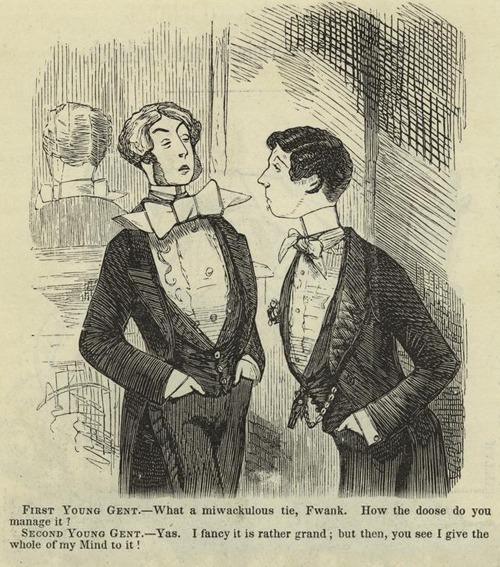
For the Gentle Readers who cannot read the text, it is as follows:
FIRST YOUNG GENT: What a miwackulous tie, Fwank, How the doose do you manage it?
SECOND YOUNG GENT: Yas. I fancy it is rather grand; but then, you see I give the whole of my Mind to it!
Fwank, you are an inspiration to us all.
Monday, October 24, 2011
Shocking
Mention has been made of Nikola Tesla, who is, quite possibly, one of the only real mad scientists to exist. How did he get his start? With cats!
Even though, later in life, Tesla spoke to pigeons, he grew up with cats and when petting his family cat, got shocked. He became interested in electricity and eventually made a 130 foot bolt of lightening from one of his Tesla coils and potentially invented a "Teleforce Beam" which shot ball lightening at 60 million volts.
Truly electrifying research, wouldn't you agree?
Even though, later in life, Tesla spoke to pigeons, he grew up with cats and when petting his family cat, got shocked. He became interested in electricity and eventually made a 130 foot bolt of lightening from one of his Tesla coils and potentially invented a "Teleforce Beam" which shot ball lightening at 60 million volts.
Truly electrifying research, wouldn't you agree?
Thursday, October 13, 2011
Heeeeeeeere's Johnny! Keats!
No one hates an author more than another author, particularly if they are authors in the same time period. (Fenimore Cooper's Literary Offenses come to mind), but few can be as sneering in prose as Lord Byron:
Lord Byron on John Keats (1820)
“Here are Johnny Keats’ piss-a-bed poetry, and three novels by God knows whom… No more Keats, I entreat: flay him alive; if some of you don’t I must skin him myself: there is no bearing the drivelling idiotism of the Mankin.”
Wednesday, October 12, 2011
Give that man a hand!
France has a complicated relationship with many of its saints, primarily because, during the French Revolution, they misplaced most of them.
Take, for example, Saint Quentin, one of France's patron saints. During the fourth century, Quentin made his way to Roman occupied Gaul to preach, where he was summarily arrested, tortured, released by angels, arrested, tortured again, etc. until he died. Since all this happened in a city that later became Amiens, Saint Quentin's remains remained in the Picardy region, eventually making their way to the city of Saint Quentin.
Several centuries later, le deluge!
Part of the French Revolution included a secularization and de-Christianizing movement and Saint Quentin's remains got moved out of their display case and into the basement. When the monarchy came back, there was some difficulty re-finding the remains and putting it back in the Basilica.
In 2009, it was discovered that whoever re-found Saint Quentin had more difficulty than expected, as the leg bones and skull fragment did indeed date from Saint Quentin's century, but his hand did not. If one travels north of Paris to Saint Quentin, one can see the leg bones and skull fragment of someone who at least came from the correct century, and the decomposed hand of apparently only God knows who.
Take, for example, Saint Quentin, one of France's patron saints. During the fourth century, Quentin made his way to Roman occupied Gaul to preach, where he was summarily arrested, tortured, released by angels, arrested, tortured again, etc. until he died. Since all this happened in a city that later became Amiens, Saint Quentin's remains remained in the Picardy region, eventually making their way to the city of Saint Quentin.
Several centuries later, le deluge!
Part of the French Revolution included a secularization and de-Christianizing movement and Saint Quentin's remains got moved out of their display case and into the basement. When the monarchy came back, there was some difficulty re-finding the remains and putting it back in the Basilica.
In 2009, it was discovered that whoever re-found Saint Quentin had more difficulty than expected, as the leg bones and skull fragment did indeed date from Saint Quentin's century, but his hand did not. If one travels north of Paris to Saint Quentin, one can see the leg bones and skull fragment of someone who at least came from the correct century, and the decomposed hand of apparently only God knows who.
Saturday, October 8, 2011
What stinks of brooding?
Subscribe to:
Posts (Atom)