Saturday, October 29, 2011

A little Halloween inspiration?


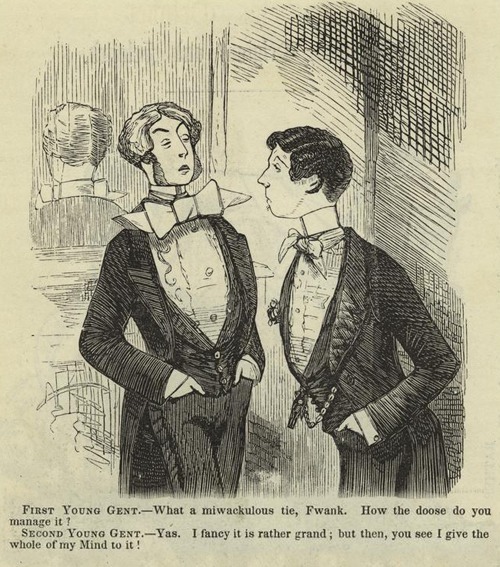
For the Gentle Readers who cannot read the text, it is as follows:

FIRST YOUNG GENT: What a miwackulous tie, Fwank, How the doose do you manage it?

SECOND YOUNG GENT: Yas. I fancy it is rather grand; but then, you see I give the whole of my Mind to it!

Fwank, you are an inspiration to us all.

Monday, October 24, 2011

Shocking

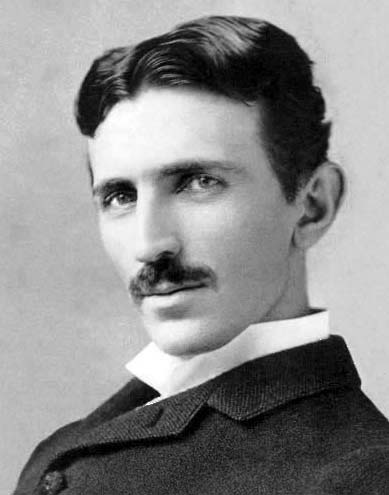
Mention has been made of Nikola Tesla, who is, quite possibly, one of the only real mad scientists to exist. How did he get his start? With cats!

Even though, later in life, Tesla spoke to pigeons, he grew up with cats and when petting his family cat, got shocked. He became interested in electricity and eventually made a 130 foot bolt of lightening from one of his Tesla coils and potentially invented a "Teleforce Beam" which shot ball lightening at 60 million volts.

Truly electrifying research, wouldn't you agree?

Thursday, October 13, 2011

Heeeeeeeere's Johnny! Keats!

No one hates an author more than another author, particularly if they are authors in the same time period. (Fenimore Cooper's Literary Offenses come to mind), but few can be as sneering in prose as Lord Byron:


Lord Byron on John Keats (1820)
“Here are Johnny Keats’ piss-a-bed poetry, and three novels by God knows whom… No more Keats, I entreat: flay him alive; if some of you don’t I must skin him myself: there is no bearing the drivelling idiotism of the Mankin.”

Wednesday, October 12, 2011

Give that man a hand!

France has a complicated relationship with many of its saints, primarily because, during the French Revolution, they misplaced most of them.

Take, for example, Saint Quentin, one of France's patron saints. During the fourth century, Quentin made his way to Roman occupied Gaul to preach, where he was summarily arrested, tortured, released by angels, arrested, tortured again, etc. until he died. Since all this happened in a city that later became Amiens, Saint Quentin's remains remained in the Picardy region, eventually making their way to the city of Saint Quentin.

Several centuries later, le deluge!

Part of the French Revolution included a secularization and de-Christianizing movement and Saint Quentin's remains got moved out of their display case and into the basement. When the monarchy came back, there was some difficulty re-finding the remains and putting it back in the Basilica.

In 2009, it was discovered that whoever re-found Saint Quentin had more difficulty than expected, as the leg bones and skull fragment did indeed date from Saint Quentin's century, but his hand did not. If one travels north of Paris to Saint Quentin, one can see the leg bones and skull fragment of someone who at least came from the correct century, and the decomposed hand of apparently only God knows who.

Saturday, October 8, 2011

What stinks of brooding?

For those Gentle Readers who have not yet seen the delightful parody of Wuthering Heights by Kate Beaton, the Amateur Historian suggests going here and here.

Saturday, September 24, 2011

Horrible Histories Madame Tussaud's Make-Up Show


The Amateur Historian will never look at ads for Madame Tussaud's with equanimity again.

Wednesday, September 21, 2011

Quite a Talent

Of all the monarchs of the eighteenth century, the one with the coolest name has got to be Queen Nanny of the Maroons. 

Most of Nanny's history was preserved orally and because of that, and the fact that she was an ex-slave who managed to free approximately 800 other slaves from British colonial rule in Jamaica have contributed to her lack of publicity.

The Maroons were a group of African ex-slaves and native inhabitants of Jamacia who understandably didn't like the whole slavery-and-stealing-land thing the British had going on. Queen Nanny was the leader of the Windward Maroons, a group that lived high in the mountains and excelled at clever attacks. Nanny managed to unite the other Maroons and successful get the British to acknowledge the land they lived on as theirs.

 By far one of the most interesting details about Nanny, other than the fact that she is now on Jamaican currency, is that she could catch bullets. Some believe that she caught them with her hands, as it was an art-form in Africa to be able to do so. The more entertaining version is that she caught bullets with her buttocks and farted them back out.

Sunday, September 18, 2011

Why We Like Edison over Tesla

Everybody loves Nikola Tesla (everyone but Thomas Edison, that is)! A quick wikipedia search lists all the products, ideas and technology that Tesla envisioned, discovered and/or created that we still use today. One of Tesla's most useful discoveries was alternating electric current.

As the Amateur Historian is an Amateur and an Historian, not any sort of scientist, she cannot tell you excatly what the difference is between Tesla's alternating electric current and Edison's direct current. Presumably the names and who discovered them? At any rate, Edison was feircely jealous of Tesla after Tesla supplied the electricity to the Wrold's Columbian Exposition at the World's Fair.

Edison reacted by electrocuting stray puppies with alternating electric current. His hypothesis that large amounts of electricity would indeed kill those it came in contact with was correct. As the public did not entirely understand alternating current (the Amateur Historian completely understands), public opinion turned against Tesla (though they did not stop using alternating current). It did not help that Telsa had mental and social problems and was afraid of round objects.

So basically, we like Thomas Edison for inventing a lot of things, but also for electrocuting elephants. It is a proud day for humanity, I am sure.

Tuesday, September 6, 2011

Some Ladies Clearly Need to Speak with Their Milliners

Gentle Readers! Do you enjoy period costumes, talking during films and being casually superior in conversation with your acquaintances? If you answered 'yes' to one of the three, or are just curious, the Amateur Historian wishes to direct you to this site, which charts which costumes and costume pieces get reused in period pieces. Have you ever wondered why, exactly, certain regency party gowns resemble each other?

It's because they are the exact same gown! Even if you do not wish to be casually smug when informing an acquaintance that Billie Piper's white gown in the new, odd adaptation of Austen's Mansfield Park by the BBC was first created for the peerless Emma Thomson in Sense and Sensibility, it is still an interesting, fun website to explore. T

he website does not focus only on period costumes, though they certainly gave the Amateur Historian a great many new historical series/films to look up, but also features modern clothes and sci-fi/fantasy costumes.

Thursday, September 1, 2011

Horrible Histories Historical Historical Wife Swap French Royal Special

During his troubled adolescence, Louis XVI also liked making courtiers chase him around his rooms in Versailles before they could ceremonially undress him, and one yanked out the earring of one of his guards with a blue sash of state. No wonder he grew up into the marvelously effective ruler remembered by French history.