
The Amateur Historian is, fortunately or unfortunately, an American and as plagued to death with the endless sufferage of the primary season as the rest of the country. However, it has given the Amateur Historian time to reflect on the necessity of a campaign slogan.
The human brain is wired for language and, in an odd turn, particularly susceptible to rhyme.
One such political rhyme destroyed the candidacy of one Henry Addington, 1rst Viscount Sidmouth in 1804. Addington, it must be admitted, did not have the greatest record while in office. He unsuccessfully attempted to sue for peace with Napoleon before giving up and declaring war on France again and was a terrible orator. Mind you, these were the days of Burke, Fox, Sheridan and Pitt, where gentlemen learnt to recite Horace in school; to be a bad orator was to be a bad politician. To be a bad politician meant one could not rally MPs to one's cause and therefore to lose one's bills and, thereafter, to lose the trust of the king.
When compared to Pitt's successions of pan-European coalitions, his renowned oratory and his successful management of the Houses of Parliament, Addington looked a poor figure indeed, giving rise to the epigram:
"London is to Paddington
as Pitt is to Addington."
Showing posts with label Pitt the Younger. Show all posts
Showing posts with label Pitt the Younger. Show all posts
Wednesday, April 4, 2012

Thursday, December 1, 2011
The Hotness of King George
Apparently the Amateur Historian is not the only William Pitt the Younger fan out there.
Saturday, August 13, 2011
Giddup
As mentioned in an earlier post this week, Pitt the Younger's favorite way of spending the evening was to drink three bottles of port with his close friends and cabinet ministers. His favorite drinking partner was Dundas, who could not quite match Pitt's three bottles, but not from lack of effort.
During what seems to be one particularly memorable dinner party hosted by Charles Jenkinson in Croydon, Pitt and Dundas decided that they were sober enough to ride.
They were not.
The Prime Minister of England and the most famous Scottish MP of the time took it into their heads to gallop through an open toll gate separating Streatham and Tooting, and were shot at by the toll keeper.
Talk about taking a shot at greatness....
During what seems to be one particularly memorable dinner party hosted by Charles Jenkinson in Croydon, Pitt and Dundas decided that they were sober enough to ride.
They were not.
The Prime Minister of England and the most famous Scottish MP of the time took it into their heads to gallop through an open toll gate separating Streatham and Tooting, and were shot at by the toll keeper.
Talk about taking a shot at greatness....
Thursday, August 11, 2011
Bunga bunga certainly sounds like a nonsense word
In a world of bunga-bunga parties with minors and Prime Ministers as the main guests, the Amateur Historian finds it something of a relief to turn from Berlusconi's antics to William Pitt the Younger's.
Pit the Younger was notoriously uninterested in women, his one "fling" with Eleanor Eden ending with an oft-examined letter explaining to her father, Lord Auckland, why they couldn't be married. Though that is the subject of another post (the Amateur Historian is sure her Gentle Readers will be thrilled with a quasi-scholarly examination of Pitt the Younger's sexuality or lack thereof), Pitt's own parties were, to be quite honest, not very good. Pitt's idea of a wild evening was to drink three bottles of port with Dundas, Wilberforce or any of his other ministers in attendance, and then to rehearse Parliamentary debates. Slow down, wild man!
Part of this has to do with the early death of his beloved sister, Harriot, in 1785. Her role as his political hostess forced him out of his customary reserve and extreme shyness and, at her death, Pitt was left to the mercies of the Duchess of Gordon. To say that Pitt very soon disliked the Duchess of Gordon, who called him "pet" and tried to set him up with her daughter Charlotte, may be summed up in the following exchange:
Duchess of Gordon: Well, Mr. Pitt, do you talk as much nonsense now as you used to when you lived with me?
Pitt the Younger: I do not know, madam, whether I talk so much nonsense, I certainly do not hear so much."
Pit the Younger was notoriously uninterested in women, his one "fling" with Eleanor Eden ending with an oft-examined letter explaining to her father, Lord Auckland, why they couldn't be married. Though that is the subject of another post (the Amateur Historian is sure her Gentle Readers will be thrilled with a quasi-scholarly examination of Pitt the Younger's sexuality or lack thereof), Pitt's own parties were, to be quite honest, not very good. Pitt's idea of a wild evening was to drink three bottles of port with Dundas, Wilberforce or any of his other ministers in attendance, and then to rehearse Parliamentary debates. Slow down, wild man!
Part of this has to do with the early death of his beloved sister, Harriot, in 1785. Her role as his political hostess forced him out of his customary reserve and extreme shyness and, at her death, Pitt was left to the mercies of the Duchess of Gordon. To say that Pitt very soon disliked the Duchess of Gordon, who called him "pet" and tried to set him up with her daughter Charlotte, may be summed up in the following exchange:
Duchess of Gordon: Well, Mr. Pitt, do you talk as much nonsense now as you used to when you lived with me?
Pitt the Younger: I do not know, madam, whether I talk so much nonsense, I certainly do not hear so much."
Friday, August 28, 2009
Canning, How Could You?
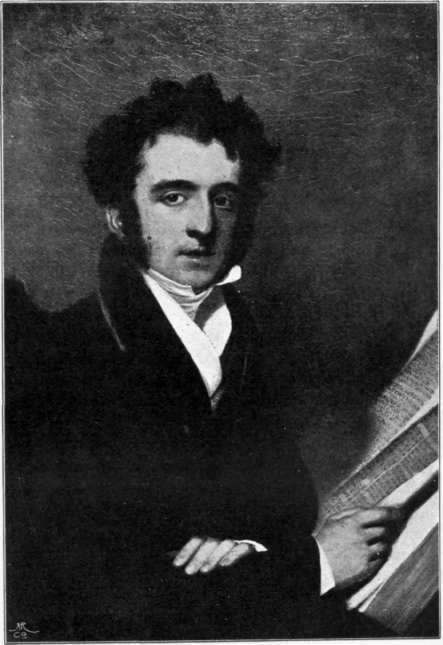 Pitt was naturally reserved and called himself "the shyest man alive", so he spent a great deal of time listening to speeches made in the House or in the committees without saying a word or allowing the speaker to approach him. Though this annoyed the House and the committees, it allowed Pitt to display his remarkable capacity for spotting political talent. Of the hundreds of MPs Pitt convinced to either join Parliament to begin with, or to vote along with Pitt's policies, there were two future Prime Ministers and five future Cabinet Ministers. Pitt's ministry in the 1790s even included four of the five Prime Ministers that would take up office after Pitt had left it.
Of course, Pitt focused almost solely on political accumen and not personality. He was not inclined to expand his social circle, he disliked having to meet new people and be friendly to them and resented any intrusion of his privacy by people he a. did not know or b. did not wish to know better. One of these people was George Canning, who, after being discovered by Pitt, developed a devotion to the Prime Minister that bordered on fanatical. Pitt eventually warmed to him, but it took several years for Pitt to consider him a friend, and Pitt was occasionally thrown by Canning's enthusiasm.
At one point, Canning did the unthinkable and touched Pitt on the shoulder in the House of Commons. The other MPs were shocked, Pitt was alarmed and Canning was forced to defend himself in his journal:
"Once I was seen, when I wanted to speak with him, and he was looking another way, to put my hand on his shoulder. How can you conceive a more silly thing to trouble people's heads than this? ... I know indeed that I have, with people whom I like, old or young, great or small, something of a caressing manner... and so have a great many other people--a great many have it not... they consider Mr. Pitt, naturally enough, as one of the latter class, the non-shakers--whereas he is in fact a very hearty, salutation-giving, shake hands sort of person--and one therefore whom I feel it is natural to take by the arm, or to touch upon the shoulder even (which is the great offence)... But if it be wrong it must be altered."
Pitt made it clear that it must be altered and Canning did not touch him on the shoulder again.
Thursday, June 4, 2009
Political beef, it's what's for dinner

Sheridan could be quite the wit in Parliament when he wanted to be (Old Sherry aside).
During the French Revolution, there was a massive governmental backlash against the democratic societies springing up around the country. Pitt ignored them until around 1793, when Britain and France declared war on each other. This was fantastic news for people like Edmund Burke, who spent pretty much all of his time in Parliament railing about the French mob and how dangerous revolutions were. Burke decided to talk about the revolutionary societies springing up around the country, shortly after Pitt gave his reluctant assent to the war (Tangent Time! Pitt wanted to focus on Britain's economic troubles instead of meddling in continental politics; part of what sparked the French Revolution were several years of very bad harvests. The French government actually begged Pitt to send over 20,000 sacks of flour, and Pitt refused, on the grounds that the British public would riot if there wasn't enough flour. The French rioted instead. I think--please be aware, Gentle Readers, that this is once again the opinion of an Amateur Historian--that Pitt's insistance on paying British allies to fight the French during the first coallition against the French was a sign of Pitt's lingering reluctance to start up a war.)
Burke was convinced that these societies were planning a British Revolution (which some of them were) and had stockpiled weapons (which most of them were not, save for the revolutionary groups in Ireland). He quite suddenly threw a dagger onto the floor of the House of Commons shouting, "There is French fraternity for you! This is the poignard which French Jacobins would plunge in the heart of our sovereign."
Sheridan brought a premature end to the speech by quipping, "Where's the fork?"
Thursday, May 14, 2009
No Love Lost, Then
Charles James Fox on William Pitt the Younger: "All he knows of love is a description he got from The Illiad."
Ouch.
Ouch.
Wednesday, May 13, 2009
Yet Another Funny Portrait Story

This particular Funny Portrait Story (of which the Amateur Historian now recollects there are several) is also an installment of Funny Things that Happened to Pitt the Younger.
The landscapist Sir Francis Bourgeois once told the diariest Joseph Farington that, he, Sir Francis, had once
"Called on [Gainsborough] and saw a half-length portrait, and was struck with the haughty expression of the countenance, and observed it to Gainsborough, who expressed satisfaction at the remark, as it proved that He had hit the Character. Gainsborough said that it was a portrait of Mr. Pitt, who He said came the day before to sit for his picture and on coming into the painting room sat down in the painter’s chair and began to read.
Gainsborough, struck with the hauteur and disrespectful manner of Mr. Pitt treated him in this way.- He took up his pallet and seeming to be trifling among his Colors, began carelessly to hum toll, roll de roll, on hearing which Mr. Pitt recollected himself shut his book, and sat in a proper manner."
Thursday, May 7, 2009
Strong tea and scandal-- Bless me, how refreshing!

Tea is, today, a quintessential part of British identity but, until 1784, it was reserved solely for the upper classes.
The British upper classes first began to take tea in approximately 1645, when the East India Trading Company began importing it. Britain had a total monopoly on the leaf and thus, it was rare and terribly expensive... made even more so by the 119% tax on it. Thank you King Charles I's parliament. Though tea remained expensive (and locked away in little silver caddies made especially for the purpose), it gradually became part of the lives of most citizens of the British empire (see the Boston Tea Party, for evidence of this).
Tea really entered into the life of the average Brit thanks to (you guessed it!) William Pitt the Younger, who reduced the tax to 12%, making tea affordable to everyone and thus a part of the British national identity. And also making him a hero to the tea-loving Amateur Historian.
Friday, May 1, 2009
Man, being reasonable, must get drunk....

In the Georgian and Regency period of history people tended to drink a lot. As Byron wrote in his satiric masterpiece, Don Juan:
Let us have wine and women, mirth and laughter,
Sermons and soda-water the day after.
Man, being reasonable, must get drunk;
The best of life is but intoxication:
Glory, the grape, love, gold, in these are sunk
The hopes of all men, and of every nation;
Without their sap, how branchless were the trunk
Of life's strange tree, so fruitful on occasion:
But to return,—Get very drunk; and when
You wake with headache, you shall see what then.
Ring for your valet—bid him quickly bring
Some hock and soda-water, then you'll know
A pleasure worthy Xerxes the great king;
For not the bless'd sherbet, sublimed with snow,
Nor the first sparkle of the desert-spring,
Nor Burgundy in all its sunset glow,
After long travel, ennui, love, or slaughter,
Vie with that draught of hock and soda-water.
Byron added flair to his claret-quaffing by drinking out of the skull of a mediveal monk. Keats apparently liked to take a pinch of cayenne pepper and put it on the tip of his tongue before knocking back his claret. Though claret appears to be the standard drink of the Romantic poets (aside from laudanum, which pretty much everyone drunk, according to Thomas de Quincey), port was the drink of politicians.
When William Pitt the Younger was fourteen, the Pitt family doctor advised Pitt to treat his inherited gout with a bottle of port a day. Pitt apparently liked port a great deal because Pitt soon had a reputation of downing three bottles a day. He often had late night drinking parties with one of his ministers, Dundas, a fact which gave rise to a popular epigram:
Pitt: I cannot see the Speaker, Hal; can you?
Dundas: Not see the Speaker, Will? Why I see two!
Pitt, however, rarely appeared the worse for drink until the very end of his life, when his alcoholism significantly contributed to his state of constant ill-health. When he was younger, however, he did not have this problem. One day Pitt walked into the House of Commons, more full of port than a liquor store and promptly vomited in the antechamber. He then took the floor and perfectly delivered a speech. The Amateur Historian is not quite sure on what, but, considering Pitt had drunk enough to vomit in the antechamber, she is impressed that Pitt was even able to stay conscious, let alone make parlimentary orations.
Sunday, April 19, 2009
Pitt and Mademoiselle Necker

Lauren's post on Mme Necker reminded me of yet another amusing incident in the life of William Pitt the Younger. While on his one vacation to the Continent, William Pitt the Younger visited Paris with William Wilberforce and his brother-in-law to be, Edward Elliot. Pitt's father, the Earl of Chatham, was extremely popular and Pitt met with a number of French officals, including Jacques Necker, the Finance Minister to Louis XVI. Pitt made quite an impression. Mme Necker became dead-set on having Pitt as a son-in-law, since Pitt had become an MP at 21, the Chancellor of the Exchequer at 23 and looked to be the Prime Minister at 24.
Mademoiselle Germaine Necker, was not quite so impressed. Mlle Necker, later Mme de Stael, was said to have refused because it would have meant being away from, what were at the time, the two great loves of her life (aka Paris and Papa)-- a fate worse than death.
William Pitt the Younger either brushed off this rejection or refused the idea of marrying Germaine Necker by saying, "I am already married to my country." The Amateur Historian reads this as a sign of Pitt's workaholic nature, his recognition that Germaine Necker was far too much for him a handle, a possible sign that he was quite piqued at Germaine Necker's total dismissal of his suit and his usual self-awareness and self-knowledge, as Pitt later refused to marry in 1797 because he didn't think it fair on any woman to be married to a man "who could not give a proper share of time to his wife, for how would it be if he was always at the House, or in business, and she always at the opera, or whiling about in her carriage" (from Lady Hester Stanhope's Memoirs, vol. 1, p. 180).
Other historians, however, have taken this to be a sign of Pitt's homosexuality. History is a strange field.
Monday, April 13, 2009
Aren't you glad we have anaesthesia?

Shortly after his election to the office of Prime Minister, William Pitt was discovered to have encysted tumor on his cheek that needed to be surgically removed. Surgery was always dicey in a pre-anaesthetic age. It was intensely painful and, as anyone who has seen The Madness of King George knows, 18th century medicine was often terribly detrimental to the patient.
However, Pitt had famous self-mastery and self-control. He refused to have his hands tied, as was usual during surgeries, to keep the patient from pushing away the knife or otherwise increasing the damage and pain of an already agonizing operation. He assured his surgeon, one John Hunter, that he would not move and it would therefore be unnecessary to tie his hands. Dr. Hunter informed Pitt that the surgery would take six minutes, to which Pitt had the somewhat unusal reaction of sitting down very calmly and staring out the window of 10 Downing Street at the Horse Guards' clock across the way.
He remained perfectly motionless until it was over, at which point he very cheerfully remarked, "You have exceeded your time by half a minute."
Monday, March 30, 2009
Color Coded for Your Convenience!

Clothes were as essential a part of the Georgian political system as they are today. Every politician must be well dressed and know their political colors. Though there were no acrimonious debates over flag lapel pins, King Louis XVI managed to save the lives of himself and his family by agreeing to wear a revolutionary Phyrigan cap and a tricolor cockade. Fashion was an integral part of the political process.
The Whigs, a group which supported a more oligarchial form of rule with power mostly in the hands of the aristocracy, but which also included republican radicals like Thomas Paine, wore buff and blue. These were the colors of the American Revolutionary Army's uniforms. Most Whig leaders wore buff knee-breeches or waistcoats and a blue coat in their offical portraits. See the portrait of Sheridan on the left.

The Tories, a more conservative group which supported the power of the monarchy, wore green. This was the color of the uniform of the British dragoons, again, from the war of the American Revolution. See the portrait of Banastre Tarleton to the right.
Where does leave Pitt the Younger, below, in black, you may ask? Pitt considered himself an independant Whig for most of his life, which meant that he was a stickler for the constitution and prefered a balance of power between the aristocracy and the monarchy. He also, according to contemporary reports, did not have much time or inclination to devote himself to following fashion, and wore black because it hid inkstains the best.

Monday, March 16, 2009
An Unholy Alliance

In 1783, Pitt the Younger, then only 23, declined the king's offer to become Prime Minister, on the grounds that he could not possibly muster enough support in Parliament. The king expressed himself movingly, if not gramatically, in the one-sentance missive: "I am much hurt to find you determined to decline at an hour when those who have any regard for the Constitution as established by law ought to stand forth against the most daring and most unprincipled faction to stand forth that the annals of this Kingdom ever produced!"
This threat to the constitution was the "marriage" of Charles James Fox and Lord North, two politicians who had next to nothing in common except a desire to be on the Cabinet. The alliance of these two politicians gained the necessary majority in Parliament and thus would force the king, who had the consitutional right to ask any member of Parliament he thought likely to gain a majority to be Prime Minister, or, as it was then called, First Lord of the Treasury, to put them in power.
Pitt had once been one of Fox's disciples, but was disgusted at what we would term "selling out" and from then on considered himself an independant Whig. Quoth Pitt, "If this ill-omened marriage is not already solennized, I know a just and lawful impediment, and, in the name of public safety, I here forbid the bans."
However, Pitt, as the representative of the rotten borough of Appleby, had little clout with Parliament and the Duke of Portland was appointed as a do-nothing Prime Minister, with Fox and North as Secretaries of State. The king reportedly could not be cheered and attempted to abdicate but, struck with horror at the prospect of the Prince of Wales becoming king, contented himself to writing increasingy desperate letters to Pitt.
Friday, February 20, 2009
Uncorking Old Sherry

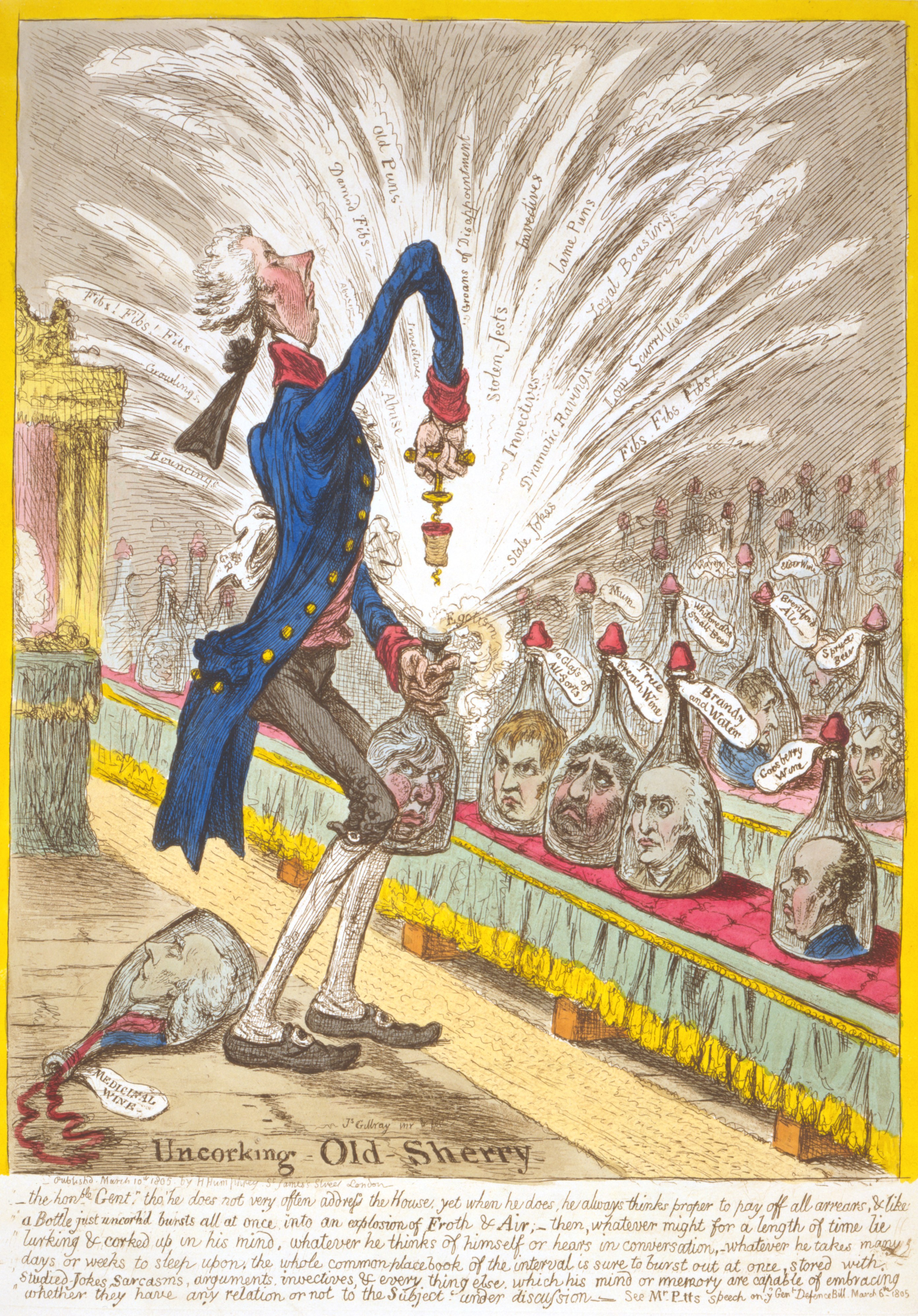
It has been far too long since the Amateur Historian has paid homage to the man whose name graces the title of this blog. This particular print, drawn on March 10, 1805, is not only a witty satire against Richard Brinsley Sheridan, a playwright (he wrote the charming and wickedly witty School for Scandal of which there are very few adaptations and, alas, fewer decent ones), owner of the Drury Lane Theatre and Whig politician, but also another installment of Funny Things That Happened to Pitt the Younger.
In 1805, Pitt the Younger was in the first year of his second term as Prime Minister, after having retired for two years due to ill-health and the king's knee-jerk reactionism to Catholic Emancipation and Napoleon was gleefully conquering the Continent. He was brought back because the previous Prime Minister, Addington (in the print lying spilled on the floor; he's labeled 'medicinal wine' because he was the son of a doctor) was deeply unpopular for his incompetence in trying to get Napoleon to agree to an armistice and then sticking to it. Pitt therefore introduced a bill to change the recruiting policy for the Army, causing Sheridan to get up and gave a long and rambling speech about nothing in particular.
This very well might be one of the Amateur Historian's favorite Pitt the Younger moments, as Pitt responded by criticizing Sheridan's use of rhetoric, complimenting Sheridan on 'his extraordinary powers of imagination and of fancy' and then comparing Sheridan's oratory to 'a bottle just uncorked [which] bursts all at once into an explosion of froth and air. All that his own fancy can suggest or that he has collected from others; all that he can utter in the ebullition of the moment; all that he has slept on and studied are combined and produced for our entertainment...and out it comes altogether, whether or not it has any, even the smallest relation to the subject in debate.'
This print, of which Sheridan himself bought six copies, has Pitt, still thin from ill-health "Uncorking Old Sherry", i.e. quite literally taking the cork out of a bottle with Sheridan's face in it. The bottle spews forth invective, stolen jests, lame puns, dramatic ravings, egotism, damned fibs, groans of disappointment and the like. Behind Sheridan are all the other members of the Whig party, capped with a bonnet rogue and labeled based on their political opinions or their place of origin. For a better copy of the print and to read Pitt the Younger's scathingly witty comparison of Sheridan to an uncorked bottle (written under the print itself) click here.
Thursday, January 15, 2009
Pitt the Younger Goes Grouse Shooting
Funny things tended to happen to Pitt the Younger when he was, well... younger. It is possible that this was because Pitt, who was a notorious drinker, could outdrink most university students and often led his college friends in drunken routs. At one point in time, Pitt instigated a practical joke by stealing a friend's top hat during a house party at William Wilberforce's villa in Wimbleton, cutting the hat to pieces and then planting the pieces in the garden.

The Amateur Historian is sure the joke made more sense when drunk.
However, one of the most amusing of his university experiences had to be when he was invited to the country estate of his friend, Henry Bankes, along with William Wilberforce and a number of others. Pitt readily accepted this invitation, as he was a younger son without a country estate and London (this was at the beginning of the industrial revolution, and also at a point where London was one of the msot populated cities on the planet) was said to be deadly in the summer. While they were there, Pitt and his friends engaged in some grouse shooting.

No record remains of what they shot, except that the short-sighted Wilberforce took aim at Pitt and nearly shot him in the head by mistake.
Grouse shooting later came back to haunt Pitt the Younger; in 1797, his bill to introduce some regulation and social security for child laborers failed when the MPs decided they'd rather debate grouse-shooting insted.
Wilberforce got the worst end. For the rest of his life, his friends teased him for having taken "a shot a greatness" and missed.
Tuesday, January 6, 2009
Pitt the Younger Has Fun Times in France
 History can be fascinating for a variety of reasons. This Amateur Historian must admit to her Gentle Readers that part of her fascination with the 18th century is thanks to her fascination with Prime Minister William Pitt the Younger. Why yes, Gentle Reader, you have found the only Pitt the Younger fangirl this Amateur Historian knows about, though she would be glad to start a club.
To the below right you have Gainsborough's stately portrait of a Prime Minister in perfect control of both himself and his elegant setting (note the neatness of Pitt's attire and how the line of the pen matches the line of his right arm- very orderly is the young Mr. Pitt) and to the upper left you have Gillray's less than flattering print of Pitt the Younger as a "An Excrescence; – a Fungus; – alias – a Toadstool upon a Dung-hill", as Gillray believed Pitt's power to stem solely from rotten Royal Favor. Note the rosy nose, which is a pot-shot at Pitt's habit of drinking three bottles of port a day.

William Pitt the Younger became Prime Minister of Great Britain at 24, a position he held (except for two years) until his death, which not only makes him the youngest Prime Minister in history, but also one with the second longest term in office. Many people, including Pitt himself, who was and MP at 21 and Chancellor of the Exchequer at 23, were quite surprised when George III tried to bully Pitt into taking office in 1782, just as Pitt was about to complete his gentlemanly education by taking a Grand Tour of the Continent with two of his friends, William Wilberforce (who spearheaded the British Abolition movement) and Edward Eliot (who later married one of Pitt’s sisters).
Being bullied by a monarch is enough to put anyone into a tizzy, which is probably why none of these gentlemen thought to get a letter of introduction. In the 1780s, letters of introduction served not only as a passport into a country, but a passport into society. The three gentlemen managed to secure a letter to a certain Monsieur Coustier in Rheims, just before they had to leave England.
In the words of Mr. William Wilberforce: “From Calais we made directly for Rheims, and the day after our arrival dressed ourselves unusually well, and proceeded to the house of Mons. Coustier to present, with not a little awe, our only letters of recommendation. It was with some surprise that we found Mons. Coustier behind a counter distributing figs and raisins. I had heard that it was very usual for gentlemen on the continent to practice some handicraft trade or other for their amusement [Marie Antoinette liked pretending to be a milkmaid, herself], and therefore for my own part I concluded that his taste was in the fig way, and that he was only playing at grocer for his diversion; and, viewing the matter in this light, I could not help admiring the excellence of his imitation; but we soon found that Mons. Coustier was a ‘véritable epicier,’ and that not a very eminent one.”
They thus spent what one can assume was an extremely boring week at Rheims, since their friend the grocer did not even sell figs to the local aristocracy and could not introduce them to anyone. Since they spoke no French (Wilberforce had slacked off at Cambridge, Eliot had studied law, not languages, and Pitt had studied classical languages like Greek and Latin which, though helpful for becoming a famous Parliamentary orator, was of no practical value in Rheims) and kept to themselves, they were almost arrested as spies.
Fortunately for them, the bishop of Rheims know Pitt the Elder, the late Earl of Chatham/Pitt’s now-dead father, and took them in as guests, causing Mr. Wilberforce to note: “N.B. Archbishops in England are not like Archeveques in France; these last are jolly fellows of about forty years of age, who play at billiards, &c. like other people”.
Sage words, Mr. Wilberforce, sage words.
Thus concludes the first part of what will be an admittedly long series on Funny Things That Happened to Pitt the Younger.

William Pitt the Younger became Prime Minister of Great Britain at 24, a position he held (except for two years) until his death, which not only makes him the youngest Prime Minister in history, but also one with the second longest term in office. Many people, including Pitt himself, who was and MP at 21 and Chancellor of the Exchequer at 23, were quite surprised when George III tried to bully Pitt into taking office in 1782, just as Pitt was about to complete his gentlemanly education by taking a Grand Tour of the Continent with two of his friends, William Wilberforce (who spearheaded the British Abolition movement) and Edward Eliot (who later married one of Pitt’s sisters).
Being bullied by a monarch is enough to put anyone into a tizzy, which is probably why none of these gentlemen thought to get a letter of introduction. In the 1780s, letters of introduction served not only as a passport into a country, but a passport into society. The three gentlemen managed to secure a letter to a certain Monsieur Coustier in Rheims, just before they had to leave England.
In the words of Mr. William Wilberforce: “From Calais we made directly for Rheims, and the day after our arrival dressed ourselves unusually well, and proceeded to the house of Mons. Coustier to present, with not a little awe, our only letters of recommendation. It was with some surprise that we found Mons. Coustier behind a counter distributing figs and raisins. I had heard that it was very usual for gentlemen on the continent to practice some handicraft trade or other for their amusement [Marie Antoinette liked pretending to be a milkmaid, herself], and therefore for my own part I concluded that his taste was in the fig way, and that he was only playing at grocer for his diversion; and, viewing the matter in this light, I could not help admiring the excellence of his imitation; but we soon found that Mons. Coustier was a ‘véritable epicier,’ and that not a very eminent one.”
They thus spent what one can assume was an extremely boring week at Rheims, since their friend the grocer did not even sell figs to the local aristocracy and could not introduce them to anyone. Since they spoke no French (Wilberforce had slacked off at Cambridge, Eliot had studied law, not languages, and Pitt had studied classical languages like Greek and Latin which, though helpful for becoming a famous Parliamentary orator, was of no practical value in Rheims) and kept to themselves, they were almost arrested as spies.
Fortunately for them, the bishop of Rheims know Pitt the Elder, the late Earl of Chatham/Pitt’s now-dead father, and took them in as guests, causing Mr. Wilberforce to note: “N.B. Archbishops in England are not like Archeveques in France; these last are jolly fellows of about forty years of age, who play at billiards, &c. like other people”.
Sage words, Mr. Wilberforce, sage words.
Thus concludes the first part of what will be an admittedly long series on Funny Things That Happened to Pitt the Younger.
Subscribe to:
Posts (Atom)