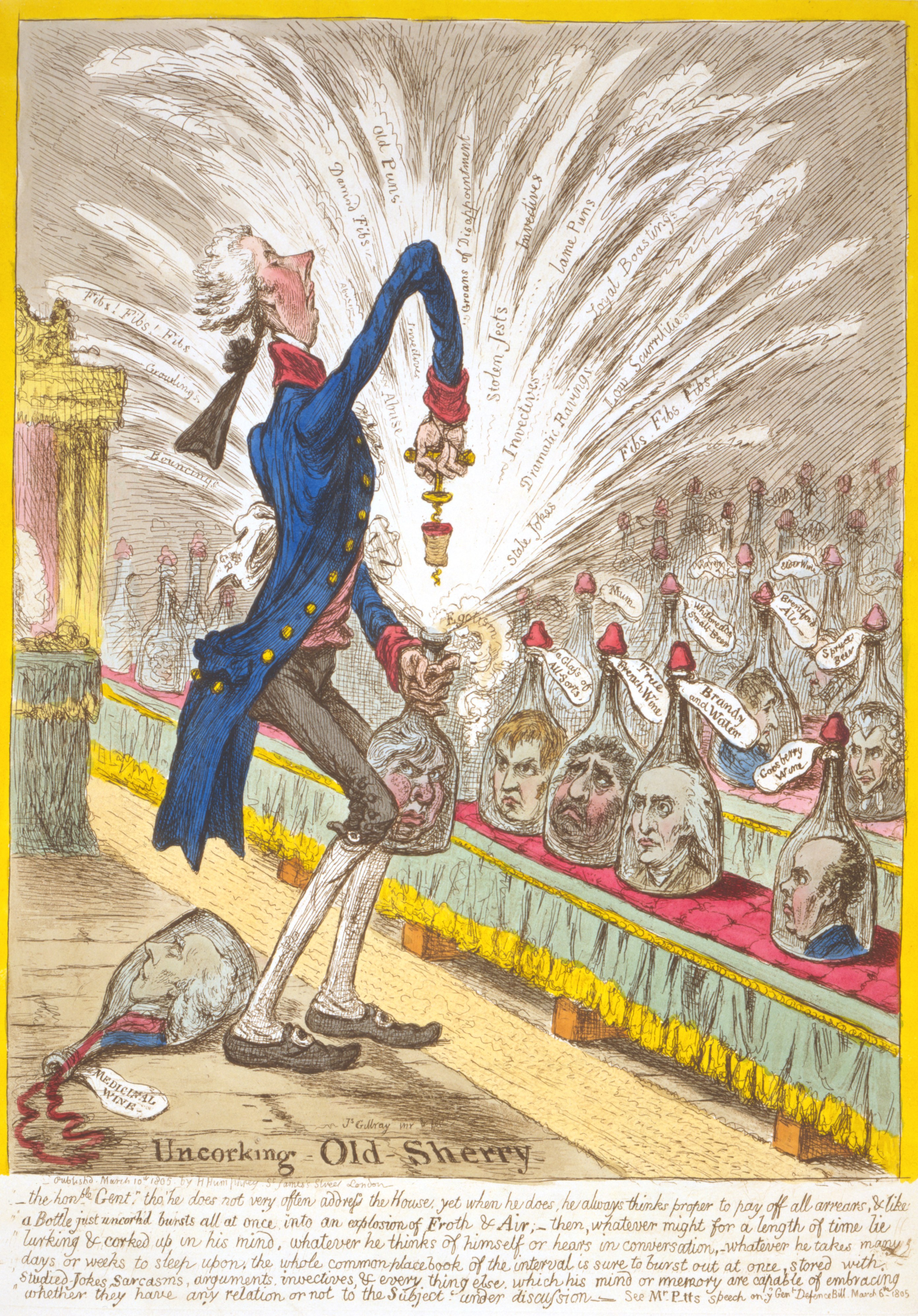
It has been far too long since the Amateur Historian has paid homage to the man whose name graces the title of this blog. This particular print, drawn on March 10, 1805, is not only a witty satire against Richard Brinsley Sheridan, a playwright (he wrote the charming and wickedly witty School for Scandal of which there are very few adaptations and, alas, fewer decent ones), owner of the Drury Lane Theatre and Whig politician, but also another installment of Funny Things That Happened to Pitt the Younger.
In 1805, Pitt the Younger was in the first year of his second term as Prime Minister, after having retired for two years due to ill-health and the king's knee-jerk reactionism to Catholic Emancipation and Napoleon was gleefully conquering the Continent. He was brought back because the previous Prime Minister, Addington (in the print lying spilled on the floor; he's labeled 'medicinal wine' because he was the son of a doctor) was deeply unpopular for his incompetence in trying to get Napoleon to agree to an armistice and then sticking to it. Pitt therefore introduced a bill to change the recruiting policy for the Army, causing Sheridan to get up and gave a long and rambling speech about nothing in particular.
This very well might be one of the Amateur Historian's favorite Pitt the Younger moments, as Pitt responded by criticizing Sheridan's use of rhetoric, complimenting Sheridan on 'his extraordinary powers of imagination and of fancy' and then comparing Sheridan's oratory to 'a bottle just uncorked [which] bursts all at once into an explosion of froth and air. All that his own fancy can suggest or that he has collected from others; all that he can utter in the ebullition of the moment; all that he has slept on and studied are combined and produced for our entertainment...and out it comes altogether, whether or not it has any, even the smallest relation to the subject in debate.'
This print, of which Sheridan himself bought six copies, has Pitt, still thin from ill-health "Uncorking Old Sherry", i.e. quite literally taking the cork out of a bottle with Sheridan's face in it. The bottle spews forth invective, stolen jests, lame puns, dramatic ravings, egotism, damned fibs, groans of disappointment and the like. Behind Sheridan are all the other members of the Whig party, capped with a bonnet rogue and labeled based on their political opinions or their place of origin. For a better copy of the print and to read Pitt the Younger's scathingly witty comparison of Sheridan to an uncorked bottle (written under the print itself) click here.