Showing posts with label Sheridan. Show all posts

Thursday, June 4, 2009

Political beef, it's what's for dinner


Sheridan could be quite the wit in Parliament when he wanted to be (Old Sherry aside).

During the French Revolution, there was a massive governmental backlash against the democratic societies springing up around the country. Pitt ignored them until around 1793, when Britain and France declared war on each other. This was fantastic news for people like Edmund Burke, who spent pretty much all of his time in Parliament railing about the French mob and how dangerous revolutions were. Burke decided to talk about the revolutionary societies springing up around the country, shortly after Pitt gave his reluctant assent to the war (Tangent Time! Pitt wanted to focus on Britain's economic troubles instead of meddling in continental politics; part of what sparked the French Revolution were several years of very bad harvests. The French government actually begged Pitt to send over 20,000 sacks of flour, and Pitt refused, on the grounds that the British public would riot if there wasn't enough flour. The French rioted instead. I think--please be aware, Gentle Readers, that this is once again the opinion of an Amateur Historian--that Pitt's insistance on paying British allies to fight the French during the first coallition against the French was a sign of Pitt's lingering reluctance to start up a war.)

Burke was convinced that these societies were planning a British Revolution (which some of them were) and had stockpiled weapons (which most of them were not, save for the revolutionary groups in Ireland). He quite suddenly threw a dagger onto the floor of the House of Commons shouting, "There is French fraternity for you! This is the poignard which French Jacobins would plunge in the heart of our sovereign."

Sheridan brought a premature end to the speech by quipping, "Where's the fork?"

Wednesday, May 27, 2009

Zing!


Richard Brinsley Sheridan was as famous for his plays as he was for his liberal opinion and was equally as famous for his wit. Sheridan was strolling through Piccadilly Square one day when he met up with two English lords. They decided to join him on his walk and took a position on either side of him.

"I say, Sherry," said one of the lords. "We were just discussing whether you were a rogue or a fool."

Sheridan immediately linked arms with both men and replied, "Why, I do believe I am between both."

Monday, March 30, 2009

Color Coded for Your Convenience!


Clothes were as essential a part of the Georgian political system as they are today. Every politician must be well dressed and know their political colors. Though there were no acrimonious debates over flag lapel pins, King Louis XVI managed to save the lives of himself and his family by agreeing to wear a revolutionary Phyrigan cap and a tricolor cockade. Fashion was an integral part of the political process.

The Whigs, a group which supported a more oligarchial form of rule with power mostly in the hands of the aristocracy, but which also included republican radicals like Thomas Paine, wore buff and blue. These were the colors of the American Revolutionary Army's uniforms. Most Whig leaders wore buff knee-breeches or waistcoats and a blue coat in their offical portraits. See the portrait of Sheridan on the left.


The Tories, a more conservative group which supported the power of the monarchy, wore green. This was the color of the uniform of the British dragoons, again, from the war of the American Revolution. See the portrait of Banastre Tarleton to the right.

Where does leave Pitt the Younger, below, in black, you may ask? Pitt considered himself an independant Whig for most of his life, which meant that he was a stickler for the constitution and prefered a balance of power between the aristocracy and the monarchy. He also, according to contemporary reports, did not have much time or inclination to devote himself to following fashion, and wore black because it hid inkstains the best.

Thursday, March 19, 2009

Bad Luck O'The Irish

A belated happy St. Patrick's Day to you all, and, in honor of this, here is another historical tidbit about one famous Irish playwright (all the famous British playwrights, save Shakespeare, seem to be Irish, though this Amateur Historian could not tell you why the Blarney Stone proves so inspirational to stage dramas), Richard Brinsley Sheridan.

Sheridan, portrayed as a dynamic figure by Reynolds, to the left, was an infamous womanizer. This caused his first wife Elizabeth Linley, portrayed as such a natural beauty she seems part of her surroundings by Gainsborough, to the right, considerable pain. The fact that Elizabeth was considered one of the finest singers and most beautiful women of the late 18th century did not seem to stop Sheridan. Though affairs were common and acceptable as long as they were discreet, Sheridan had a bad habit of being caught in flagrante. The woman Sheridan appears to have loved the most devotedly, Harriet Spenser Bessborough, Lady Duncannon, was caught with Sheridan by her husband, who then attempted to introduce divorce proceedings. Considering that Lord Duncannon did not notice when his wife was pregnant with Lord Granville Leveson-Gower's children later on does not speak to Lord Duncannon's powers of observation or to Sheridan's discretion.


Soon after being caught out, Lady Duncannon, terrified of the social ostracism brought on by divorce, ended the affair. Sheridan returned to his wife, who was staying with friends at Crewe Hall, and begged forgiveness. Sheridan seems to have had luck as bad as his judgment, as Mrs. Sheridan wrote a few days later:

"Can you believe it possible that at the very time when Sheridan was pleading for forgiveness from me on this account, before it was certain that it would be hushed up, at the moment almost in which he was swearing and imprecating all sorts of curses on himself on me and his child, if ever he was led away by any motive to be false to me again, he threw the whole family at Crewe into confusion and distress by playing the fool with Miss FD [the governess] and contriving so awkwardly too, as to be discovered by the whole house, locked up with her in a bed chamber in an unfrequented part of the house."

Friday, February 20, 2009

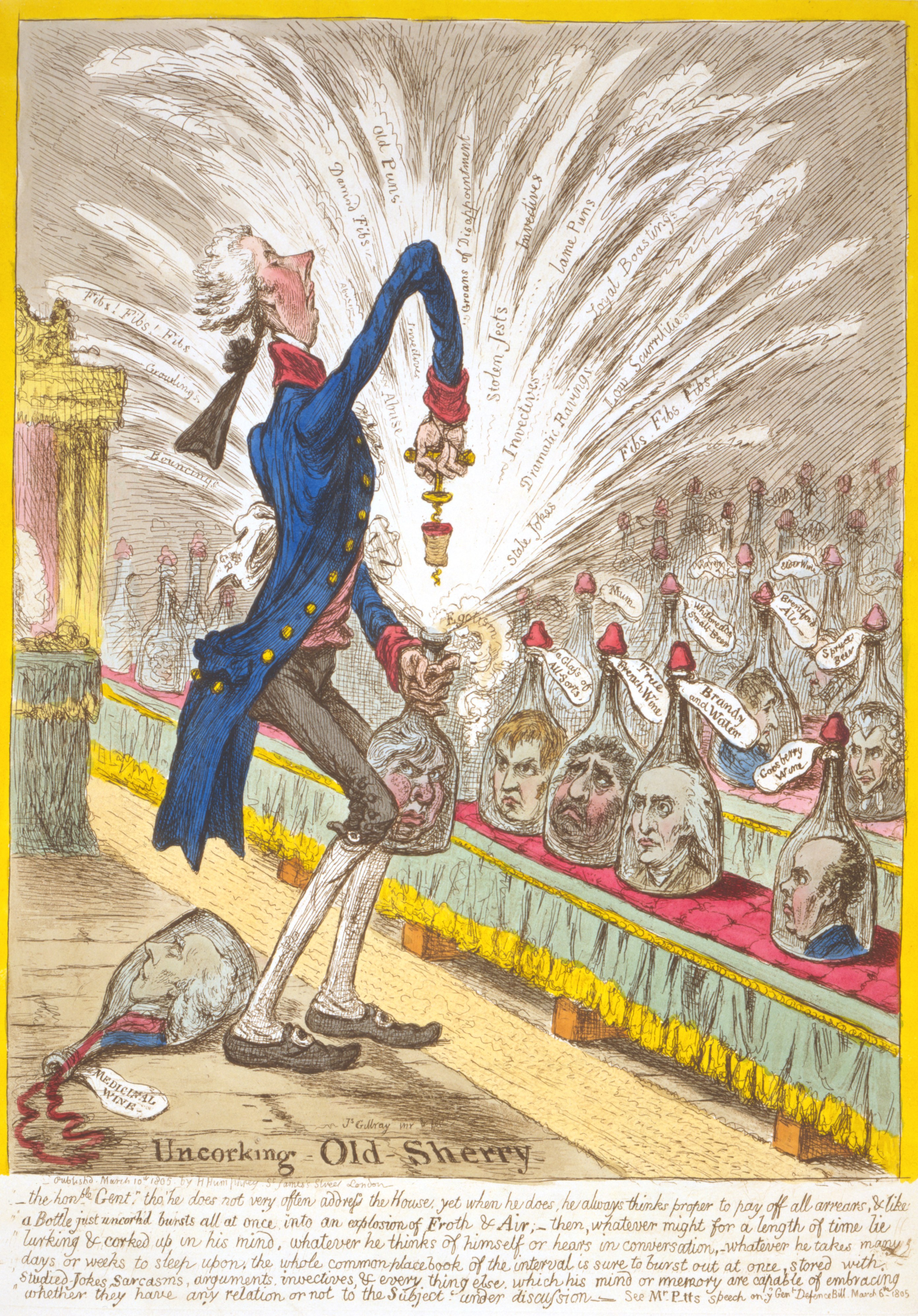
Uncorking Old Sherry


It has been far too long since the Amateur Historian has paid homage to the man whose name graces the title of this blog. This particular print, drawn on March 10, 1805, is not only a witty satire against Richard Brinsley Sheridan, a playwright (he wrote the charming and wickedly witty School for Scandal of which there are very few adaptations and, alas, fewer decent ones), owner of the Drury Lane Theatre and Whig politician, but also another installment of Funny Things That Happened to Pitt the Younger.

In 1805, Pitt the Younger was in the first year of his second term as Prime Minister, after having retired for two years due to ill-health and the king's knee-jerk reactionism to Catholic Emancipation and Napoleon was gleefully conquering the Continent. He was brought back because the previous Prime Minister, Addington (in the print lying spilled on the floor; he's labeled 'medicinal wine' because he was the son of a doctor) was deeply unpopular for his incompetence in trying to get Napoleon to agree to an armistice and then sticking to it. Pitt therefore introduced a bill to change the recruiting policy for the Army, causing Sheridan to get up and gave a long and rambling speech about nothing in particular.

This very well might be one of the Amateur Historian's favorite Pitt the Younger moments, as Pitt responded by criticizing Sheridan's use of rhetoric, complimenting Sheridan on 'his extraordinary powers of imagination and of fancy' and then comparing Sheridan's oratory to 'a bottle just uncorked [which] bursts all at once into an explosion of froth and air. All that his own fancy can suggest or that he has collected from others; all that he can utter in the ebullition of the moment; all that he has slept on and studied are combined and produced for our entertainment...and out it comes altogether, whether or not it has any, even the smallest relation to the subject in debate.'

This print, of which Sheridan himself bought six copies, has Pitt, still thin from ill-health "Uncorking Old Sherry", i.e. quite literally taking the cork out of a bottle with Sheridan's face in it. The bottle spews forth invective, stolen jests, lame puns, dramatic ravings, egotism, damned fibs, groans of disappointment and the like. Behind Sheridan are all the other members of the Whig party, capped with a bonnet rogue and labeled based on their political opinions or their place of origin. For a better copy of the print and to read Pitt the Younger's scathingly witty comparison of Sheridan to an uncorked bottle (written under the print itself) click here.