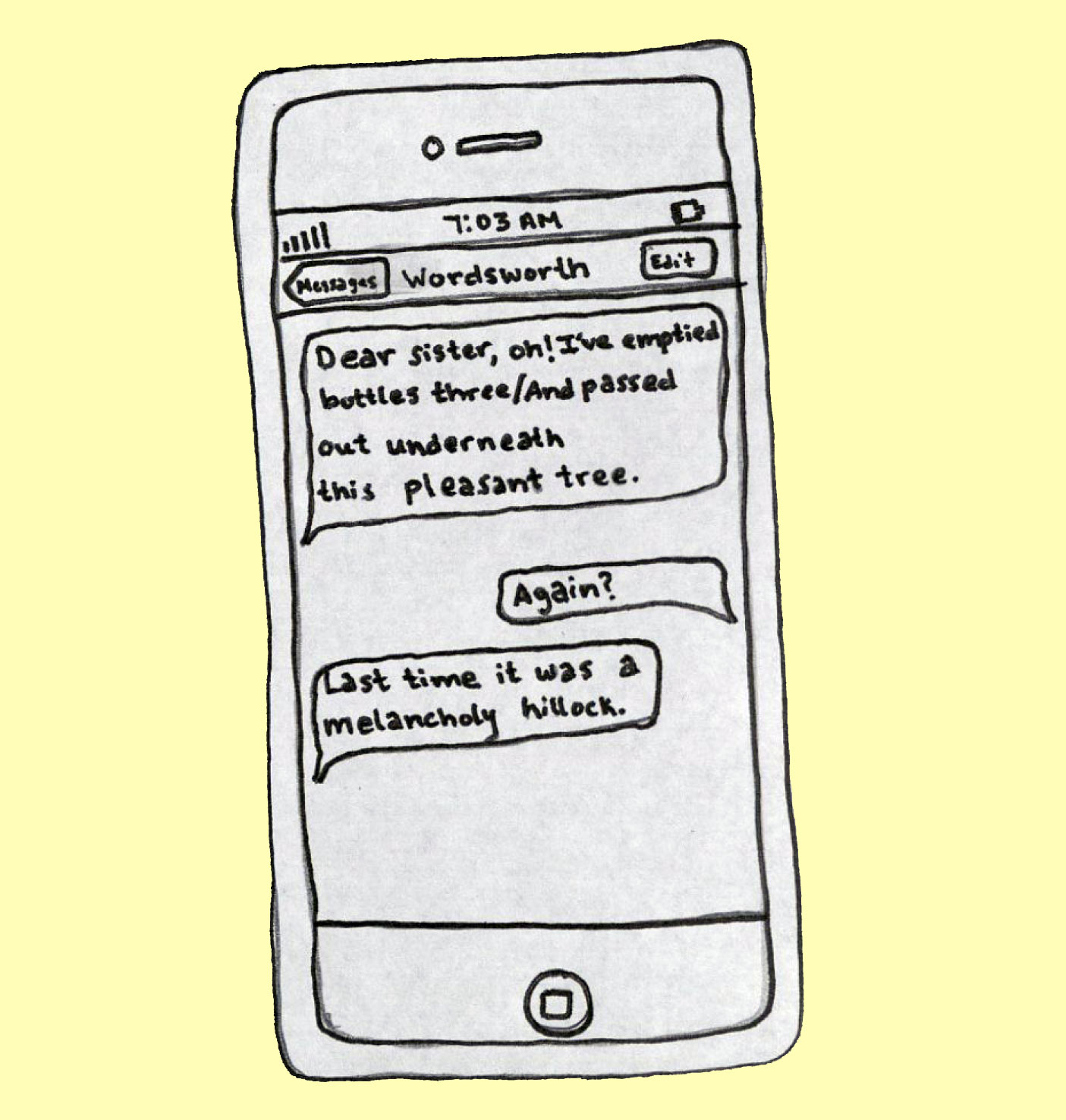
Quite an accurate representation of a drunk text from Wordsworth to his sister. Visit the Paris Review website here for more.
Showing posts with label william wordsworth. Show all posts
Monday, June 18, 2012
Wednesday, May 12, 2010
I Wandered as Lonely as a Cloud of Opium Fumes
Gentle Readers, please be forewarned that this was an actual, serious tourism video for the Lake Countries of England. Why they decided that a giant squirrel named "MC Nuts" rapping Wordsworth would be the best testament to their attractiveness as a tourist destination is somewhat puzzling. However, as Ponpon from ArmJoe a few days ago taught us, nothing improves 19th century literature like a random animal doing anachronistic things.
Monday, April 26, 2010
The German intelligentsia, despite having their country invaded by Napoleon, were more-or-less unanimous in their approval (Beethoven excluded). Goethe, with deep pleasure, received the Legion d'Honneur from Napoleon himself and declared that Napoleon, after the Revolution was "the expression of all that was reasonable, legitimate, and European in the Revolutionary movement". According to the British historian Alistair Horne, the philosopher Hegel went even further. "Hegel was said to have stood bareheaded in the street, even when the French soldiery stole his possessions; to him, Napoleon represented the 'Embodiment of the Absolute Ideal'. One hopes that said Embodiment was kind enough to return Herr Hegel's possessions.
Labels:
Goethe,
Hegel,
Lord Byron,
Napoleon,
william wordsworth
Sunday, April 5, 2009
How to Be a Romantic Poet, Part Six

Tip #5: Expire young, or, at least, die in an interesting fashion.
This is self-explanitory, but make sure you do not, like Wordsworth, accidentally live to old age and die at home of a common cold. If you must die of a common cold, take care to die amidst suitable theatrics, such as the Greek War for Independence. Once again, a wasting illness is an invaluable asset to any Romantic Poet, but you could also die whilst seeing visions and drawing pictures of your spouse's soul, or accidentally drown yourself in the Gulf of Spezia, after seeing your doppelganger.
Perhaps the best Romantic Expiration was that of Thomas Love Peacock, who Nobly Perished in a house fire when he refused to abandon his massive library, shouting, "By the immortal gods, I will not move!"
Labels:
Blake,
Byron,
How to Be a Romantic Poet,
Shelley,
william wordsworth
Saturday, April 4, 2009
How to Be a Romantic Poet, Part Five
Tip #5: Cultivate a Deep Love of Nature.
Part of being a Romantic Poet is being constantly moved to the point of epic poetry studied by generations of surly English students to come at the sight of a daffodil. Nature can be the language through which God speaks to you, God itself, the reflection of your own perfections, or merely a great place to escape from your numerous critics and creditors.
Compare your loves to flowers, or at least have the decency to compare them to rocks and mountains. Constantly reflect on the glories of nature, and travel everywhere you can to experience them. Italy is very popular, as it is also a great place to die of a wasting disease. Invoke Nature as your muse and your teacher and be sure to reject classical authors as the promoters of worthless knowledge while still making allusions to the most obscure of Greek tragedies whenever you can. This plays into another aspect of being a Romantic Poet. If you cannot love yourself beyond reason, call yourself the Poet of the Age and see yourself as inherently better than all your contemporaries, it is a good idea to have (or to fake) low self-esteem and constantly despise your verses, your education and your inadequacies. This will endear you to all the ladies of your acquantaince, as long as you really do have the poetic skills and popularity to prove this poor opinion of yourself false. Otherwise you will feel really terrible about yourself, move in with your publisher and accidentally die of heart failure from your opium addiction.
Part of being a Romantic Poet is being constantly moved to the point of epic poetry studied by generations of surly English students to come at the sight of a daffodil. Nature can be the language through which God speaks to you, God itself, the reflection of your own perfections, or merely a great place to escape from your numerous critics and creditors.
Compare your loves to flowers, or at least have the decency to compare them to rocks and mountains. Constantly reflect on the glories of nature, and travel everywhere you can to experience them. Italy is very popular, as it is also a great place to die of a wasting disease. Invoke Nature as your muse and your teacher and be sure to reject classical authors as the promoters of worthless knowledge while still making allusions to the most obscure of Greek tragedies whenever you can. This plays into another aspect of being a Romantic Poet. If you cannot love yourself beyond reason, call yourself the Poet of the Age and see yourself as inherently better than all your contemporaries, it is a good idea to have (or to fake) low self-esteem and constantly despise your verses, your education and your inadequacies. This will endear you to all the ladies of your acquantaince, as long as you really do have the poetic skills and popularity to prove this poor opinion of yourself false. Otherwise you will feel really terrible about yourself, move in with your publisher and accidentally die of heart failure from your opium addiction.
Friday, April 3, 2009
How to Be a Romantic Poet, Part Four

Tip #4: Have many youthful exploits! These exploits must, however, fall into the categories of dissipation, athletics or expulsion.
For dissipation, try to seduce as many people as you possibly can, from Cambridge choirboys to your Calvanist Bible teacher. Pass your time drinking and flirting with anyone who so much as catches your eye. If you are lucky, they will scorn you later on and thus allow you to develop professionally useful angst and dejection. Attend a good number of rowdy parties so as to later regret your mis-spent youth, to discover your superiority to the rest of the world, or merely to look dashing and melancholy and so cement your place in society.
For athletics, nothing is better than climbing mountains, swimming against the current, or walking a notable distance. Once you have spent a good deal of time in nature, you can reflect on its glories, or your glory in conquering it and wow the ladies by telling them you climbed the Alps (or just a hill, provided you make the hill full of faries or the like). If you are lucky, your midnight wanderings could lead to (you guessed it!) a wasting disease. If not, you could develop arthritis in all your joints and end up addicted to laudenum, which is not a bad booby prize.
For expulsion, try writing something extremely controversial and send it to all your class deans in an attempt to start up a campus-wide conversation about a difficult subject. Not only can you establish yourself as a writer, you can also get to show the unjustness of society and get out of taking your final exams.
Thursday, April 2, 2009
How to Be a Romantic Poet, Part Three
If Tip #2 did not work for you, try following tip #3: Cultivate a good working relationship with Death.
It is somewhat difficult to do this, since Death is not said to be a terribly communicative fellow, but this will help you in the long run: the Grim Reaper can’t say much, but you can! Wax poetic about your own demise as much as possible. Again, a wasting disease is an invaluable tool, since it gives you plenty of time to compose. If you can, drink out of the skull of a medieval monk, just to prove you're that hard core. Or, if you like kill off a couple of characters in your poems in horrible and agonizing ways. If you are loath to do so, kill off an albatross instead and see what happens (tip 3a: if you do shoot an albatross and your enraged shipmates tie it around your neck, don't be alarmed if your shipmates' relationship with death is much different than your own, to whit, They Become Zombies. This is perfectly normal thing to happen to a Romantic visionary.)
The sight of a graveyard at midnight, or any kind of ruin should send you into a tizzy of poetic feeling. If it doesn’t, fake it and talk about how very inspiring it is to you to be so constantly reminded of your own impermanence and the immortality of your poetry before lapsing into a dreamy melancholy. Remember, suicide must always be an option, even if you are not very serious about following through.
“I should, many a good day, have blown my brains out,” reflected Byron, “but for the recollection that it would have given pleasure to my mother-in-law.”
It is somewhat difficult to do this, since Death is not said to be a terribly communicative fellow, but this will help you in the long run: the Grim Reaper can’t say much, but you can! Wax poetic about your own demise as much as possible. Again, a wasting disease is an invaluable tool, since it gives you plenty of time to compose. If you can, drink out of the skull of a medieval monk, just to prove you're that hard core. Or, if you like kill off a couple of characters in your poems in horrible and agonizing ways. If you are loath to do so, kill off an albatross instead and see what happens (tip 3a: if you do shoot an albatross and your enraged shipmates tie it around your neck, don't be alarmed if your shipmates' relationship with death is much different than your own, to whit, They Become Zombies. This is perfectly normal thing to happen to a Romantic visionary.)

The sight of a graveyard at midnight, or any kind of ruin should send you into a tizzy of poetic feeling. If it doesn’t, fake it and talk about how very inspiring it is to you to be so constantly reminded of your own impermanence and the immortality of your poetry before lapsing into a dreamy melancholy. Remember, suicide must always be an option, even if you are not very serious about following through.
“I should, many a good day, have blown my brains out,” reflected Byron, “but for the recollection that it would have given pleasure to my mother-in-law.”
Wednesday, April 1, 2009
How to Be a Romantic Poet, Part Two
Tip #2: Appear to have been spurned in love! It doesn’t really matter if you have or not, just address slightly melodramatic poems about your suffering, emotional, physical and spiritual to ‘------’. No one has to know you jotted down your quatrain because you stubbed your toe. You are in pain because your one true love, ------, who is coincidentally, every romantic poet’s one true love (Ode to ------, To ------, etc.) does not love you, has died, has decided to marry someone else, or has begged you to stop stalking them. Once again, it helps if you have caught some sort of wasting disease (political radicalism counts as a wasting disease, since you probably won’t live long if you catch it), so as to better enable you to lean upon your couch and sigh over the futility of your passion and of your existence in general.
If at all possible, marry someone you do not care for and immediately fall in love with someone else. As a baseline, try to fall in love with someone very close to you. The closer they are, the more Romantic Poet Points you get (say, one point for your neighbor, two points for your best friend’s sister-in-law, and three points for your own half-sibling). In extreme cases, you are allowed to fall in love with the offspring of another famous author, just as long as you shock said author and their spouse and cause everyone in England to snub you and force you on a tour of the Continent.
Labels:
Byron,
How to Be a Romantic Poet,
Keats,
Shelley,
william wordsworth
Tuesday, March 31, 2009
How to Be a Romantic Poet, Part One

Gentle Reader, who among us has not looked at a ruin and been sent into spastic fits of glee that could only be contained in blank verse, been tempted to imitate the ancients, attack the government in rhyming couplets about the wind, reflect constantly on one's impermanence, engage in highly complicated love affairs that would puzzle any future scholar of your life, immortalize your friends as Gentle-Hearted So-and-So, spite the lovers who spurned you by dying of a wasting disease while composing your own epitaph, or found a utopian commune on the banks of the Susquehanna?
If your answer to all these questions is no, then, alas! You are not a Romantic Poet.
What a sad state of affairs, Gentle Reader. The Amateur Historian quite feels your pain and thus introduces yet another series to this blog: "How To Be A Romantic Poet." (There is a fantastic article that does a much better and much more concise job of listing this than the Amateur Historian and, in fact, inspired this series. It was published in a museum magazine once and it was also once passed out in the Amateur Historian's English class and she can no longer recall who wrote it or where it was published. However, credit for this idea goes to whoever wrote it first. The Amateur Historian apologizes for her crappy memory.
Tip 1: Look the part! You must have curls in wild disarray, to prove that your mind is on higher things and that you yourself have been touched by the zeitgeist, the spirit of the era. It cannot be too messy, however, or people will just think you are a hobo. The Amateur Historian suggests folowing Byron's model of sleeping with his hair in curlers. Abandon your cravat as a sign of an oppressive society who would seek to muzzle your voice with its restrictive neckwear and defy it by wearing an open-necked shirt in all weather. This not only makes you look cool, it can make you downright chilly and let you catch a wasting disease. Everyone always takes you more seriously if you are likely to die young after producing your own epitaph.
If you cannot catch a wasting disease despite your best efforts to do so, attempt to look the part by keeping a suitably ethereal figure by, as was Byron's wont, playing cricket while wearing seven waistcoats and a greatcoat. If cricket is not to your liking, try to be relentlessly bullied as a small child, so as to stunt your growth by being kept from your food, writing at all hours of the night and never sleeping, or hiking up mountains to feed your soul on the beauties of rural England and not on, say, the hard-boiled egg your slave, er, that is sister, made for you.
Check back every day this week for new tips on how to prove to all those detractors who claim you have no soul or sentiment that you can, as Wordsworth put it, be:
"A man speaking to men... endowed with more lively sensibility, more enthusiasm and tenderness, who has a greater knowledge of human nature, and a more comprehensive soul, than one supposed to be common among mankind; a man pleased with his own passions and volitions, and who rejoices more than other men in the spirit of life that is in him; delighting to contemplate similar volitions and passions as manifested in the goings-on of the Universe, and habitually compelled to create them where he does not find them."
Friday, March 13, 2009
Sentimental Friendships, Take One
In the late 18th century, sentimental friendships were all the rage. These were and are extremely close, very emotional friendships in which the two people do not hesitate to declare their undying love to one another, spill out their innermost secrets, hang around each others' necks whilst weeping, and kiss each other. The Amateur Historian theorizies that this was particularly popular amongst the upper classes in the late 18th century, where most marriages were not based on love, and there was no divorce if love-matches sadly went sour.
Your average bourgoisie or aristocrat would therefore have to find the emotional fulfillment necessary to a happy existance outside of marriage. This resulted either in affairs (which were generally accepted if the couple in question were discreet) or in sentimental friendships.
The poet Samuel Taylor Coleridge had a disappointing marriage (in The Eolian Harp, he begins to wax poetic about his wife, who promptly tells him to shut up) and developed a sentimental friendship not only with William Wordsworth, but with Thomas Poole. Unfortunately for the increasingly dependent Wordsworth, during their trip to Germany, Coleridge realized that Poole was more necessary for his emotional well-being.
Coleridge's letters to Poole include: "The Ocean is between us & I feel how much I love you!", "Of many friends, whom I love and esteem, my head & heart have ever chosen you as the Friend--as the one being, in whom is involved the full & whole sacred title....", and "My spirit is more feminine than your's--I cannot write to you without tears/ and I know that when you read my letters, and when you talk of me, you must often 'compound with misty eyes'...."
The Amateur Historian's personal favorite?
"O my God! how I long to be at home--My whole Being so yearns after you, that when I think of the moment of our meeting, I catch the fasion of German joy, rush into your arms, and embrace you.... Now the Spring comes, the vital sap of my affections rises, as in a tree!"
Your average bourgoisie or aristocrat would therefore have to find the emotional fulfillment necessary to a happy existance outside of marriage. This resulted either in affairs (which were generally accepted if the couple in question were discreet) or in sentimental friendships.
The poet Samuel Taylor Coleridge had a disappointing marriage (in The Eolian Harp, he begins to wax poetic about his wife, who promptly tells him to shut up) and developed a sentimental friendship not only with William Wordsworth, but with Thomas Poole. Unfortunately for the increasingly dependent Wordsworth, during their trip to Germany, Coleridge realized that Poole was more necessary for his emotional well-being.
Coleridge's letters to Poole include: "The Ocean is between us & I feel how much I love you!", "Of many friends, whom I love and esteem, my head & heart have ever chosen you as the Friend--as the one being, in whom is involved the full & whole sacred title....", and "My spirit is more feminine than your's--I cannot write to you without tears/ and I know that when you read my letters, and when you talk of me, you must often 'compound with misty eyes'...."
The Amateur Historian's personal favorite?
"O my God! how I long to be at home--My whole Being so yearns after you, that when I think of the moment of our meeting, I catch the fasion of German joy, rush into your arms, and embrace you.... Now the Spring comes, the vital sap of my affections rises, as in a tree!"
Monday, March 9, 2009
Poetic Eccentricity

Wordsworth is one of the best known and one of the most ridiculed of the Romantic poets. Who among us, Gentle Readers, has not had to read "I wandered as lonely as a cloud" and wondered why on earth the poet was so obsessed with daffodils? (The Amateur Historian wishes to mention that her favorite flowers are daffodils and she has, on occasion, quoted said poem while buying daffodils.) Those familiar with his sister Dorothy and her journals will also wonder why the well-documented entry in which she and her brother take and walk and stumble across a host of golden daffodils turned into a poem in which she was not present?
William Wordsworth's ambivalence towards his sister is one of his least endearing traits (Richard E. Matlak suggests that Wordsworth's Lucy poems, a series of elegaic poems in which the narrator has a presage of his beloved's death and then angsts on about his loss for three more poems, stem from Wordsworth's ambivalence about his sister and his subconscious wish that she was dead). One of his more entertaining traits is one which he mentions in Book IV of his incredibly long and somewhat (in the Amateur Historian's opinion) eye-rollingly narcissistic poem, The Prelude. Wordsworth composed outloud while taking walks. On these walks he brought his dog with him. After a particularly good bit of verse, Wordsworth would pet his dog. Most of the time the dog ran ahead, and would bark and run back if it saw anyone.
Wordsworth writes: "Punctual to such admonishment, I hushed/ My voice, composed my gait, and shaped myself/ To give and take a greeting that might save/ My name from piteous rumours, such as wait/ On men suspected to be crazed in brain."
Subscribe to:
Posts (Atom)
