
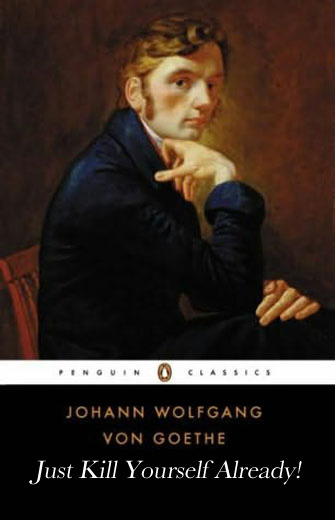
The Amateur Historian has a particular fondness for literary feuds. Though Mark Twain's scathing criticisms of the literary offenses of the Deerslayer tales are still the Amateur Historian's favorite, William Makepeace Thackeray had some salient criticisms of Goethe's The Sorrows of Young Werther:
Werther had a love for Charlotte
Such as words could never utter;
Would you know how first he met her?
She was cutting bread and butter.
Charlotte was a married lady,
And a moral man was Werther,
And, for all the wealth of Indies,
Would do nothing for to hurt her.
So he sighed and pined and ogled,
And his passion boiled and bubbled,
Till he blew his silly brains out,
And no more was by it troubled.
Charlotte, having seen his body
Borne before her on a shutter,
Like a well-conducted person,
Went on cutting bread and butter.
Showing posts with label Goethe. Show all posts
Showing posts with label Goethe. Show all posts
Monday, August 15, 2011

Sunday, May 1, 2011
Monday, April 26, 2010
 Reactions to Napoleon Bonaparate have always been mixed, particularly among the Romantics. Byron had a life-long fascination and self-identification with Napoleon, going so far in Childe Harolde as to call Napoleon "the greatest... of men" and to call himself "the grand Napoleon in realms of rhyme". Wordsworth, on the other hand, saw Waterloo as an act of "Almighty God" and became so vehement in his disapprobation of Napoleon he joined the Grasmere Volunteers to help defend England in case "Satan" should dare invade.
The German intelligentsia, despite having their country invaded by Napoleon, were more-or-less unanimous in their approval (Beethoven excluded). Goethe, with deep pleasure, received the Legion d'Honneur from Napoleon himself and declared that Napoleon, after the Revolution was "the expression of all that was reasonable, legitimate, and European in the Revolutionary movement". According to the British historian Alistair Horne, the philosopher Hegel went even further. "Hegel was said to have stood bareheaded in the street, even when the French soldiery stole his possessions; to him, Napoleon represented the 'Embodiment of the Absolute Ideal'. One hopes that said Embodiment was kind enough to return Herr Hegel's possessions.
Monday, February 8, 2010
Romantic Army on the March off Cliffs!
In belated honor of this blog's one year birthday, have a free opera from Paris! This is Massenet's Werther. Unfortunately the subtitles are in French, but the Amateur Historian would like to point out two scenes of Romantic OTT that need to be seen- 82:16-83:00 where Werther falls to the floor and curls into a fetal position at the loss of Charlotte, and 88:18-30, where Werther jumps off a wall in lieu of any other civilized way of ending a conversation. I highly recommend the opera, which is lovely, musically speaking, and suffers only slightly from being a Romantic work of literature that got reinterpreted into Victorian sentimentalism.
The Amateur Historian adores Romanticism, but is more of Byron's camp than Wordsworth's. The best Romanticism is done with a straight-face, but with tongue firmly in cheek.
Subscribe to:
Posts (Atom)