
Today Alfred, Lord Tennyson is the butt of Dorothy Parker's wit:
Should Heaven send me any son,
I hope he's not like Tennyson.
I'd rather have him play a fiddle
Than rise and bow and speak an idyll.
Saturday, July 17, 2010

Friday, July 16, 2010
Thursday, July 15, 2010
Wednesday, July 14, 2010
Happy Bastille Day, Gentle Readers! In honor of this holiday, the Amateur Historian would like to provide you all with Dorothy Parker's thoughts on a famous French citizen, George Sand:
What time the gifted lady took
Away from paper, pen, and book,
She spent in amorous dalliance
(They do those things so well in France).
What time the gifted lady took
Away from paper, pen, and book,
She spent in amorous dalliance
(They do those things so well in France).
Tuesday, July 13, 2010
Monday, July 12, 2010
Sunday, July 11, 2010
Today, the Amateur Historian would like to kick off a week of poetry about poets from the 19th century, or, to be entirely truthful, Gentle Reader, the wonderful wit of Dorothy Parker in her A Pig's Eye View of Literature.
We begin with:
The Lives and Times of John Keats,
Percy Bysshe Shelley, and
George Gordon Noel, Lord Byron
Byron and Shelley and Keats
Were a trio of Lyrical treats.
The forehead of Shelley was cluttered with curls,
And Keats never was a descendant of earls,
And Byron walked out with a number of girls,
But it didn't impair the poetical feats
Of Byron and Shelley,
Of Byron and Shelley,
Of Byron and Shelley and Keats.
We begin with:
The Lives and Times of John Keats,
Percy Bysshe Shelley, and
George Gordon Noel, Lord Byron
Byron and Shelley and Keats
Were a trio of Lyrical treats.
The forehead of Shelley was cluttered with curls,
And Keats never was a descendant of earls,
And Byron walked out with a number of girls,
But it didn't impair the poetical feats
Of Byron and Shelley,
Of Byron and Shelley,
Of Byron and Shelley and Keats.
Monday, July 5, 2010
Gerard de Nerval et son homard

The Amateur Historian is a huge fan of Gerard de Nerval, a Romantic poet who is much more famous in France than anywhere else, but seems to be renowned the world over for his unusual taste in pets. And, Gentle Readers, by "unusual" the Amateur Historian means "a lobster", and by "lobster" she refers to "Thibault", a pet lobster de Nerval often walked on the end of a blue ribbon.
When in Pere Lachaise yesterday, the Amateur Historian took the opportunity to place a plastic lobster on a ribbon leash (unfortunately a green one) on de Nerval's grave. While there, the Amateur Historian saw a tour guide get very excited over de Nerval's new plastic friend:
For the non-French speakers, the tour guide is giving a brief summary of de Nerval's life and explaining that de Nerval is famous for walking with a lobster on the end of a leash. He then explains that he has lost his glasses and needs a member of the group to read the quote the Amateur Historian left with the lobster:
"Why would a lobster be any more ridiculous than a dog, or a cat, or a gazelle or a lion, or any other animal one chooses to take for a walk? I have a liking for lobsters, they are tranquil, serious creatures who know the secrets of the deep and don't bark....."
At the end, he mentioned that the lobster was an unusual event and took a photo of it.
Wednesday, June 30, 2010
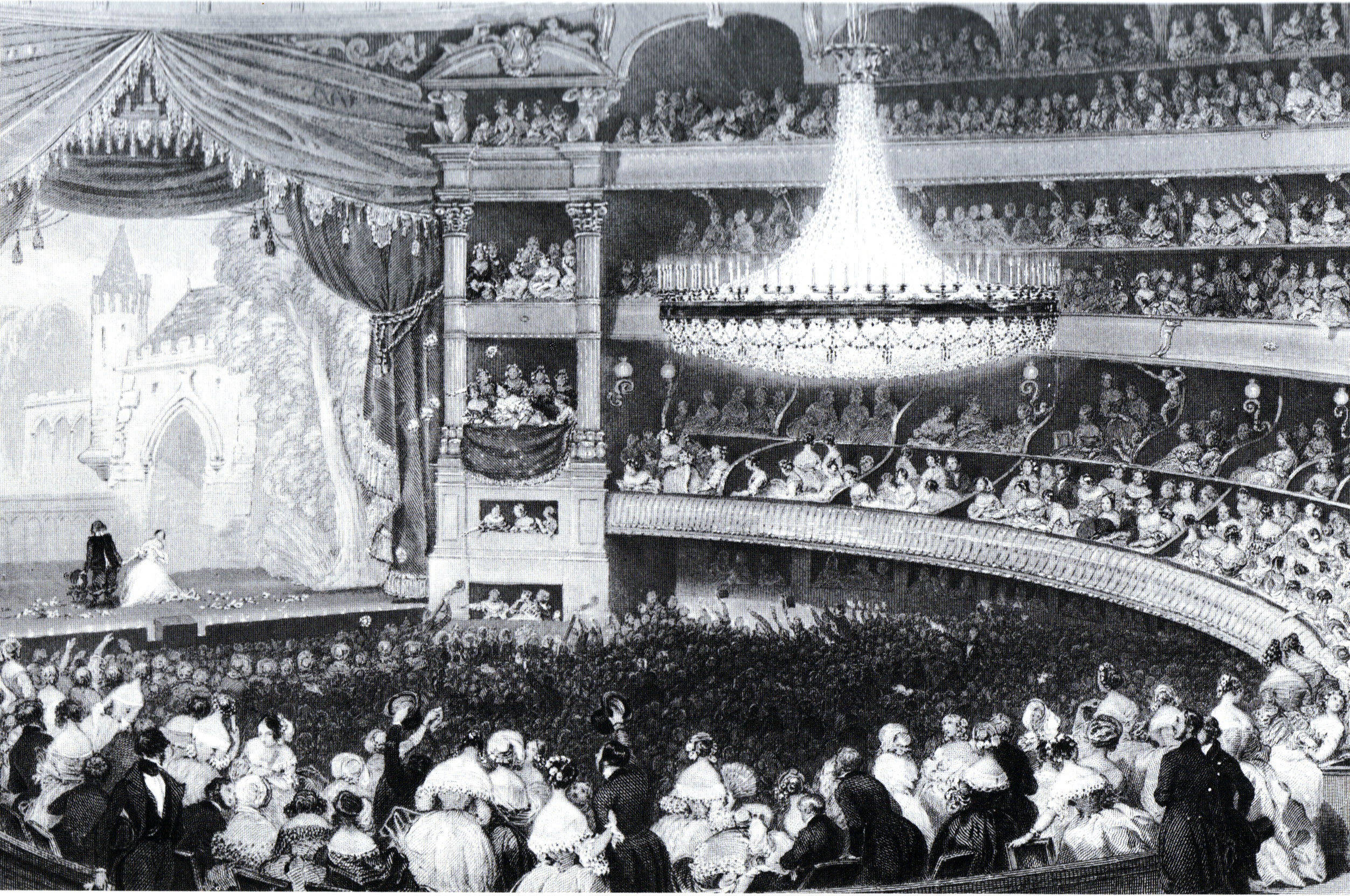
For the French Romantics, theatre tended to be Very Serious Business indeed. The Battle of Hernani was, indeed, the flowering of the Romantic decision that in the debate of whether art reflects, or life reflects art, the answer is 'art is life'.
Certain Romantics were so dedicated to certain performers, plays or ensembles that they reserved the same seats for every performance, every evening at a given venue. For example, at the Théâtre-Italien, Ernest Legouvé reported that there were about sixty or so men of different ages and professions (though mostly lawyers, magistrates and writers), formed a sort of Romantic phalanx whose only law was to never miss a performance. They generally arrived an hour early, to discuss the upcoming performance and compare it with past ones that they had seen, and acted as a sort of jury, leading the rest of the audience in applause or silence.
If someone was so gauche as to start up a round of applause when the Romantic Regulars did not think an actor had merited one, an appointed spokesperson would say, quite sharply, "Is that one of the regulars of the Théâtre-Italien?"
At that point, the applause usually stopped.
Saturday, June 26, 2010
Hauteville House: An Introduction

The Amateur Historian begs the pardon of her Gentle Readers, as she has been on vacation/various geeky trips, i.e. to see Hauteville House on Guernsey. Hauteville House is, as Hugo and his family describe it, a poem in several rooms.
Unfortunately, that poem is one of Hugo's, so the floor plan has been inspired by Dante's Divine Comedy and is full of somber slogans about the transience of mortal existence, punctuated by skulls, Flemish paintings of peasants beating up the aristocracy, the clergy and the army, Orientalist touches like walls lined with unused crockery and Hugo's favorite interior design choice, carpeted ceilings.
According to the Divine Comedy floorplan, the ground floor is hell, full of somber colors, dark wood paneling and very little light. The second floor is purgatory, which is sumptuously and rather ironically decorated in Napoleon III style, full of silk brocades and metallic tapestries (several of which are, in fact, on the ceiling). The third floor and attic are paradise, with enormous windows dominating each room.
It is unclear, at this time, if there is a link between where Hugo placed people's bedrooms and the floors of his house. For example, Hugo's room is up in the attic, where the light streams in, his sons have rooms on the second floor, his wife and daughter have rooms in Purgatory and his poor, belagured secretary's room was on the first. It is quite possible that Hugo was very gently suggesting to M. Vacquerie to find another job; after all, when one's employer kindly reserves one a room in hell, it is rather a lowering experience.
Subscribe to:
Posts (Atom)