
If there was one thing that Victor Hugo loved more than himself, it was women. Though a great champion of social justice he was the patron of a number of Parisian brothels. Therefore, during his funeral, the policemen that the French government had brought in to keep the funeral from getting violent were upset that said government wished to shut down all the bars/ billiard rooms/ brothels in honor of Victor Hugo. The government then seemed to realize that Hugo would have wished for the brothels to remain open (some brothels even offered their services for free, in honor of the loss of so great a patron), or, rather, that the riot they wished to avoid would have started if said brothels closed and allowed them to remain open.
They did however, respectfully request all the prostitutes to wear mourning.
FUN FACT: The Place des Vosages, where Hugo spent a significant portion of his adult life used to be called the Place Royale. After the 1848 revolution, the department of Vosages was the first to send their taxes into the republican government, so the government changed the Place Royale to the Place des Vosages. See, good things come out of paying your taxes in a timely fashion!
Wednesday, June 9, 2010

Wednesday, May 26, 2010

Robespierre is a particularly interesting figure of the French Revolution, since 'Maximilien Robespierre, lawyer and delegate from Arras' has become so conflated with the propagandistic reinterpretations of his work, his speeches and his person. Despite all this, Robespierre has always remained very popular with women. The Amateur Historian is not well-versed enough in Robespierrist academia to venture a guess as to why this is, but his female fanbase has a long and respectable legacy.
For example, the famous feminist and playwright Olympe de Gouges appears to have written Robespierre a fanletter around the time of Louis XVI's trial and execution. She suggested that they drown themselves together in the Seine as an act of extreme patriotism.
It is not unsurprising that Robespierre preferred to express his patriotism in a less damp and deadly fashion.
Sunday, May 16, 2010
Brontë Sisters Power Dolls
In the spirit of the past few posts, discover anew youtube's intriguing interpretation of 19th century literature, in the form of "Brontë Sisters Power Dolls". Never have the gender paradigms of the 19th century publishing industry been so epically or oddly dismantled.
Wednesday, May 12, 2010
I Wandered as Lonely as a Cloud of Opium Fumes
Gentle Readers, please be forewarned that this was an actual, serious tourism video for the Lake Countries of England. Why they decided that a giant squirrel named "MC Nuts" rapping Wordsworth would be the best testament to their attractiveness as a tourist destination is somewhat puzzling. However, as Ponpon from ArmJoe a few days ago taught us, nothing improves 19th century literature like a random animal doing anachronistic things.
Tuesday, May 11, 2010
The Most Unusual Medal Awarded for Conduct During the Battle of Waterloo

Les Miserables has, as yesterday's post proved, a strange and powerful effect on people. When the novel first came out, for example, there was a great and powerful backlash against the digression Hugo included on the battle of Waterloo. Hugo had the audacity to include what he considered "perhaps the finest word ever spoken by a Frenchman," the defiant cry of "Merde!" by General Cambronne to the English during the battle.
This was not only excluded from several early translations of Les Miserables (most notably, the English one) but also caused a debate over General Cambronne's exclamation so virrulent that a sergeant (Deleau) who insisted that no such vulgarity had passed from General Cambronne's lips, despite the temptation to do so, won a medal.
Hugo was incredibly flattered: "To get a man the croix d'honneur, all I have to do is say merde."
Monday, May 10, 2010
Les Misérables: Letting the Disenfranchised Hit Back. In Green Minis, Apparently.

The Amateur Historian makes no secret of the fact that her favorite novel is Victor Hugo's Les Misérables, an epically long novel that at once presents the serious social problems of 19th century France and mythologizes them. Les Misérables has many interpretations (i.e. the musical, the multiple films and TV series) but the Amateur Historian finds that the Japanese have created by far the most absurd.
The Japanese company Takase has created a free downloadable 2D fighting game based on Les Miserables called ArmJoe, after the novel's Japanese title, Aa Mujou (ああ無情). The game features most of Victor Hugo's major characters, such as Jean Valjean, Enjolras (spelled Enjorlas, for whatever reason), Marius, Cosette, Éponine, Thénardier, and Javert, but also adds the characters Hugo was so negligent as to forget to include in his manuscript. These new additions consist of a policeman, a robotic clone of Valjean called RoboJean, an embodiment of Judgement, and, the Amateur Historian's personal favorite, a tea-drinking rabbit named Ponpon.
Enjoy, Gentle Readers. Everyone should have the experience of letting a tea-drinking rabbit run over Inspector Javert in a green Mini.


Monday, April 26, 2010
 Reactions to Napoleon Bonaparate have always been mixed, particularly among the Romantics. Byron had a life-long fascination and self-identification with Napoleon, going so far in Childe Harolde as to call Napoleon "the greatest... of men" and to call himself "the grand Napoleon in realms of rhyme". Wordsworth, on the other hand, saw Waterloo as an act of "Almighty God" and became so vehement in his disapprobation of Napoleon he joined the Grasmere Volunteers to help defend England in case "Satan" should dare invade.
The German intelligentsia, despite having their country invaded by Napoleon, were more-or-less unanimous in their approval (Beethoven excluded). Goethe, with deep pleasure, received the Legion d'Honneur from Napoleon himself and declared that Napoleon, after the Revolution was "the expression of all that was reasonable, legitimate, and European in the Revolutionary movement". According to the British historian Alistair Horne, the philosopher Hegel went even further. "Hegel was said to have stood bareheaded in the street, even when the French soldiery stole his possessions; to him, Napoleon represented the 'Embodiment of the Absolute Ideal'. One hopes that said Embodiment was kind enough to return Herr Hegel's possessions.
Wednesday, April 21, 2010

 It is always difficult to smuggle a banned book into a country in which it is banned, particularly when said banned book is Victor Hugo's Napoleon-le-Petit, which was obviously critical of Napoleon III, who exiled the author, and that country is France, ruled by said Napoleon III. Hugo's work reached Paris:
-tucked in barrels of hay
-wrapped around tobacco leaves
-stuffed in carriage clocks
-sandwhiched between two sheets of metal, i.e. as a sardine
-in bundles of pages strapped to the legs of tourists in baggy trousers
-hidden in the bindings of prayer books
-in women's garters
Perhaps the most outlandish method of dissemination reads like something out of Dumas novel, though it comes straight from the French Foreign Office:
"The latest mode of clandestine transmission consists of small balloons fashioned from sheets of printed paper which will be launched whenever the wind stands fair for France."
Monday, April 12, 2010
The Other Dumas Apparently Just Sucked
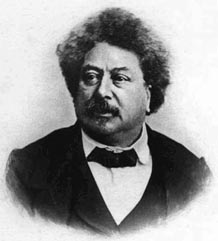
One Thursday in 1847, a little known playwright, Adolphe Dumas put on his play L'Ecole des familles. The Monday before, Edouard Thierry asked Alexandre Dumas, "When are they going to play your L'Ecole des familles at the Theatre-Historique?"
"Thursday," said Alexandre Dumas.
"How long do you think it will run?"
"Thursday," repeated Alexandre Dumas.
"But I didn't ask you when, I asked how long it will run."
"Well yes!" replied Alexandre Dumas. "I told you- Thursday."
Thursday, March 11, 2010
Malays were pretty fierce back then it seems

While we are on the subject of opium, it would be remiss of the Amateur Historian not to mention Thomas de Quincey, whose rambling but fascinating narrative Confessions of an English Opium Eater, is not only an intriguing look at addiction, altered states of consciousness, English Romanticism and 18th-19th century England, but a repository of bizarre happenings, such as the Malay Incident. It is best to leave most of the description of this even in de Quincey's own words.
‘One day a Malay knocked on my door. What business could a Malay have to transact among the recesses of the English mountains was not my business to conjecture, but possibly he was on the road to Seaport, about forty miles distant’.
Though the servant girl, 'who had never seen an Asiatic before' was left in mutual bewilderment with the Malay, who spoke English as well as she spoke Malay, de Quincey took it upon himself to see to it that said nameless Malay got a place to stay and something to it. Then de Quincey gave him a parting gift in the form of (you guessed it!) a large lump of opium. de Quincey writes:
‘I was struck with some little consternation when I saw him suddenly raise his hand to his mouth, and bolt the whole, divided into three pieces, at one mouthful. The quantity (of opium) was enough to kill some half-dozen dragoons, together with their horses, supposing neither bipeds nor quadrupeds were trained opium-eaters.'
The Malay was perfectly fine, though de Quincey had highly symbolic nightmares for several pages after that.
Subscribe to:
Posts (Atom)